Showing posts with label Washington Nationals. Show all posts

Tuesday, November 12, 2013

Fighters Sign Michael Crotta

Michael Crotta signed with the Nippon Ham Fighters in the NPB for equivalent of $500,000. A 6'6 30 year old right-handed pitcher, Crotta pitched in the Major Leagues in 2011 for the Pittsburgh Pirates, the team that drafted him in the 17th round in 2006 out of Florida Atlantic University. The short stint didn't go very well, as he gave up 11 runs in 10.2 innings. He then didn't pitch at all in 2012 thanks to a terrible elbow injury.

Crotta spent the entire 2013 season on the Nationals' AAA team, pitching only in relief and statistically, not a whole lot stands out. He had a 3.57 ERA, with a 17.2 strikeout percentage and walk percentage of nearly 10 percent. However, I thought it was worth looking further to see what the Fighters might see in Crotta.

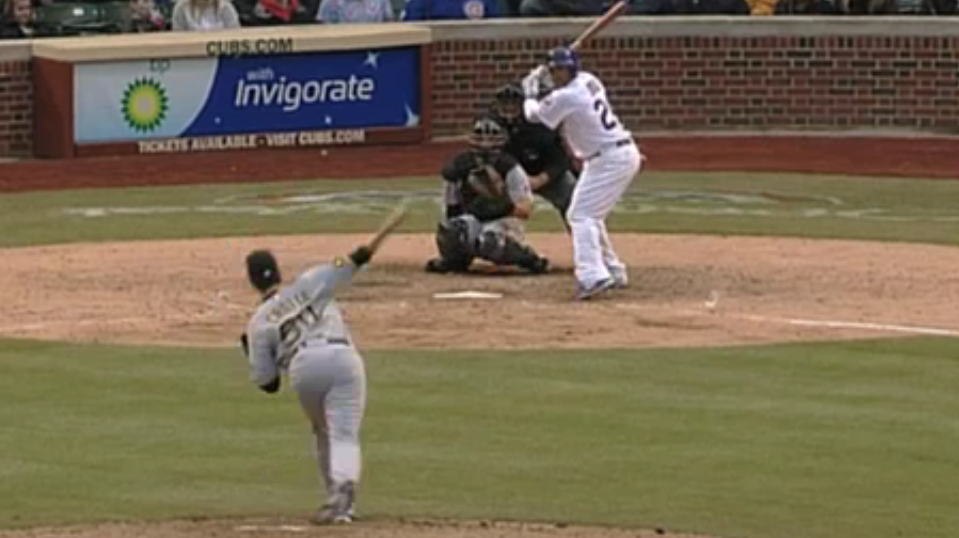
Despite the injury, his delivery has remained virtually the same. Here is a look at what his delivery looked like in 2010:


And here was his release point in 2011:


 Here is what his delivery looked like in 2013:

And his 2013 release point:


The Lehigh Valley gun on MiLB.tv tends to be slow, but I checked the last time he pitched at the park (one of the few MiLB broadcasts with on screen radar guns) and Crotta was throwing 95 MPH with some armside tail. He occasionally kept it high, but would really bust in on a right-hander's bat, seeming to use the two seam like Japanese pitches often use the two seam, trying to get inside rather than throwing it to opposite platoon batters to keep it outside. He can get occasional sink glove side as well and didn't give up a homer all year, so it doesn't seem that staying over the middle of the plate was a problem. He was up to 96, with very consistent velocity, throwing mostly 94 the next inning.

The other pitch Crotta showed was a 84-85 MPH slider. He perhaps had some problem getting on top of it, with mostly downward movement. It was mainly used against lefties, against an occasional righty (though it stayed arm side). It did not appear to be a splitter or change and didn't appear to be a very good pitch. Against impatient hitters when he gets it somewhat down it can be a groundball pitch.

In the Majors, Crotta didn't throw near as hard, averaging under 93 MPH. The MLBAM tags and the Pitch Info tags disagreed whether he threw mainly sinkers or mainly four seamers, but they agreed that he threw a slider as his main breaking pitch and just one changeup. I definitely saw two different fastballs in my short look, but I would probably label them two seamer and sinker.

In my previous article I looked at how NPB teams targeted height and velocity, and the Fighters were above average at possessing both. Crotta is a great example of a guy possessing both, almost at an extreme. 

You do wonder if he is going to miss enough bats to be a successful back of the bullpen pitcher in the NPB, where getting strikeouts can be difficult. The track record and breaking pitch do not suggest he will rack up many strikeouts, but the fastball velocity might. If he can work a little higher in the zone, and still throw 94-96 MPH, he will get plenty of swings and misses.

Saturday, June 15, 2013

Ian Dickson Scouting Report

Ian Dickson is a 22 (will be 23 years old at the end of the season) right-handed pitcher that stands at a listed 6-5. The Cubs traded him to the Nationals for Henry Rodriguez (whom I wrote about here). Statistically, since being picked by the Cubs in the 35th round of the draft in 2011, Dickson has been mediocre, with a 4.33 kwERA and was moved to the bullpen early in 2013. So far this year in A-ball, Dickson has a 4.23 SIERA and 4.14 kwERA with an okay strikeout rate, but too many walks.

I watched his lone MiLB.TV outing (which was a start in April) in 2013 to get a better idea of what Dickson was throwing, as actual scouting reports on Dickson seem hard to find.

It looks like he throws a lot of moving fastballs. He kept them up, most of them middle of the plate or higher. This may help explain the home run rate in a relatively pitcher friendly league. Some did sink some to the glove side, which is probably what he is trying to do. It seemed to have a little bit better command as the game went along. He can work as a backdor moving fastball to right-handers and the velocity looked reasonably good (audio wasn't working on the broadcast so I am not sure what his velo was game in the game). With his very heavy usage of the pitch he just isn't going to miss a lot of bats with it. He threw an occasional 4-seam (just going by movement, as it was more straight) fastball  in on the hands of righties.
His delivery doesn't have a lot of moving parts to it, but the size is clearly not working to his advantage. Both in short season in 2012 and in full season in 2013, his groundball rate was really poor.
The only breaking or off-speed pitch I saw was a slider that seemed to sweep reasonably well, maybe a little bit soft and "loopy" (not real tight or hard). He located it like a traditional slider. Didn't throw it a ton, but he increased usage as the game went along. Dickson doesn't really have a tool to get lefties out, but so far in his minor league career, he actually has reverse splits.

It looks like Dickson is a probably just an organizational relief arm. It seems unlikely that he will really find any success in AA, if he makes it that far. He was drafted very late in the draft, and so far, he is performing like you expect a pitcher drafted late in the draft. He has just two real pitches, with none of them plus or really average, with control that is mediocre.

Wednesday, June 5, 2013

Why Henry Rodriguez Has Failed In the Majors

Henry Rodriguez was designated for assignment by the Washington Nationals after posting a career 4.46 kwERA and 99 FIP - in 144.2 innings. The problem was most simply walks, as he wasn't hittable in terms of BABIP or homers, with both well below league average, but his strikeout rate wasn't overwhelming either (just less than 23%). Of course, Rodriguez started his career with the Athletics, but we will look at all his data.

Rodriguez has been one of the top velocity fastball pitchers in the entire Pitch F/X era, which makes his struggles so interesting. According to average velocity by the MLBAM tags, he has steadily lost velocity, and it seems that he has had a statistical decline to go with it. However, when you look at the velocity of his top 25% pitches by year, the decline is less dramatic.

2013: 99.28 MPH

2012: 99.26 MPH

2011: 99.43 MPH

2010: 100.37 MPH

2009: 100.03 MPH

So really he didn't lose top end velocity in any way that should really have changed anything. The average of all pitches thrown in the Majors was 94.57 MPH, let's see how his how his velocity and release point data breaks down with results for his career:

Whiffs: 93.56 MPH, 6.27 v,-1.14 h
Run Scoring Plays: 95.01, 6.27 v, -1.24 h
Outs: 96.12, 6.25 v ,-1.19 h
In Play, No Outs: 94.64 MPH, 6.28 v, -1.19 h

Not surprisingly, the closer to the center of the rubber he releases the ball, the better the result (though it didn't affect the results BABIP plays). The velocity is a little more complicated, as the hardest group is the one that is turned into outs, and the softest group is the whiffs. The ones in between were the hits and runs. Perhaps his fastest fastballs are turned into outs, while his slider and change are getting whiffs. Vertical movement didn't have a real difference.

The average vertical movement of his 4-seam fastball is 9.13, which is good movement, and even better than the average whiff on a plus fastball this season. Movement is clearly not the problem.

Here are his average locations by pitch type:

That is a good place to put a moving fastball, and the change and slider are in somewhat standard spots, though perhaps lower and less to the edge of the plate than usual, suggesting that he is burying them and not really throwing them for strikes often. His 4-seamer being glove side on average and not arm side is unusual. This means he clearly isn't having a problem finishing his delivery, but may be pulling the ball.

His average locations by result:

Other than his average pitch being glove side, this isn't that unusual (the outs being above the hits is, but BABIP could be an explanation). He is getting his whiffs down and glove side, suggesting his slider (which would explain the lower MPH on whiffs) is getting the job done. Throwing glove side doesn't seem to be his problem as most of his runs allowed are on arm side pitches, suggesting the 2-seamer or change isn't getting the job done.

Even though release point data suggests that he is releasing the ball at a higher point than when he first came up, he hasn't really changed pitching location by year, other than his 2011 season, probably not coincidentally his best season, is the lowest


Rodriguez' problems don't seem to be the traditional answers like "too many balls up" or that his fastball was "too straight". Instead, as his walk rates suggests, he may just not be throwing enough strikes.

He threw strikes just 58% of the time in 2012 and 58.9 % of the time for his career, which is Carlos Marmolian territory. With that said, he pitches in the zone 43.2 % of the time, which is better than notable relievers Huston Street, Scott Downs, along with notable starters Gio Gonzalez, Jeremy Hellickson, and Jarrod Parker. So the zone percentage is actually acceptable, but his strike percentage lags behind, suggesting he isn't getting swings and misses out of the zone to make up for the zone percentage. The other 11 pitchers that have his identical outside the zone swing percentage (according to Fangraphs, with at least 100 innings since Rodriguez' debut) have an average zone percentage of 45.63 %, suggesting that Rodriguez isn't living with the amount of pitches he throws in the zone because he isn't getting the swings at pitches out of the zone. This suggests that his stuff either a) his stuff (especially his breaking balls) isn't good enough to get hitters to chase or b) when he is out of the zone, he is so far out of the zone that hitters aren't tempted to chase. Both of these are hard to test, but the first one seems unlikely since he has a good swinging strike percentage.

The problem probably isn't that Rodriguez throws such a heavy dosage of fastballs, as there have been some successful closers with an even higher percentage of fastballs (such as Valverde, Perez, Balfour, Feliz, Chapman, and Walden). With his velocity, that shouldn't be a problem unless his release point is just easy to see, which anecdotally doesn't seem to be the case, though when he comes further out, he is less likely to succeed. According to Brooks Baseball his slider gets above average horizontal movement and below average vertical movement. His change gets slightly above average horizontal movement and slightly better vertical movement, yet it is his slider that seems to be the better pitch.

Perhaps when Rodriguez misses out of the zone, it is just too much out of the zone. While wild pitches can be a subjective stat, often just in the hands of the official scorer, Rodriguez throws a wild pitch .055 times per batter faced. League average in 2012 was .008, which means that Rodriguez, in his time in the Majors, has thrown nearly 31 more wild pitches than an average pitcher would. This matches up with what I (and probably most Nationals' fans) have seen when watching Rodriguez. He sometimes self destructs and can't get anything close to the zone, which I think explains, even with his stuff, why he can't get swings at pitches out of the zone, and therefore, can't get hitters out at an exceptional or even average rate in the Majors despite his exceptional velocity. I would always take chances on guys like this, and it might not be a bad idea for a team to claim him and see if they can pitch him in low leverage situations and tweak or overhaul his mechanics, because if he ever does get around the zone, he should be really good. 

Thursday, April 4, 2013

Times to First: Part 21


1. Jason Bay  7.79 (on a double)

2. Raul Ibanez (Mariners): 4.38

3. Tony Wolters (Indians): 4.14

4. Will Middlebrooks (Red Sox): 12.72 (on a triple)

5. Jason Bourgeois (Rays): 3.84 (on a bunt)

6. Travis Jankowski (Padres): 4.2

7. Emmanuel Burris (Reds): 4.09

8. Joey Butler (Rangers): 6.87 (2nd to home)

9. Michael McKenry (Pirates): 4.41

10. Adam Greenburg (Orioles/Free Agent): 4.15

11. Josh Harrison (Pirates): 4.19

12. Chris Coghlan (Marlins): 7.87 (on a double)

13. Felix Perez (Reds): 11.76 (on a triple)

14. Ryan Howard (Phillies): 4.59

15. Geraldo Parra (Diamondbacks): 4.19

16. Jason Kubel (Diamondbacks): 8.59 (on a double)

17. Aaron Hill (Diamondbacks): 4.16

18. Carlos Pena (Astros): 4.29

19. Lyle Overbay (Yankees): 4.71

20. Brian Goodwin (Nationals): 4.18

All the times so far:


Wednesday, March 20, 2013

University of Georgia Prospects: Crumley and Cole

The University of Georgia is not really loaded with prospects this year, but when I watched them on TV, I noticed a couple of interesting 2014 draft prospects and wrote a little about each below.

Luke Crumley is a tall right-handed pitcher, standing at 6-6 with some projection. As a Freshman in 2012, he wasn't that impressive, splitting between the rotation and the bullpen, struggling with walks, and not missing many bats.

His delivery had an inconsistent landing point, with a small hop-looking type finish. Crumly was 88-91 MPH on his mostly unimpressive fastball, that was pretty straight and hittable. There were too many left up high, and it was a short outing for him against Texas A&M.

His main breaking pitch was a soft slider with a lot of vertical movement. It was called a slider (by the announcing crew based on information given to them by the school), but it looked like a curveball. The change has good dip when down, but he left it up for horrible pitch and homer. 

Hunter Cole is another 2014 guy that was originally picked out of the 49th round by the Nationals out of high school.

Cole is not big, and is sort of lanky at 6-1 195. At the plate, he has a pretty knee bent stance. He played basically full time as a freshman and played pretty well with a .823 OPS. He had a 2.36 Tool WAA, which is not bad considering he was a Freshman, but not really high draft material. However, it was his plate discipline that drug it down, as he was an above average home run hitter and had a good speed score, the two more predictive parts of Tool WAA. At least statistically, he is interesting going forward, depending on how this season goes.

Defensively, he seemed to have some problems with reads in center. He also had a really ugly drop. A little bit of an awkward runner, he doesn't look especially athletic. He pitched a lot in high school, so it is probably safe to have him down as a plus arm.

Monday, February 25, 2013

Simple Spring Training Pitch Data: Germen, Rice, and Karns

Here are notes and simple pitch data from 3 pitchers in the Spring Training game between the Nationals and Mets. There was a TV radar gun, but there is no Pitch F/X in Florida Spring Training. All 3 pitchers have never pitched in the Majors or have publicly available Pitch F/X data.

The locations and heat maps are from the catcher perspective and the radar gun was supposedly 1 MPH slow compared to other radar guns at the game, but I didn't adjust the velocity. The comparisons come from Brooks Baseball's Pitch F/X leaderboard, with it set to relief pitchers. I linked the comparisons to their FanGraphs pages.

Scott Rice is a veteran that was drafted in the 1st round way back in 1999, yet hasn't made the Majors and is still pitching. He pitched out of the Dodgers' AAA affiliate's bullpen in 2012, with a kwERA of 4.25. The two pitchers below I put in a Google Docs spreadsheet and listed the result, but I didn't do that for Rice. There were a lot of weird formatting things going on with the heat maps and the spreadsheets, so I just hyperlinked the spreadsheets to the other two pitchers:


84                 Low left
88                 High Left
86                 Low Left
86                 Low Middle
80                 Low Right
80                 Low Middle
81                 Middle Right
85                 Low Right
88                 Low Left
89                 Low Right
89                 Low Middle
88                 Low Right
85                 Low Left
89                 Low Middle

Overall Pitch Average: 85.57 MPH
Comparison: Marco Estrada
Fastball Average: 87.3
Comparison: Darren O'Day
Breaking Ball Average: 81.25
Changeup Comparison: Tyler Clippard 
Simple Heat Map:
 

1


1
4 4 4


General Observations: He moves the ball around, nothing is straight, simple delivery

Nathan Karns was a 12th round pick by the Nationals in 2009 (he was actually picked in the 10th round out of high school), but at age 25, he still hasn't reached AA. He did reach as high as A + in 2012 and had a 2.77 kwERA in 13 starts.

Overall Pitch Average: 91.56 MPH
Comparison: Rafael Dolis
Fastball Average: 93.92 MPH
Comparison: Jeff Fulchino
Breaking Ball Average: 84.5 MPH
Slider Comparison: Luke Gregerson

Results:
11 Balls
2 Flyballs
8 Fouls
2 Groundballs
7 Called Strikes
2 Whiffs
65.6 Strike %

Heat Map
4 11 1
2 2 7


2 3


General Observations: Extremely easy and simple delivery, but he had some real problems finishing the delivery and landing. Control probably wasn't as good as strike percentage indicates.

Gonzalez Germen: The 25 year old Met made it to AAA in 2012, but spent most of the year in AA, where he had a 3.91 kwERA. He was originally signed out of the Dominican Republic, where he dominated in the summer league in 2008 and 2009.

 Overall Pitch Average: 87.21 MPH
Comparison: Tom Gordon
Fastball Average: 91 MPH
Comparison: Daniel Jennings
Breaking Ball Average: 82.17 MPH
Slider Comparison: Claudio Vargas

Results:
4 Balls
2 Fly-balls
3 Fouls
2 Grounders
1 Called Strike
2 Whiffs
71.42 Strike %
Simple Heat Map (these have no ball/strike differentiation/bias):


1
2 2 1


3 5

General Observations: Control of breaking pitch was poor. Gets on top of ball very well.

Friday, January 18, 2013

Blake Treinen and Age Adjustments

The Washington Nationals acquired Blake Treinen from the Oakland Athletics as part of the deal that sent Michael Morse to the Mariners and John Jaso to the A's. Treinen was a 7th round pick out of South Dakota State in 2011 (a year after being a 23rd round pick by the Florida Marlins) by the A's

In 2012, he spent the entire year in the California League as a 24 year old in which league average age was 23.2 for pitchers and 22.5 for hitters. He threw 103 innings, mostly as a starter with a 3.43 SIERA, 3.55 kwERA, and 95 FIP - (using both league and one year park factor). Of course, common prospect wisdom tells us (if not to just ignore minor league, especially pitchers, numbers altogether) that numbers put up by pitchers too old for a league mean nothing really.

To test this, I looked at pitchers that were too old (at least 1 full year above league average) for their league in the Cal League from 2005-2009 (giving them time to reach the Majors or fail). For ones that made the Majors, I put the average Cal League FIP - from that year in the parenthesis. I also added their average velocity as another informative variable.

2009 Cal League:
2 out of 38 (77 FIP -), 90.4 MPH
2008:  2 out of 23 (98 FIP -) 91.2 MPH
2007: 4 out of 38 (77 FIP -), 90.4 MPH
2006: 2 out of 27 (88 FIP -), 89.55 MPH
2005: 7 out of 41 (76 FIP -), 88.62 MPH

So it seems that the older pitchers that made the Majors were better than Treinen was in A+ statistically, but they didn't throw very hard. They could have been old for the level because the teams didn't believe in the pitchers because they threw so soft but overwhelming numbers somewhat forced them to give them a look. Just from a cursory look, they didn't appear to be very good in the Majors (which is expected because of the velocity), but I didn't factor that in.

Now what about 25 year olds in AA, since that is what Treinen will be next year (I am assuming)? Since he will be pitching in the Eastern League for the Nationals organization, I looked there from 2006-2009 (giving the players plenty of time to sort out their careers). Since there were a large number of them older than 24, I only included 25-26 year olds and this time, I looked at how they did it in the Majors.

2009: 6 out of 26 made the Majors with a total of -1.5 WAA. Average FB of 91.15
2008: 11 out of 27 made the MLB and had a -5.5 WAA with Average FB of 90.04
2007: 12 out of 32 made the MLB and had a -6 WAA with Average FB of 89.32
2006: 4 out of 24 made the MLB and had a -2.3 WAA with Average FB of 88.15

Almost without exception, these pitchers were unsuccessful in the big leagues and had weak to slightly below average fastballs (it is interesting that it went up every year). So what about Treinen? He doesn't seem to fit fully in this group, as he has hit 95 MPH on his fastball. So one the one hand, he wasn't as dominant for his league despite his advanced age as we have seen other older pitchers that ended up making the big leagues. However, he throws harder, and we know fastball velocity is more important than minor league statistics. So I went back and watched Treinen on MiLB.TV. His delivery reminds me of Scott Patterson somewhat as a really tall pitcher with a noisy delivery that seems really jerky (this seems to be a reason why most view Treinen as a reliever long term). The comparisons stop there though as Treinen's fastball is better (he was around 93 MPH on June 26th) and he has a high leg kick, unlike Patterson. He seems to get some decent sink as well

He is said to have a cutter, but it looked like his moving fastball as it moved more arm side than glove side (which is what you would expect a cutter to do).
He also reportedly throws a curve, but it must not be a big part of his repertoire, as I didn't see it, which is a big difference between him and Patterson obviously. 
His change fades arm side and he seemed to have problems getting it down. He seemed to throw it a lot, but I would expect him to ditch it if he ever goes to the bullpen. If he goes there, I expect him to be a guy who throws hard, hard, and harder. In the rotation, I don't really expect him to miss many bats, and instead having to rely on command and ground-balls.

Thursday, January 10, 2013

Brandon Mann Scouting Report

Brandon Mann signed a MiLB contract with the Nationals. Mann has pitched the last two years in the NPB for the Yokohama Bay Stars. He was used mainly as a reliever in 2011 and mainly as a starter in 2012. Overall, he threw 92.2 innings in the NPB with a kwERA - of 113. For obvious reasons (kwERA just involves strikeouts and walks), I didn't include park factors when looking at kwERA -, but when looking at FIP -, I did include park factors.

The Yokohama Bay Stars park regressed park factor over the last two seasons has been 115. I only wanted to look at the last two seasons because that is when the ball changed and I think the variables of the pre-2011 NPB makes it really hard to compare the two, as they are basically different leagues. However, from 2006-2010, it wasn't that different, with a 113 park factor, meaning that offense was suppressed at basically the same scale for Yokohama's park as the rest of the NPB. Just from a cursory look at the park factors, it seems this was basically true across the NPB.

Mann had a 3.69 FIP in his two years in the NPB, while league average (in the Central League) FIP was 3.46. However, when you adjust it for the park, you would expect the average Bay Stars (assuming half of their games are at home and the other half are at parks that roughly average out to be average) pitcher to have a FIP of 3.72. Using this crude method, Mann had about a 99 FIP - in the NPB.

The big problem is relief/starter splits, which it seems we don't have unless we want to manually go back and input them for the NPB ourselves. I don't want to do that for this post, so we will just go with the statistical fact that Mann was average to below average in the NPB, depending on whether you want to include home runs or not. Considering that he split his time between reliever and starter, you would expect him to be better than starters and probably a little better than the mean. He really wasn't, so there wasn't a lot to like about him from a statistical standpoint.

Mann is a 28 year old left-hander that was drafted in the 27th round by the Tampa Bay Rays back in 2002 (when they were still the Devil Rays obviously). He would spend multiple years in A-ball, and miss all of 2007, but reached AA in 2009 where he posted a 4.87 kwERA mostly as a starter. He would split 2010 with the Dodgers A+ as a reliever and the Atlantic League (Independent ball) as a starter before going to Japan.

According to NPB Tracker, he never reached 90 MPH on his fastball and averaged 88.2 MPH with a slow curve (~71 MPH), along with sliders and changeups that averaged about 80 MPH. It also seems that he added a 2-seam fastball ("shutto") in his 2nd year in the NPB (his worse year, in which he was a starter). As far as MLB starters go, there isn't a great comparison when it comes to pitches and velocity other than Bruce Chen, though Mann's fastball is slightly better. When looking at non qualified  pitchers, Eric Stults is very similar (though his curve is a little slower) and maybe Chris Young with a few more MPH on the fastball is another comparison.

When watching video of Mann, you notice that he has a fairly standard delivery that seems easy to repeat and comes over the top in a 3/4 delivery. Even though it seems that the Nationals do need a left-handed reliever, it would be really surprising if Mann makes it out of spring training with the big league club. I see him starting the year in AAA.

Wednesday, December 26, 2012

Chris Marrero: Adam Laroche Insurance?

The Nationals are reportedly still in talks with Adam Laroche in an attempt to re-sign him. Of course, they don't have a deal yet, so it is not clear whether or not he will be returning. So if we played a little "what if" game and assumed that Laroche wasn't returning, what would be the Nationals options at first base? The most obvious option seems to be platooning Tyler Moore and Chad Tracy.
Another more inventive option, especially if they believe Anthony Rendon is ready, would be to move Ryan Zimmerman and his ugly throwing motion to 1st base. When you look at their minor league options from 2012 (using Baseball Reference's organizational depth chart), most of them weren't pretty. Mark DeRosa's (who was with the big league team in 2012) baseball career is probably over, Mark Teahen wasn't an option and signed elsewhere, Jason Michaels was terrible in AAA, AA first baseman Tim Pahuta is 29 years old, and Justin Bloxom is not ready for the Majors (at least not according to a cursory look at his career path/statistics). Enter an interesting 3rd option, one that the Nationals turned to, unsuccessfully, in 2011 for a short time:

Chris Marrero was a 1st round pick (15th overall) in 2006, and was even ranked as the 27th best prospect in baseball, despite playing mainly 1st base, by Baseball America in 2008. However, he struggled in 2011 (-1.1 WAA in 31 games) when he reached the Majors, and has had major injury issues. This combo caused Marrero to not reach the Majors in 2012. In fact, he played in 5 different minor league levels in 2012. He played just 53 games in all (37 in AAA) in 2012, thanks to a hamstring tear. In 2008, he broke his right fibula.

With that kind of injury history, there is not many empirical reasons to believe he will be healthy in 2013, though he was pretty healthy through 2009-2011. As a first baseman (he played the corner outfield positions before his injury in '08), he obviously lacks speed (2.0 speed score in 2011 in AAA, 2.5 in AAA in 2012), and he doesn't seem to be a good defensive 1st baseman either with bad FRAAs in 2012 and most of his career in the minors. With the bat, his 2012 was a disappointment, as he was terrible in AAA. In 2011, he was solid in AAA (129 wRC +, tied with Matt Hague), but not overwhelming for a first baseman, 6th in the International League. However, he was younger than all of the players above him. In fact, in 2012, no IL player 22 years or younger had a 129 wRC + or better (Starling Marte was 23). Dayan Viciedo was better in 2011, as was Jesus Montero and Freddie Freeman (both 20) in 2010. Obviously there are mixed results in the Majors with those players so far (Dustin Pedroia was the only player 22 years or younger with a 129 wRC + or better in the IL in either 2006 or 2007), but it does at least give the impression that Marrero was some kind of prospect before the 2012 injury. He has always been a guy with elite (or at least nearly elite) power but his reputation is of one that has struggled with breaking balls. The latter certainly played out in the Majors, as he struck out 27 times and walked just 4 times, with 0 homers and 5 doubles. His swing at the plate definitely needs a lot of work, as he keeps his hands low, and it really affects his swing path, which is not one you would expect from a power hitter. According to his swing maps, he was very aggressive (3.58 P/PA, which stabilizes very quickly), and had some serious holes in his swing.

Marrero is not really an option for 2013 for me. He should start in AAA while the Nationals exercise one of the options listed in the above paragraph (and exercise Marrero's 2nd option). In the minors, Marrero has been significantly better against lefties than he has against righties, especially when it comes to K/BB. Unfortunately, when he was in the Majors, he had to face a lot more righties than lefties. He may turn out to be just a platoon 1st baseman/pinch hitter or he could even be a AAAA hitter. He has put up legitimate numbers in the minors despite having serious holes that stop him from being a big league player. This, and the injuries that will continue to keep him off the field/diminish his skill set, really makes it hard to be a big fan of Marrero.

Tuesday, December 18, 2012

Nationals sign Tyler Herron: Scouting Report

The Washington Nationals have signed Tyler Herron according to Baseball America. Herron, 26 years old, was a 1st round (46th overall) pick by Cardinals in 2005. He was released after reaching AA in 2009 and pitched a little for the Pirates in AA. Herron spent 2010 in the Frontier League, pitching mostly as a reliever in 36 innings with a 3.73 FIP (in a league with a 3.92 FIP and 4.84 ERA. I'm guessing defense was the reason for the big difference. Whether it was because of park, bad defense, or just poor pitching, Herron's team had a league worst 6.42 ERA, so all things considered, including small sample size, Herron was very solid), but didn't pitch at all in 2011, then spent all of 2012 with Fargo-Moorhead of the American Associaton. Herron was mainly a starter (but also made 6 relief appearances), throwing 123 innings with a 3.07 FIP. League average ERA was 4.62, with 5.31 runs per game, and 3.93 FIP. The team was the best offensively and in pitching, so it is really hard to say anything about their park factors.

He is currently pitching in the Puerto Rican Winter League. As far as I know, they don't have any streams or anyway to watch the games, but FanGraphs' "Scout" has him rated as the 10th best pitcher in the league (I will be honest, while the data that goes into "Scout" is pretty straight forward, I simply don't know how predictive it is, especially with Winter League statistics. If anyone knows of a good evaluation of it, send it to me or leave it in the comments). In Puerto Rico, he has a 1.38 GO/AO in 6 starts, with a 2.84 FIP in 6 starts. That FIP, if it was his ERA, would be the 5th best in the league, but the crowd above him is mixed. One is a guy who has been out of affiliated baseball since 2010, a guy who has been out of affiliated ball since 2008, a Mexican Leaguer, and
Hector Santiago, who had success out of the White Sox bullpen in 2012. Especially considering the sample size, it is hard to put much stock in these numbers.

Since all Winnipeg Goldeyes (an American Association team) games (or at least home games) are available on YouTube, that is where I am getting the empirical observations from.

He is still listed at 6-3 190, but it seems that he is heavier than that now. Reportedly, Herron still has a fastball of 89-93 MPH, along with a change-up and a soft curveball doesn't have exceptional loop or break. It registered as low as 66-70 MPH on the radar gun, but didn't have the dramatic loop you see in most slow curves. Nothing he throws is straight, as his fastball has some pretty dramatic arm-side tail (though occasionally it would cut inside to left-handed hitters). When I saw him, he was mainly 87-89 MPH according to the broadcast radar gun, and was very fastball heavy. He didn't seem to have the best command either. The changeup didn't provide much speed differential, as it sat between 82-85 MPH (and it seemed he threw it more against righties than lefties for some reason, perhaps because of the cutter). It doesn't move a lot and his command of it was iffy at best.

Obviously this latter empirical data doesn't suggest a big league pitcher, and the statistics in the American Association and winter ball are not concrete enough to overrule the lack of stuff. At his age, the Nationals could use him as an old AA pitcher, or more likely, give him a shot in AAA. It is just really hard to see him ever making a MLB impact, as he doesn't have the breaking pitches or deception to live with a below average fastball. I believe he will go where his fastball takes him.

Friday, December 7, 2012

Hector Nelo: Rule 5 Draft Scouting Report

Hector Nelo was taken by the Dodgers in the AAA phase of the Rule 5 draft from the Nationals. Nelo spent the whole year in Washington's AA and was originally drafted by the Texas Rangers in the 15th round in 2007. The 26 year old right-hander has been a reliever basically his whole career and made 47 appearances out of the bullpen in 2012. The 6-1 right-hander had a FIP .28 better than league average and SIERA .77 better than league average. He matched a gigantic strikeout rate with a big ground-ball rate and large walk rate.

He was voted by Baseball America as having the best fastball in the Carolina League in 2011 and gets up to 96-100 MPH. When I went back and watched him (via MiLB.TV, I watched his last outing of the season), he was very fastball heavy and moved it both up and down and threw it straight and cut and moved it. His control of it was very poor (perhaps why he was throwing it up and down). He does seem to throw a separate sinker along with a soft unimpressive slider/curveball. He can throw it for strikes but it doesn't seem like a put away pitch. His delivery looks pretty simple and repeatable, so I don't think that is why he is having control problems.

He doesn't have any real platoon splits, nearly equally effective against both lefties and righties. Nelo was actually better at home in 2012 even though the park is slightly hitter friendly (small sample size alerts apply for one year reliever splits especially). That kind of fastball is always interesting and will continue to get Nelo jobs. The Dodgers do not have to use him in the Major Leagues this year (unlike if he was taken in the MLB portion of the Rule 5 draft), but I think he is a guy that could help their bullpen. While one must take his 2012 numbers with a major grain of salt since he was older than the competition, I think the relative skill set is there. Certainly the talent and stuff is, but his command must get better. If he doesn't impress in Spring Training enough to get a MLB roster spot (on a team that isn't afraid to spend and spend on relievers), then AAA Albuquerque will be quite a test for him. As long as he doesn't walk the entire PCL (and the gobs of 30+ year old sluggers), he should do just fine thanks to his ground-ball rate. Eventually, he should get his chance, and I think he would do reasonable well in a MLB bullpen.

Wednesday, November 28, 2012

Bobby Bramhall Signs With Nationals (Scouting Report)

The Nationals have signed Bobby Bramhall to a minor league contract. Bramhall was an 18th round pick by the Brewers in 2007 out of Rice.

A short lefty (5-11), Bramhall has gotten some starts in the minors (including 16 games in AA), but has mainly been a reliever. After a solid 2008 in Advanced A, Bramhall threw 97 innings in AA in 2009 and wasn't bad, with a 3.91 FIP (as a pitcher that was a year younger than the league. The league average ERA was 3.84 that year. Huntsville's park has been hitter friendly over the last couple of years at least). He had a decent strikeout rate, high walk rate, and a decent home run rate. However, in 2010, he threw in just 3 games (all in the Arizona Rookie League) and didn't pitch at all in 2011 after having Tommy John Surgery. In 2012, he hooked up with the Marlins organization and spent most of the league in AA (making one start). At age 27, he was obviously old for the league, but had a solid year with a good strikeout rate (and low walk rate). He didn't get many ground-balls, but didn't struggle with line drives or homers.

He also threw a game in A + and in AAA (which I watched). Since I couldn't find any videos of him on YouTube, I made one:


When I saw him, he was mainly keeping the ball away with most of his pitches and showed off a good breaking ball. His delivery seems pretty standard, mainly tying to take advantage of his height, but he does pause a bit to start his delivery. His fastball was just around 86 MPH, so he is clearly going to have to pitch off his breaking ball. Bramhall's command was pretty spotty when I saw him, something you don't want to see from an older/below average stuff pitcher. He is mainly going to have to rely on his breaking ball and should mainly face lefties, both because of his stuff and his numbers (26.8 K%, 4.1 BB %, .37 HR/9IP in 2012 against lefties).

Bramhall went on the DL with a back strain in August of 2012, and injuries seem like they will be part of the package for Bramhall. This is a concern for pitchers who are somewhat small. This is why I don't get why he keeps starting games in the minors. The Nationals should keep him in the bullpen and see if he can succeed in AAA as a lefty specialist.

Friday, November 23, 2012

Nationals Sign Caleb Clay

The Washington Nationals have signed 24 year old right-handed pitcher Caleb Clay to a minor league deal. Clay was a sandwich pick (44th overall but technically 1st round) in 2006 by the Red Sox and has spent his entire career there. After pitching mostly as a starter through 2010, he was moved to the bullpen when he moved up to AA. He had Tommy John Surgery in 2007, but the move to the bullpen probably had more to do with mediocre results in 2011 and 2012, as he had a 4.40 FIP in Class A (3.70 League Average ERA) and 3.96 FIP (3.90 League Average ERA) in Advanced A. The move to the bullpen didn't seem to help, as over the last two years he has thrown 122.1 AA innings with a FIP 1.04 over league average and SIERA .05 better than league average. So obviously the problem Clay has been having is home runs (1.54 HR/9IP), which probably has to do a lot with his ground-ball rate (33.9 %). He has not exactly pitched in a pitcher friendly environment with a 107 Park Factor over the last two years, and a move to the Nationals organization will help, as both their AA and AAA parks were harder to hit homers in this year than their respective league averages (with AA Harrisburg playing below league average overall and AAA Syracuse playing roughly league average overall). As you would expect, Clay was better on the road in his two years in AA, but his HR/9IP was actually higher on the road. It was his K/BB that was better on the road, which is rather weird (though 63 road innings versus 59.1 innings at home are not large sample sizes). 

Clay pitched in a short sample in the Arizona Fall League in 2011 so we have Pitch F/X data from one of his outings. His fastball was about average, at 91.57 MPH. He also threw a hard slider at 87 MPH, a curve at 72 MPH, and a changeup at 83 MPH. According to other scouting reports, his fastball is below average at 88-90 MPH (at one time his fastball got up to 95 MPH according to Baseball America and Sox Prospects) and the slider is not as hard as Pitch F/X picked it up. The changeup is evidently his best pitch for whiffs and he has good control, which shows up statistically as well, as even though he struggled with walks in 2011, he walked just 6.5% of batters in 2012. Baseball America said he had the best in the Carolina League in 2010 (he walked just 4.8 % of batters that year).

In watching video of him, his delivery is pretty standard other than it seems he brings his leg out towards 3rd base and up a little more than usual. To me, his best pitch is his slider, which sweeps from left to right in a very hard fashion, though I can see why some like his changeup. However, this MLB Prospect Portal video is probably a good summation of his career so far:


He threw some good breaking balls down and kept the ball low with good control, but even though he had the platoon advantage (he hasn't really had major platoon splits over the last two seasons), a ball out of the strike zone was driven out of the ballpark. It doesn't seem like their is anything wrong with his pitchability, it just looks like his stuff isn't good enough. 

Tuesday, August 28, 2012

Times to 1st: Part 4


1. Jorge Soler (Cubs A): 4.40

2. Jason Heyward (Braves): 4.10

3. Freddie Freeman (Braves): 4.51

4. Andruw Jones (Yankees): 4.41

5. Russell Martin (Yankees): 4.55

6. Tyler Greene (Astros): 4.04

7. Brian Bogusevic (Astros): 4.28

8. Mike Baxter (Mets): 4.33

9. Vernon Wells (Angels): 4.32

10. Bryce Harper (Nationals): (about) 4.00 (thanks to Kevin Goldstein)

11. Erik Kratz (Phillies): 4.58

12. Denard Span (Twins): 3.60 (on a bunt)

13. Hunter Pence (Giants): 4.10

14. Hector Sanchez (Giants): 4.47

15. Reed Johnson (Braves): 4.22

16. Chipper Jones (Braves): 4.54

17. Ben Revere (Twins): 4.06

18. Mike Olt (Rangers) 4.39

19. Joe Mauer (Twins): 4.30

20. Chris Herrman (Twins AA): 4.67

Friday, July 13, 2012

Low Level Minor League Notes

Some assorted prospect notes:

Alex Meyer of the Hagerstown Suns has a 95-97 MPH (touched 98 MPH in the Futures game as I watched his start before the Futures game and the Futures game) fastball. It has iffy command and he mixes it with a pretty good looking slider at 87 MPH

Cutter Dysktra on the Suns (the Nationals A affiliate) is listed as a 3rd baseman, but played 2nd when I saw him. He made a very good play defensively. Offensively, his long stint in A + last year was horrible, but he has been better (at least as far as K/BB is concerned) in the lower level. Matt Skole leads the league in walks and homers. He has an uppercut type swing, and a fly-ball hitter type swing.

The Tri-City Dust Devils (Colorado Rockies A-) closer Seth Willoughby is a skinny right hander with some swing and miss stuff. He has a good looking straight fastball, along with a moving fastball, and a curveball he can throw for strikes. At this point, he has thrown just 9 innings so it is hard to draw any conclusions, but it has been going well for him. 

Drew Bowlin of the San Jose Giants is a little too old for the level and has just a 90 MPH fastball as a righty reliever. He has struggled so far this year, with a lot of strikeouts, but too many walks and a high ERA. 

Richard Castillo of the AA Springfield Cardinals has a weird arm angle as a right-handed starter. He is pretty short and it doesn't look like he throws very hard. He has a soft moving fastball that tails low and in to righties. This is definitely his feature pitch and he was getting quite a bit of grounders.

Staten Island Yankees:
Saxton Butler is a big first baseman, so it is hard to get excited about him, but he has some really good pull power. He has a good looking swing and can go the other way with authority too.
Fu-Lin Kuo has a good approach and good long at-bats. He has a really good looking contact tool but nothing to suggest he will hit for much power.

Santos Rodriguez is a tall (6-5) lanky (180 pounds) left handed reliever for the Birmingham Barons (the AA of the White Sox). He hits 94-96 MPH on the gun, but even with his frame, at 24 he probably won't gain anymore velocity. He has been a fly-ball pitcher for a lot of his career with some pretty good K ratios (with perhaps too many walks).


Ryan Acosta of the Dodgers system (Rancho Cucamonga Quakes) has a curveball that he can throw for strikes. Despite an inconsistent delivery, he can throw 91-94 MPH as a right handed reliever. Acosta also has a changeup that he throws a lot. It has some break, but he can't really throw it for strikes. This didn't stop him from having confidence in it. This probably didn't help his control problems. He has sort of a starter's repertoire if he can gain command. It looks like he can miss bats.


Peter Hissey of the Portland Sea Dogs (Red Sox organization) is a lefty with a weak uppercut swing. His line drive rate is above league average, but his ISO is well below league average. He is an efficient base stealer but doesn't walk a ton.

Michael Foltynewicz is a former 1st round pick by the Astros currently playing for the Lexington Legends. He has a 94-97 MPH fastball, with pretty good control/command. He doesn't really have a great breaking pitch but has a decent curve that he can throw for strikes. The fastball is his best pitch, as he can locate it low or high. That pitch is why he was a first round pick. He gets some whiffs but doesn't appear to be a real strikeout pitcher (which matches with his numbers). 
Mike Kvasnicka switch hitting catcher with a huge swing. He whiffs a lot and couldn't catch up to a plus fastball. Over the last two years, a 197 game period at Lexington, he is slugging just .368.

Saturday, February 4, 2012

Nationals sign Edwin Jackson

The Washington Nationals have signed starting pitcher Edwin Jackson to a 1 year 10 million dollar deal. According to Fangraphs, Jackson has averaged a WAR of 3.73 over the last 3 years. Jackson is usually known for being pretty inconsistent, but that seems to be a misnomer when looking at key pitching stats, as his last 3 WARs have been 3.6, 3.8, 3.8, with FIP - of 96, 91, 89, with a little more variance of Adjusted PEs of 1.14, .09, and 1.22. With Jackson, he has pitched in so many different places that we should know what kind of pitcher he is without even using ballpark adjusted metrics. He has done an okay job keeping the ball in the ballpark in his career with a .99 HR/9IP rate. He has really improved his groundball rate over the last two years, with 1.55 and 1.4 GB/FB ratios in 2010 and 2011 respectively. He throws just a touch under 95 on his fastball on average, and has had very nice walk rates over the last 3 years. His SIERAs have been funky over the last 3 years, disagreeing with his FIPs big time. This is just a 1 year deal, so its not a long term risk. 10 million dollars actually seems slightly low according to Fangraphs WAR, and this seems to be a pretty poor deal for Jackson. This is not only a great deal for the Nationals, but it makes me wonder why 29 other teams weren't making this offer.

Wednesday, February 1, 2012

Free Agent Watch: Jeff Frazier

In 2011, Jeff Frazier had the worst BABIP in the AAA International League, with a .237. This brought his batting average down to a .226, and OBP to .295. He walked about average at 8 percent of the time, with a mediocre ISO of .137. This bad BABIP isn't normal for Frazier, as his he had BABIPs of .333, .325, and .264 in 3 previous stints in AAA. His Neutralized stats (that is with BABIP set at .300) is .286 BA and .366 OBP. This projects to a .320 OBP in the Majors and (using his AAA SLG, projected for the Majors) .395 SLG, or 75.84 Runs Created in 140 games. This is about 10 runs more than an average player (or 2 runs more than average if you use .323 OBP and .377 SLG).
Has played just 9 games in the Majors and is 29 years old, so obviously demand isn't very high for him. He has spent most of his career as an outfielder, but has been playing a lot of 1st over the last year. He really isn't that good at either position, and one would expect him to cost you a few runs defensively, and probably offset a lot of the offensive benefit. According to Baseball Reference, Frazier is a free agent. If I were a team, I would definitely give him a non-roster invite to Spring Training and a minor league deal.

Monday, January 23, 2012

Athletics sign Jonny Gomes

The Athletics signed Jonny Gomes to a one year 1.1 million dollar deal. He split 2011 between the Nationals and Reds and posted a .7 WAR, worth 2.1 million dollars according to the Halladay Standard. Over the past 3 years, Gomes has averaged a .3 WAR (worth 900,000 dollars) with a .297 BABIP in that time. Offensively, he has a .329 OBP, 106 OPS +, and .330 Secondary Average. He is an above average home run hitter, with an ISO of .209, walks slightly above average, and has a 3.84 Pit/PA. So basically in every offensive category Gomes is slightly above average. Defensively, its a whole other story. His fielding percentage and range factor are both way under average. Depending on which metric you trust more, Gomes has cost his teams 46-40 runs more than an average fielder would in his career. Using runs created, we can measure (we did this in the Jack Cust article) how many runs and wins Gomes will be worth for the Athletics. According to Runs Created per Game metric, Gomes is worth .59 runs per game (technically he has a 5.3 Runs Created per game metric, but that assumes an offense of 9 Gomes', here I am isolating it to 1 Gomes'). Since he has played 428 games in the outfield, he will cost his team a run more than average about every 10 games. An average offensive player would create 65.3 runs in 140 games, while Gomes would create about 82.6 runs, or 17.3 runs more than an average player. Defensively in this time (assuming he never plays DH), he will cost his team 14 runs more than average. This is all a long way of saying that Gomes is worth 3.3 more runs a year than an "average player". There are two ways to look at this, I believe. One way makes Billy Beane and the Swinging A's look like geniuses, and one way makes Gomes' agent look like a genius. First, Beane might point out that the average MLB player salary is 3.1 million. Gomes is slightly better than average, and yet will be playing for a third of that salary. Gomes needs a new agent. Gomes' agent might try to save his job by pointing out that according to the Halladay Standard (a standard we have relied on heavily in this blog), Gomes is worth just $900,000, and so he is making 200 thousand extra dollars. It all depends on which metric you rely on more.

Wednesday, January 11, 2012

What offensive statistics are most important?

I wanted to see what base statistic most correlates to runs scored. This way we know which statistics to value when looking at offensive players. I used Fangraphs customizable reports, and looked at all 30 teams from 2000-2011. I selected a few different statistics to see the correlations.


The Yankees have scored the most runs during this time period, and also have the most home runs and walks. They are 27th in Sacrifice hits and have less strikeouts than average. They have also grounded into the 2nd most double plays and are 5th in stolen bases. They are second in batting average and first in OBP. They are tied for first in slugging and tied for second in ISO. As far as BABIP goes, they are tied for 5th. The worst team in this era is the Expos/Nationals, scoring 8177 runs or 77.4% of the runs the Yankees scored (according to Sabermetric formula of 10 runs equaling a win, this is 238.3 more losses than the Yankees or almost 20 more losses a season). The Expos/Nationals were in the bottom half in baseball in homers and walks. They were 12th in baseball in strikeouts and had the second most sacrifice hits. They grounded into the 13th most double plays, and were about mid-pack in stolen bases. They were second to last in both batting average and OBP. They were 5th to last in ISO and 3rd to last in SLG with the 7th worst BABIP.

3 of the top 5 home run teams were top 5 run teams. The same ratio applied to walks. 3 of the worst home run teams were part of the bottom 5 in runs scored. 2 of the worst 5 walk teams were among the worst 5 offenses, while none of the 5 best walk teams were part of the worst 5 offenses. Only 1 of the top 5 strikeout teams were 1 of the worst 5 offensive teams, and 1 of those were actually part of the top 5 offenses. 1 of the teams with the 5 lowest strikeout totals were one of the worst 5 offenses and none of them were in the top 5. As far as sacrifice hits go, they seem to be more helpful than I originally thought, as 2 of the top 5 offenses were also in the top 5 in sacrifice hits (and of course the Expos were in the bottom 5 of offenses and top 5 of sacrifice hits). Only 1 team that were in the top 5 in grounding into double plays were 1 of the worst 5 offenses (of course the best offensive team had the second most GIDP). None of the teams that hit into the least double plays were in the top 5 offenses. The Yankees were the only team in the top 5 in stolen bases and the top 5 in runs scored. The Red Sox were among the worst teams as far as stolen bases, but also among the best offenses. Batting average had a huge correlation, all 5 teams with the most runs scored were in the top 6 in BA. 3 of the worst 5 teams in batting averages were among the worst 5 in runs. OBP also had a high correlation as 4 of the best 5 run scoring teams were among the best 5 in OBP. 4 of the worst offensive teams were also in the bottom 5 in OBP. All 5 of the top teams in runs scored were in the top 5 in Slugging, and all 5 of the bottom in runs scored were in the bottom 6 in SLG. The top 5 in Isolated Slugging contained 4 of the top 5 run scoring teams. All five of the worst offenses were in the bottom of 7 in Isolated Slugging. BABIP doesn't have quite as strong of a correlation as 2 of the top 5 offenses were also the top 5 offenses. None of the bottom 5 offenses suffered from being one of the bottom BABIPs in the league.

So it seems that offensive statistics can be ranked by importance in this order: Great correlation: OBP, BA, SLG, ISO, BB, HR,
Small correlation: SH, BABIP
No correlation: SB, GIDP, SO

Friday, December 30, 2011

Nationals add Mike Ballard

The Nationals have signed Mike Ballard to a minor league contract. In 4 years in AAA (in both the International League and the PCL), and has a miserable 4.06 PE, mostly as a starter. In 2011, he pitched in both AA and AAA, in AA he had a -2.83 PE as a starter, and in AAA he had a 2.93 PE as a starter. It seems that although his AA numbers suggest that just maybe he can make it in the big leagues, he has absolutely hit a wall in AAA. If he can't get AAA hitters out, it is unlikely that he can magically get MLB hitters out. He really struggled with homers in AAA, giving up 1.1 HR/9IP, he has a decent SO/BB ratio, because he doesn't hardly walk anyone (even though he doesn't have a standout strikeout rate). He has had a better FIP than ERA over the last two years, but not drastically better. Every year there are inconsequential minor league signings used to just fill out rosters, and this is another one of those.