Showing posts with label Pittsburgh. Show all posts

Tuesday, November 12, 2013

Fighters Sign Michael Crotta

Michael Crotta signed with the Nippon Ham Fighters in the NPB for equivalent of $500,000. A 6'6 30 year old right-handed pitcher, Crotta pitched in the Major Leagues in 2011 for the Pittsburgh Pirates, the team that drafted him in the 17th round in 2006 out of Florida Atlantic University. The short stint didn't go very well, as he gave up 11 runs in 10.2 innings. He then didn't pitch at all in 2012 thanks to a terrible elbow injury.

Crotta spent the entire 2013 season on the Nationals' AAA team, pitching only in relief and statistically, not a whole lot stands out. He had a 3.57 ERA, with a 17.2 strikeout percentage and walk percentage of nearly 10 percent. However, I thought it was worth looking further to see what the Fighters might see in Crotta.

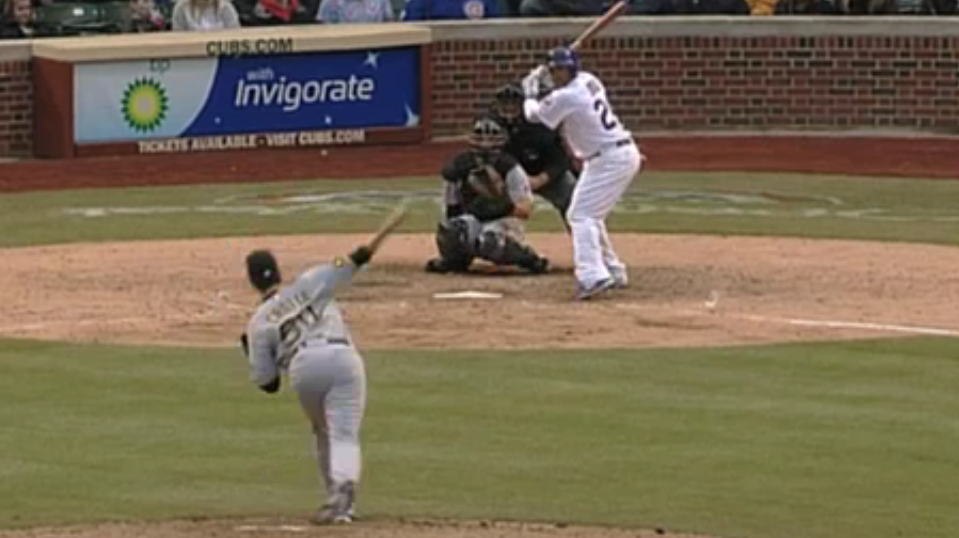
Despite the injury, his delivery has remained virtually the same. Here is a look at what his delivery looked like in 2010:


And here was his release point in 2011:


 Here is what his delivery looked like in 2013:

And his 2013 release point:


The Lehigh Valley gun on MiLB.tv tends to be slow, but I checked the last time he pitched at the park (one of the few MiLB broadcasts with on screen radar guns) and Crotta was throwing 95 MPH with some armside tail. He occasionally kept it high, but would really bust in on a right-hander's bat, seeming to use the two seam like Japanese pitches often use the two seam, trying to get inside rather than throwing it to opposite platoon batters to keep it outside. He can get occasional sink glove side as well and didn't give up a homer all year, so it doesn't seem that staying over the middle of the plate was a problem. He was up to 96, with very consistent velocity, throwing mostly 94 the next inning.

The other pitch Crotta showed was a 84-85 MPH slider. He perhaps had some problem getting on top of it, with mostly downward movement. It was mainly used against lefties, against an occasional righty (though it stayed arm side). It did not appear to be a splitter or change and didn't appear to be a very good pitch. Against impatient hitters when he gets it somewhat down it can be a groundball pitch.

In the Majors, Crotta didn't throw near as hard, averaging under 93 MPH. The MLBAM tags and the Pitch Info tags disagreed whether he threw mainly sinkers or mainly four seamers, but they agreed that he threw a slider as his main breaking pitch and just one changeup. I definitely saw two different fastballs in my short look, but I would probably label them two seamer and sinker.

In my previous article I looked at how NPB teams targeted height and velocity, and the Fighters were above average at possessing both. Crotta is a great example of a guy possessing both, almost at an extreme. 

You do wonder if he is going to miss enough bats to be a successful back of the bullpen pitcher in the NPB, where getting strikeouts can be difficult. The track record and breaking pitch do not suggest he will rack up many strikeouts, but the fastball velocity might. If he can work a little higher in the zone, and still throw 94-96 MPH, he will get plenty of swings and misses.

Thursday, May 9, 2013

Robbie Grossman From A Pitch F/X Perspective

The Astros got Robbie Grossman in the Wandy Rodriguez deal with the Pittsburgh Pirates last year. He seemed to be the kind of hitter that some of the more sabermetric guys liked more than the traditional prospect guys because so much of his offensive value was tied to walks and his approach. My odds system ranked him 380th overall and 289th offensively, so even statistically there were some problems with him. The Astros brought him up towards the end of April and have been playing him every day, so I thought it would be a good idea to peek in at the 222 pitches he has seen according to Pitch F/X so far.

Here is his spray chart so far, according to Texas Leaguers:


Here are his average zones (the whole graph is the strike zone), where he is being pitched, and where he is swinging and missing, and where he is making contact.


 Not surprisingly, he is hitting balls in the middle of the plate more than balls closer to the side of the plate. Also not surprisingly, he is being pitched pretty low in the strike zone.

Of course, Grossman is a switch hitter, so let's look at how he is being pitched by handedness.


Just like what we saw in our look at how top hitters were pitched when they first came up, Grossman is being pitched away heavily, very rarely being thrown inside. Left-handed pitchers are doing basically the same thing to him, with nearly everything low and away:


Obviously he is facing more right-handers (and is batting left-handed the majority of the time) than left-handers, as common sense and the strike zones show. This release point chart should give us an idea of the kind of pitchers he is facing:


He is getting to face quite a bit amount of righties that come far out, but not necessarily low.

Grossman's average spin on whiffs is 166.83 degrees. His average spin on contact is 175.63 versus an average spin of 180.48 overall. So not surprisingly, the pitches he is missing have the least amount of spin, which usually means breaking balls. Surprisingly, his contact is on pitches with less spin than the average pitch overall, which would suggest he isn't hitting as many fastballs as you would expect by percentage. Here are the pitches Grossman has swung and missed at by release point, with a rounded version of the velocity:


Grossman has seen 13 pitches over 95 MPH (there are more on the chart because I considered anything for the chart 94.5 MPH or more to be 95 MPH, I am not doing that here) and swung at just 3 of them, one for a swinging strike, the other for a foul tip, and another for a ball put in play for an out. He has seen 60 above average (92 to 95 MPH basically) fastballs, and has put 8 in play versus 5 swinging strikes. Out of the 31 fastballs in the average range (90 to 92), Grossman has put 9 in play and not swung and missed at any of them. So actually, Grossman is clearly handling big league fastballs pretty well. It is slow pitches that are giving him problems so far, as out of the 24 pitches less than 80 MPH he has seen, he has swung and missed at 5, with just two put in play, both for outs.

So far, Grossman hasn't shown really any power in the Major League level. It is a small sample size, but there wasn't much power in the minors either, which is one of the reasons he was rated so low in the odds system. This means (especially since he isn't a speed or defense guy) he needs to be a high OBP guy and have a really advanced approach. The signs so far suggest that he is doing a decent job of laying off pitches far outside (as his contact and whiff percentages are closer to the center of the plate than the average location), but he has been a dead fastball hitter. He is going to have to do a better job of hitting the off-speed pitches if he has a true MLB future as a starter.

Wednesday, May 8, 2013

How Good Are Minor League Scouting Reports?

Recently, I wrote about Eric Hosmer's weak spots at the plate and whether or not teams knew about his problems at the plate when he first came up. They clearly didn't, at least that is what the pitch data suggested. I've written some articles on rookies this year and how they have been pitched individually. In this article, I wanted to test whether or not teams know (or execute) the weak spots and strong spots in the rookie opposing hitters' strike zone. That is, in some way, I am trying to test just how good teams' minor league scouting reports are. So I picked 5 hitters, all that were big prospects, good in the Majors, not switch hitters, and debuted in 2007 or later. It needed to be 2007 or later so we could use the Pitch F/X data from when they debuted.

I used Brooks Baseball/Baseball Prospectus' heat maps, and for this post, we are only looking at location, and not pitches or anything else. They couldn't be switch hitters because I would have to use extra maps and that would just be annoying. I used the normalized versions for the TAV maps, but not the frequency maps. For a lot of these elite hitters (Ellsbury really isn't an elite hitter, but he is good), they don't have true cold zones, they just have extremely hot zones and zones where they are closer to average.

What I did to test whether or not teams knew their weak spots or not, I looked at their first month's frequency in the big leagues versus their career frequency map and their career TAV (True Average) map. Of course, there are some variables we can't (or didn't) control for using these maps, such as what kind of pitchers they are facing and what may be a small sample size of a first month, but I think this is the best way to approach it.

First, Bryce Harper. Here is his career frequency map, where pitchers have thrown the ball to him in his career:

Harper is a left-handed hitter, so we see that pitchers really like to go away from him, almost never throwing the ball up and in.

Here is Harper's TAV map, showing in which zones he has success:

He loves the inside pitch. That is why pitchers are going away. His weak zones are low and away and up high but not in or out. Here is how Harper was pitched in May of 2012, his first full month in the big leagues:

It seems teams knew low and away was his weak zone and attacked him the most there. It seems that teams knew where his "weak" zones were and where his strong zones were.

What about Mike Trout? His career frequency map:

Teams like to attack Trout right down the middle or outside. Career TAV:

Not surprisingly, Trout's best zone is right down the middle, and he hits low and away balls really well. Up and in is the only place he really struggles in the zone. Here is how he was pitched in July in 2011:

Just like for his career, teams challenged him by throwing it right down the middle or away. So they were wrong about where he would struggle, but they also haven't made much of an adjustment it seems (looking at his 2013 chart, it seems that pitchers are going up and in more, but still trying to go middle away as well).

Joey Votto's career frequency:

Middle and low away is where pitchers try to throw to the left-handed hitter. His TAV map:


Inside is where Votto goes crazy, but he handles the low and away pitches as well. It can't be fun to pitch to Votto, but here is what pitchers tried to do when he first came up:

They tried to keep it low and away, avoiding the inside of the plate (except maybe low and in).

Jacoby Ellsbury usually has pitchers trying to go away from him


His TAV map shows that he is a pretty balanced hitter, without weak or strong zones for the most part:

Up and away is actually his best zone, and middle in is his weak zone. The best bet is probably to change speeds and locations to Ellsbury and just not allow him to sit on one zone. Here is how he was pitched in September of 2007:


Everything was throw away from him, which I think proves to be erroneous.

Here is how Andrew McCutchen has been pitched in his career:


Middle and low and away is clearly where McCutchen has been pitched. This makes some sense when looking at his TAV map:


McCutchen hits everything in really well, and up and away is his strongest zone. Middle away and low and away is where he is just average. It seems that teams knew this when he came up, as the avoiding throwing the ball up and threw away or low to him


So the reaction seems mixed, but it appears that for the most part, teams some kind of idea where they struggled, with Trout and Ellsbury being exceptions. I wondered if just the general approach was to throw low and away from all of them, and there is certainly a lot of validity to that when you look at the first month map. Just pitching low and away to them seems to be a better description of what teams were doing then finding their weak spots. Traditional wisdom states that rookies usually see more fastballs, though we saw with Bryce Harper last year that he saw very few fastballs. Using FanGraphs leaderboards, we can look at the breakdown of pitch types using MLBAM types for rookies and the league as a whole. First, here are the rookies:


The League as a whole:


The rookies see fastballs slightly more than league average each time (other than 2012 where it is exactly the same), but the results are pretty negligible. League average sees a little more curves, sliders, and changeups than rookies, but again, we are talking about less than a percent most of the time.

My working theory, based on some of this data, is that teams that don't use minor league scouting reports (or what seems less likely, just don't really have them) very much, and that they pitch most rookies about the same as they would other hitters as far as pitch type, with maybe a few less fastballs. However, when big time prospects come up, teams try to keep the ball away from them. It seems that there isn't much evidence that the MLB teams have (or more correctly, use) detailed scouting reports on prospects that tell them which part of the zone they struggle at and which part of the zone they excel.

Wednesday, August 22, 2012

Scouting Report on Jameson Taillon

Jameson Taillon is the 2nd best prospect in Pirates system according to Baseball America. After 23 starts in Class A+, in which he had a 3.70 FIP and 4.02 SIERA, Taillon was promoted to AA.

The 6-6 245 RHP has a 95-98 MPH fastball with good movement. He threw a lot of them low and was surprisingly hittable. Taillon had more success with his fastball up high, although it had less movement. He can also really jam lefties with it. This should keep his platoon splits down. In fact, his platoon splits have been reversed so far this year, as he has actually struggled to get righties out.

At the beginning of the game, his curveball stayed high but had really sharp break. It improved as the game went along and he shattered a bat with it. It almost looks like a slider at times. Taillon should get plenty of grounders when he controls it (he had a 43.3 GB% this year in A+, roughly league average). The curve is a whiff pitch when he throws it in the dirt. He can throw it to lefties and righties and get swings and misses. It is an elite pitch when he throws it in the dirt and the AA hitters stood no chance.

He began the game with very shaky command but really got better as the game went along. Taillon has dominating stuff, and the command is a little rough around the edges but is not bad. While the arm action is somewhat strange, the delivery is very smooth overall. There is nothing to be concerned about there. When you look at his stuff and watch him pitch, it doesn't really seem to add up with the numbers. This has to be because of bouts of control issues. Even his strikeout percentage was slightly below league average. It certainly seems like I got to see him on his best day. It shows that his ceiling is obviously much higher than most pitchers. There isn't really any reason to think that he won't be a good pitcher in the majors. However, there was no real reason for him to be pitching that mediocre in High A. He is just 20 though, a few years younger than most of his opponents.

Wednesday, August 17, 2011

College Football Predictions: The Big East


This is a relatively weak conference, especially for a BCS school. They have been drummed in recent BCS bowl games, but there isn't a perennial loser in the conference, which makes it an exciting and close conference. It is also a conference with a lot of turmoil, as the top 3 (according to my picks) teams have new coaches. When TCU enters the conference, this will be a really fun.

West Virginia

A crazy off-season led to former Oklahoma State offensive coordinator Dana Holgorsen taking over as head coach. However, if the offense plays anything like Oklahoma State's offense last year, they are in good shape. They don't quite have the talent on that side of the ball that OK State does, but it is not like West Virginia is without talent.

Final Prediction: Norfolk State and Bowling Green are their two easiest games, they start with Marshall, a game you would think they should win. LSU is their toughest game, and it would be no small upset to win that one. However, most of their schedule looks really winnable. 10 wins certainly seems plausible, and they are the favorite to win the conference according to most.

Pittsburgh

After all the craziness of the off-season, Todd Graham finally became the head coach. He has had some success everywhere he has been, so this may be a good hire. They didn't have a bad year last year, it just wasn't good enough to keep Wannstedt around evidently. They return just 5 starters on the offensive side, and while the quarterback (a very solid one) is one of them, one wonders how much of a system change there is this season. Pittsburgh has a really good defense, as they return 8 starters from last years good one, and they should be able to keep everyone in check, barring a strange system change.

Final Prediction: Buffalo and Maine should be 2 pretty easy wins, but then Iowa and Notre Dame are probably two losses. Sneak Utah into that schedule and its a relatively tough one for Pitt. They still have a shot to win this conference, but will probably come in second and win about 8.
Uconn

Uconn is coming off a great season including a BCS bowl bid. However, they lost their great coach Randy Edsall, and that will be hard to replace. The grumpy Paul Pasqualoni takes over, and uncertainty looms over a very solid program. However, they return 16 starters, giving them a good shot to repeat what they did last year. They had major uncertainty at quarterback last year, further showing that the QB is still not the most important position on the field. If they can get that settled they have a real good shot at making a great run. The defense was great last year and that won't change a bit.

Final Prediction: Not an unbeatable team on this schedule, and with a start against Fordham, they have the schedule that could allow them to start out 5-0 before West Virginia. Probably not repeating the conference victory of last year, but they should still win about 7.

South Florida

This is a program that is sneaky good. They have been in 6 straight winning seasons, and were briefly ranked number 2 in the country in 07. However, they were inconsistent last year. They did beat Miami, but lost a couple of weird ones. They also lost 3 offensive linemen this off-season, and with an inconsistent quarterback and a new running back (that should be good by all reports), problems on the offensive side seem likely. Most of their secondary comes back, but the defensive line will need to be redone.

Final Prediction: Notre Dame is a tough way to start, but Ball State, Florida A&M and UTEP will give them a little bit of a break. Miami (FL) will be looking for revenge, and they end the season with West Virginia. They are a borderline team, but should still win the 6 games to qualify for a bowl game.

Cincinnati

After a great season in 09, Brian Kelly left, and it all fell apart. A terrible non-bowl season last year makes everyone wonder what direction this program is heading. They return most of their starters though, and last year was obviously a rebuilding season, so a bounce back year is not out of the question. This offense is going to be good and exciting to watch, and the defense should be improving.

Final Prediction: Tennessee and North Carolina State are the big names in their non-conference schedule. They are another borderline team, I lean towards them making a bowl game at 6 wins.

Syracuse

Doug Marrone is going into his third year as head coach, and they are coming off of a 8-5 season. Things are certainly looking up for this program. However, the offense struggled last year, but all the key parts are coming back, so it could be much improved. On the other side of the ball, the story is just the opposite, it was good last year, but most of the key pieces aren't returning.

Final Prediction: 3 of the first 4 games are very winnable, but the other one is USC. Games 2 and 3 in level of difficulty is West Virginia. They also have teams like Tulane, and South Florida that are very beatable on the schedule. Expect some struggles as neither side of the ball looks good enough to carry the team. 5 wins.

Louisville

They went 7-6 last year in a bounce back season for the program under the first year of Charlie Strong. They had lots of seniors last year though and will have to figure out how to turn this around. They have uncertainty at quarterback and will have to replace their top two receiving targets from last year. They also lost 4 starting offensive linemen, all spelling rebuilding for the offense especially. The defense doesn't really look too hot either.

Final Prediction: They begin the season with Murray State and Florida International. Weeks 3 (Kentucky) and 4 (Marshall) provide very interesting match-ups. We will learn a lot about this team in the stretch of North Carolina, Cincinatti, and Rutgers. I don't think this season will be quite as magical, 4 or 5 wins seem likely.


Rutgers

The last two years have been pretty frustrating, leading to a new offensive coordinator. Sophomore quarterback Chas Dodd already has some experience under his belt, and this well help. Their offensive line was terrible though, and its hard to imagine it gets any better. They couldn't run the ball and their defense was terrible, this doesn't magically change.

Final Prediction: A relatively sane non-conference schedule, with North Carolina being the toughest matchup. However, Navy, Louisville and West Virginia won't be an easy 3 week stretch. This is another 4 win team.