Showing posts with label Cubs. Show all posts

Thursday, May 22, 2014

Masahiro Tanaka: Start Nine

Masahiro Tanaka's ninth start of the season, pitched against the Cubs in Chicago (the first team he has faced twice), was his worst outing of the year so far. While he still struck out seven and walked one, he gave up a season high four runs, a tied for season high eight hits, and a season low six innings. On a positive note, he did not give up a homer for the third straight start.

Here is his spin and speed chart from the outing:


Here are his average spin and speeds by pitch type:

Tanaka's release points:

Average release points by pitch type:

Tanaka's pitch locations:
Average pitch locations:

Tanaka's movement chart:

Tanaka's average pitch movement:

Here is Tanaka's average result locations:

Tanaka's average locations by platoon:


Monday, November 25, 2013

AFL Pitch F/X Data: Battting Results

Moving along from just looking at a pitching perspective when it comes to Pitch F/X data in the Arizona Fall League, I wanted to take a basic look at the batting results in the Pitch F/X game from a hitter's perspective. In the next post, I plan to take a look at the results from a more individualist standpoint, but for now, I'll look at results as a whole. The simplest way to start this seems to be by looking at all the swinging strikes in the AFL Pitch F/X games, labelled by MLBAM pitch type:

There isn't a lot of surprising things here, fastballs are more likely to be swung and missed at high, curves and changeups low, and sliders low and side to side. 2-seam fastballs (FT) are usually low or in the middle of the zone when they are swung at. There are some exceptions of course, as I see a couple of high sliders, a high cutter, and a high changeup on both sides.

When looking at home runs, the pitches are high in the zone, with really only one "low pitch" hit for a home run.


Obviously there is a lot of fastballs, but there is a hanging high curve, some sliders that didn't get real low, and a hanging changeup. Below is the same graph, but labelled with the names of the hitters instead of the pitch types:

Peter O'Brien, a Yankees C/3B prospect in the lower minors, managed to hit a homer that wasn't even a strike, while Ohlman had the low home run. The highly paid Cubs' prospect Jorge Soler had the home run on the highest pitch, while Mexican Leaguer turned Astro Japhet Amador had an honorable mention (as did Peter O'Brien).

Infield fly balls is something that I think has been getting too much attention in the sabermetric community in the last couple of years, but it is something that is interesting since they are almost always turned into outs. GameDay labels them "popups", and here are the locations and the pitch types of each one measured by Pitch F/X in the AFL in 2013.

 Most of them are on fastballs thrown up and in to right-handed batters, which I don't think is surprising. There appear to be some breaking balls thrown away from right-handers that turned into popups, most likely pitches that the batter tried to pull (you wouldn't think a left-hander would pop up a low and inside breaking ball).

Groundballs are much easier to measure, and usually more predictable as a repeatable skill, but the problem is that there are more of them. This makes the graph a little messier, but here are the groundballs turned into outs in the AFL by Pitch F/X data:


There aren't many high pitches, but the concentration of pitches is mostly in the middle of the plate. Not surprisingly, a lot of cutters and 2-seam fastballs show up here, without the concentration of breaking balls that we saw in the swinging strike graph.

Here are the average locations of the 4 main GameDay results:

On average, there is no real average difference in location between outs, no outs, or run scoring plays. This suggest that most of the actual results off the bat were BABIP or randomness driven. Swinging strikes on the other hand, were thrown lower in the zone and a little further away from right-handed hitters.


Sunday, September 29, 2013

Brother Elephants Pitcher Scouting Reports

In a previous post, I looked at three CPBL pitchers who could be possibly be considered MLB prospects. However, since the league contains only four teams, I thought it would be a good idea to look at the pitchers on each team similar to how I have been looking at the deliveries in the NPB. Since complete games in the CPBL are kept on YouTube, I watched each pitcher, wrote some short notes on their pitches, and GIF'd their deliveries, just as an introduction for people not knowing anything about the CPBL but wanting to start to get to know the players. I am not doing the teams in any particular order, and the first team is the Brother Elephants. The Brothers are last in the league in overall 2013 record, but have the best pitching staff just by runs allowed (they have scored the fewest amount of runs). Hiroki Sanada and Ta-Yuan Kuan were in the post linked to above, so they won't be in this post.

I tried my best with the names, but unlike the NPB and KBO, there aren't always easy to find English translations. If you know of a better translation of a name, leave it in the comments and I will link to it or change the name (ironically, the biggest reason I wanted to do some CPBL posts is because there are basically no English resources available, which also makes doing so without being bilingual difficult). All velocity numbers are translated from KM/H to MPH.

Lin En-Yu
He was recently replaced on the active roster by Li Juguan, but he was on the roster when I started working on this, and he has more innings, so I included him. He has pretty good size, and brings his hands over his head facing the hitter before his leg kick, which isn't part of his stride. After all this, he comes forward pretty standard.
82-86 fastball
72-76 soft slider
64 curve


Yu-Ching Lin
The 24 year old has backed up a strong 2012 campaign with a slightly better 2013 campaign. His numbers are virtually the same other than walks, an area where he has improved. Just under 6 feet tall, he uses a hip turn to bring his body away from the hitter with a high leg kick, followed by a bizarre arm action.
84-88, velocity picked up to the higher stages in the second inning. Could get some downward movement on it.

76 slider mostly downward break, 73 more of a curve.

76-78 splitter like pitch that breaks arm side

A lot of deception in his overall games, a lot of bad chases out of the zone by CPBL hitters.

Miguel Mejia
The 25 year old pitched in both the Marlins and Tigers systems, almost exclusively out of the bullpen. Nothing was spectacular about his numbers, and he racked up just 131 innings in 3 years. At about 6-2 or 6-3, he uses a pause in the middle of his leg kick, and it seems to upset his own delivery timing, along with the hitter's. There is a tilt backwards in his delivery before slinging his arm forward.

92-94 early, down to 87-91 after the first couple of batters.
73 slider, good two way movement, not close to the strike zone.
78-80 splitter, up to 84


Brad Thomas
LHP, easily the tallest pitcher on the team, standing at about 6'4. According to Pitch F/X, when Thomas was in the Majors, his fastball was about 91 MPH and he threw a sinker, curve and a changeup, but here is what I saw watching him in the CPBL:

91-92, really likes to come in on right-handed hitters.

79-80 unimpressive slider he can throw for a strike
Luo Guohua
The 26 year old is enjoying his best season, posting a 3.82 ERA as a reliever.
He has a really standard delivery, standing just over 6 feet tall.

82-84 sometimes moves arm side.

75-77 breaking ball he struggled to get down, though on the occasions that he can, he gets good two way movement.

72 more of a curvey breaking ball 
Sung-Wei Tseng
RHP SP is about 5-10. This year has been the 28 year old's biggest year by far when it comes to innings pitched, and while his ERA and groundball rates held well, his strikeout to walk rate leaves something to be desired (50 to 41 in over 130 innings).
83-86, up to 87-89. 2-seamer can come in on RHB, and can throw it low with good movement.

72-74 curve/slider

Mid 70s changeup/slider he left up a lot.

Po-Hsuan Keng
At about 6 feet tall, the 28 year old has been a 1 inning reliever throughout his career (actually averaging less than an inning an outing). He is not much of a strikeout pitcher, relying on groundouts instead. He has pretty good size, good weight, broad shoulders, but slings the ball sidearm. It is more of a high sidearm, not a low sidearm.
84-86, gets some sink or 2-seam run, down to 83-84, up to 88
78 change
73 slider breaks glove side, something to go away from right-handed hitters.

 Wu Ming-Hsu
Also about 6 feet tall, the CPBL rookie threw 23.1 innings this year, so the jury seems to still be out on the 25 year old. He slings the ball hard, with a little bit wobbly landing point. Fastball command seems to be some kind of issue
89-92, gets up to 93-94, down to 86-88 with a little more command and ability to get it low.
81-82 slider, gets it glove side, not a lot of movement either way, a strike pitch
72 curve
79 split

Hung-Wen Chen
First year in the CPBL has been successful, with a 3.07 ERA and 3.6 K/BB ratio. The 27 year old pitched in the Cubs' minor league system from 2007-2011, enjoying some success, getting all the way to AAA, but not missing a lot of bats. He also spent part of 2011 in the Mexican League, where he dominated as mostly a closer in 34.2 innings. A pretty big looking guy, but actually stands under 6 feet. He has a leg sweep more than a kick, though he does come up some. Comes forward after he has set the leg back down.

87-91 up to 92-93 at end of outing can get some downward movement on it. He seemed to use it both arm side and glove side and would pitch inside to righties.

74-79 got up to 80 soft slider (though it doesn't look like a slider grip, the movement didn't look like a splitter, maybe a separate splitter), didn't seem to get it down well, a strike pitch.

Saturday, September 7, 2013

A Quick Look at Chang-Yong Lim's Debut Outing

Chang-Yong Lim made his MLB debut with the Cubs on Saturday after rehabbing in the minor leagues all season following a career in Japan and Korea. He walked a batter, gave up a single, and got a grounder into a double play.

Lim is most notable because of his sidearm release point:


We do have Pitch F/X data of Lim in the 2009 WBC, and we see that his release point has remained the same (-3.14, 3.64 in 2009, -3.16, 3.72 in 2013 per Brooks Baseball's method of 55 feet release). With Lim being a sidearmer, I thought it would be interesting to compare him to other right-handed pitchers with low release points in the Pitch F/X era:

Lim gets a little buried, but he is most similar to Cla Meredith and Darren O'Day, a little lower than Steve Cishek. Here are the locations for all of Lim's pitches in his debut:

It seems that he was working mainly arm side and low, rather than sweeping the ball away like you would expect sidearmers to do. Take for instance, Darren O'Day as a comparison. He throws low and glove side quite a bit according to the pitch breakdown by Baseball Savant:

In the WBC, Lim relied on a 95 MPH fastball, a sinker, slider, and splitter. The following speed and spin chart shows the stuff Lim threw in his debut outing for the Cubs:


He clearly doesn't have the same stuff he did four years ago (though who does?), but he can still get it up to 94 MPH. Lim threw no breaking balls, but the chart suggests three different pitches. The slow one is some kind of changeup (with basically the same movement as the fastball) and it seems that he has two different fastballs. There isn't a real difference in horizontal movement (the difference is in vertical movement), but I am calling the faster group FF (4-seam) and the slower group FT (2-seam). These actually match the MLBAM tags. While there was no vertical difference in how he located the two fastballs (he kept both low), he kept the 2-seam arm side while throwing the 4-seam glove side, pretty traditional (other than the 4-seam is extremely glove side). 

Ironically, the single he allowed, to left-hander Norichika Aoki, was actually out of the strike zone on the arm side, meaning it was quite a reach job by Aoki

Sunday, July 14, 2013

Free Agent Fantasy Team Update: Relying on Luis Cruz

A short free agent fantasy team update this week.

Scott Feldman was traded from the Cubs to the Orioles, which doesn't change his status on my team.

Wang and Camp were DFA'd, Wang was outrighted, Camp was released. I am releasing Wang myself as well. Luis Cruz and Jeff Francouer signed to the big league team to fill their roster spots. Since we are about 95 games into the season, they both get 199,000 dollars. Manny Ramirez and Kelly Shoppach signed to the minor league team, with David Ross and Ryan Madson released, both on 60 day DLs, and both looking like they won't be back this season.
Kuroda missed a start (really was just pushed back a couple of days), but returned and didn't go on the DL. Roy Oswalt hurt his hamstring and goes to the DL/Minors team. He is a release candidate, but instead I released Ben Francisco instead. I also changed Kevin Slowey back to starter, as he took Nolasco's rotation spot. This should put my MLB team at 23 players.

Scott Baker has started a rehab assignment, which obviously doesn't change his roster designation, but is a good sign.  Ryan Ludwick could be back in August according to reports.


15.4 fWAR: 43.33 wins, 51.67 losses

15.2 rWAR: 43.13 wins, 51.87 losses

-2 WAA: 45.5 wins, 49.5 losses

12.3 WARP: 42.7 wins, 52.3 losses

Instead of a writeup of one of the players, I'll just link to my article on Jeremy Guthrie's struggles from Pine Tar Press.

Wednesday, July 10, 2013

The Scott Hairston Trade

Scott Hairston was traded by the Cubs to the Nationals for minor league pitcher Ivan Pineyro. Hairston wasn't playing full time for the Cubs and was really struggling when he was playing.

I'll only looking at his data against left-handed pitching, because that is all that really matters for him. He is a lefty masher, just a platoon player for the most part, with large platoon splits in his entire career. In his small sample size with the Cubs, his overall OPS against lefties was still okay because he still hit for power. I did want to see if there was a skill set or approach change, so let's look at his average locations along with average velocities of his results.

This year with the Cubs:

Hairston as a Met (2011-2012)


It appears to me that he is still handling hard pitches just fine, but is having more problems with off-speed pitches. He was really just a hard ball hitter with the Cubs for the most part, which is also shown by the difference in location for his 2013 whiffs. He was also just pitched more low and away as a whole when he was with the Cubs, as teams seemed to take advantage of his aggressiveness. To me, this is more encouraging than the opposite (still hitting off-speed pitches the same but regressing against fastballs, like it appeared he did last season) because it still implies that he has bat speed, that is, unless he is just cheating on balls badly. The power is still there, so even if he is a binary hard ball hitter going forward, he'll still be useful as a pinch hitter in the National League.

Ivan Pineyro is a 21 year old right-handed pitcher originally signed by the Nationals out of the Dominican Republic. When I watched him pitch online, he looked lanky despite being 6-1.

The release point seems to come quite a bit out, a more than average 3/4ths delivery. Mechanically, he has a lot going on, with a lot of leg and arm motion in the middle of his delivery. It hasn't led to high walks rates though, so as long as he controls it, it probably doesn't really matter (I don't think it helped with deception).

His fastball is probably average at best when it comes to velocity, but I didn't hear a lot of readings. He seemed to keep the ball low, so I am surprised he is not an extreme groundball guy. He threw a lot of breaking balls, even in the first inning, showcasing a 76 MPH curveball. He liked to use it and a few changeups against lefties. Against right-handed batters, he can sweep a slider away, but the break isn't hard, somewhat slurvy.

The outing I saw was when he was in A-ball, and it was pretty clear that he was ready for another level. The Nationals agreed (the numbers backed it up as well), sending him up to A+ before the trade. Pitchers without huge fastballs below AA are really difficult to evaluate, especially when it comes to comparing to a MLB player. The problem is compounded, I think, when the player wasn't subjected to the draft. It makes them harder to peg when it comes to value. You can point out that Pineyro has potential, having professional success at a young age (that is, most college guys who were drafted are older than him, and you can probably count the ones ready for A+ success on one maybe two hands), but that is really vague and not helpful. He is the type of flier arm that I don't think the Nationals mind giving up for a player that can help the team now.

Wednesday, July 3, 2013

The Decline of Carlos Marmol

A few days after being designated for assignment, Carlos Marmol was traded by the Cubs to the Dodgers, along with some international bonus money, for Matt Guerrier. According to reports, the Dodgers are going to use Marmol in the minor leagues to begin to see if they can fix his mechanics. Marmol had been an effective reliever for the Cubs for sometime, but his decline became too drastic in 2013 to hang onto him. From 2007-2010, Marmol was one of the elite relievers in baseball, but 2011-2012 proved to be somewhat mediocre seasons, and 2013 has been a disaster.

The problems have mainly been control related, as his high walk rates have just gotten out of control. His wild pitches/passed balls have actually gone down, but he is throwing the ball in the zone less and throwing less strikes:

-->
Season Name Zone% Strike %
2008 Carlos Marmol 52.70% 62
2009 Carlos Marmol 51.70% 59
2010 Carlos Marmol 50.30% 61
2011 Carlos Marmol 51.10% 61
2012 Carlos Marmol 48.40% 59
2013 Carlos Marmol 46.90% 60

Not surprisingly, this data comes with a change in release point. The following shows his average release point by year, with the strike zone in the map for reference.


His furthest out release point is where he was in 2008, and since then he has moved closer to the center of the plate at release point every year. He got a little lower in 2011, so in what was probably an attempt to rework mechanics, he started releasing the ball higher than he ever has before. This is where he is at now, the highest and closest to his body he has ever been. 


Marmol is basically a two pitch pitcher and has been the whole time. There has been some regression in his velocity, and it has been somewhat inconsistent from season to season (this data is from FanGraphs, unlike the Pitch F/X data presented above in the release point charts and below in the location charts, which is pulled from Baseball Savant and the charts are mine)


Season Name vFA vSL
2008 Carlos Marmol 94 82.3
2009 Carlos Marmol 93.9 83.5
2010 Carlos Marmol 94.1 83.7
2011 Carlos Marmol 91.8 83.2
2012 Carlos Marmol 94 84.7
2013 Carlos Marmol 92.7 83.7


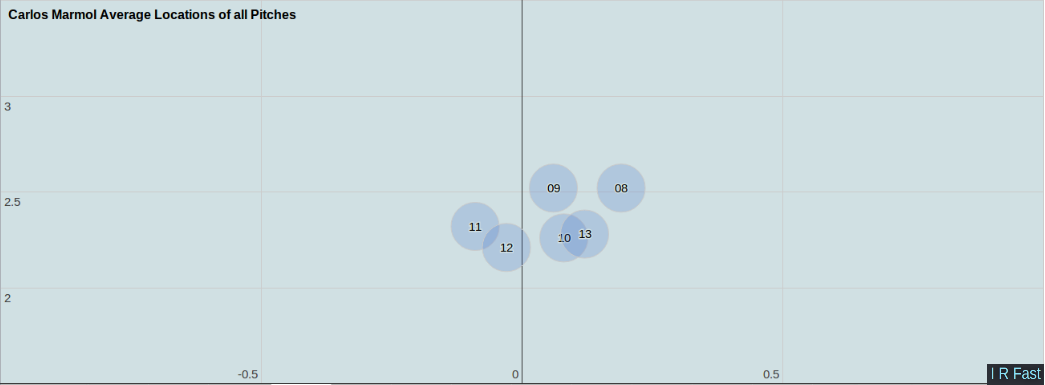
Here is where his average pitch has been located each season regardless of pitch type (In the following graphs, the entire graph is the strike zone)


Marmol was a high ball pitcher in 2008-2009, but since then has become more of a low ball pitcher. He went from a glove side pitcher to an arm side pitcher for two seasons, but so far this year he has gone back to being a glove side pitcher. 


Here we see somewhat similar results, with him actually going back to being a glove side pitcher with the fastball so far this season. It has never been a pitch he has thrown low on average, but in recent years it has been lower than it was when he was successful. With his slider, the changes are less dramatic:


Like most pitchers, he has always located his slider on the glove side of the plate. Like with the fastball, he is locating it lower on average than he did in 08-09. This seems to be just because he is throwing the slider in the zone less. 

The diminishing velocity makes the ceiling for Marmol going forward a lot lower. Even if they fix him mechanically (they have already designated him for assignment, so that seems to have been just talk), going back to the old release point that was further and out seems to be the best move if it is even possible, it is doubtful he will ever be the old Marmol again. With a fastball that is a tick or two slower, he probably won't be able to have the success with the high fastball that he once had, even if he is able to get the fastball up again.

Sunday, June 30, 2013

Free Agent Fantasy Team Update: Jason Grilli's Dominance

This time's Free Agent Fantasy Team Update contains a lot of roster moves, yet again.

I released J.C. Romero, who was on the MiLB DL and signed Randy Ruiz to take his place on the MiLB roster. I change Kevin Slowey's designation from SP to RP, as the Marlins have moved him to the bullpen. Roy Oswalt and Brian Bogusevic were promoted to the big league team, both get paid 234,240 dollars, unless something else is announced. Travis Ishikawa was promoted by the Orioles, but didn't play well and was quickly designated, so I just released him and won't take his numbers. Eric Chavez also goes to the big league team, coming off the DL. David Ross to the 7 day DL then the 60 day DL, so he goes to the inactive part of team and is a release candidate. Thomas Neal was optioned to minors so goes to minor league team, as does Melky Cabrera, who was placed on the 15 day DL. MLB team should be at 24. Hisanori Takahashi was traded from the Cubs to the Rockies, but will remain in AAA. It doesn't change his status on my team. I also signed Ben Francisco to fill out my minor league/inactive roster.

Since most teams have played about 81 games:

13.8 fWAR, 37.614 wins, 43.39 losses

14.2 bWAR, 38.014 wins, 42.99 losses

12.2 WARP, 38.12 wins, 42.88 losses

-.5 WAA, 40 wins, 41 losses

Yet again, WAA likes me the best, but I have now fallen below .500 according to all 4 metrics. WARP actually likes me more than the baseball reference WAR, which is a little strange considering WAA also comes from Baseball Reference (but I think comes from one of the biggest flaws in positional player WAR, as fielding and baserunning are weighed by average and the batting is weighed by replacement).

Jason Grilli was somewhat of an after thought signing for my team, just an attempt to use some extra money I had as a late signing and to make sure I had guaranteed bullpen depth. He has clearly been worth the money and has been one of the league's elite bullpen pitchers, proving that the good 2010-2011 seasons were no fluke. Grilli was a top prospect at the turn of the century, but he bounced around the league, with large inconsistencies.

For sake of comparison, let's look at Grilli's 2009 with the Rockies, where he was missing bats, but walking way too many hitters and had an ERA over 6, which even after a good 2008, ended his time as a member of the Rockies, as he was moved to the Rangers.


Here is Grilli so far in 2013:


He is a pure 2 pitch pitcher, and unless you believe the occasional changeup tag, this seems to be what he has been for virtually the whole Pitch F/X era (it seems that he used to throw a curve). This is a pretty dramatic change for their to be no real pitch usage changes. He has went from an arm side pitcher to a glove side pitcher, and is actually throwing the ball higher than he was before. Strangely, his average velocity of all pitches has stayed the same because he is throwing his fastball harder, yet his slider has lost velocity. Your guess is as good as mine as to how that it is possible.

There isn't a major release point change other than he is releasing the ball a little lower now, something that doesn't see to be unusual as a pitcher gets older. The location change, along with the fastball velocity uptick, seems to be why Grilli has improved. He isn't afraid to go high with the plus fastball and work on the other side of the plate.

Sunday, June 23, 2013

Miguel Alfredo Gonzalez Scouting Report

Miguel Alfredo Gonzalez, originally from Cuba, has been declared a free agent by Major League Baseball. A 25-26 (I read two different ages) year old right-handed pitcher, he is listed at 6-2 185. There aren't good scouting reports available online from what I can find, but the Dodgers and the Cubs are interested, along with some other teams that have been watching him throw.

Statistically, the last year I can find that he played in the professional league in Cuba is 2009-2010. He had a ERA 2.13 better than league average, 6.99 K/9IP (19.2 K%), and 3.9 BB% (1.45 BB/9IP). League Average that year was 5.0 K/9IP and 3.83 BB/9IP. So Gonzalez was a lot better than league average, but when comparing him to other professional Cuban pitchers that came to the states, his strikeout rate is still pedestrian.

Reports are that he has a fastball, changeup, forkball, and curveball. This is the only video I can find of Gonzalez, and is what I used to write this article.

He really looks lanky in the video, but at his age, you don't expect him to really add weight. He seems to be able to locate his fastball low or high. It looks a little straight up high and the velocity doesn't look plus, but seems workable. He showed he can get in on lefties and break bats.

The change movement doesn't look great, but it looks like he gets on top of the curveball well. I wish I could see more of those two pitches. The forkball looks more like a splitter than the traditional forkball (at least compared to the ones you see in Japan) with quite a bit of arm side movement before dropping (almost looking like some kind of 2-seam hybrid).

Statistically, he had good command, and when teams see him throwing, they will obviously know his velocity, and without having very good readings,  it is hard to really speak to his ceiling or placement in a rotation in the Majors. He does seem to have at least two big league pitches, and should be able to pitch in the big leagues, but how effectively I can't really speak to.

Sunday, June 16, 2013

Free Agent Fantasy Team Update: Kevin Gregg's Success as a Cub

This week's Free Agent Fantasy Team Update contains a lot of roster moves:

Rick Ankiel was DFA'd and then released by Mets, so he is released from my team. I had missed that Dewayne Wise was on the DL, so I moved him to the inactive part of my roster. John Lannan will be back with the the Phillies to start on Monday, so I am putting him back on the big league roster. Shawn Camp was activated from the DL as well, so he moves to the active part of my roster. Thomas Neal was recalled by the Yankees, so he also moves from the minors/inactive part of the roster to the MLB part of the roster. Assuming that he is making league minimum, he is now owed $284,000. Chien Wang was also signed by Blue Jays, so I signed him to big league roster. He will also be owed 284,000 dollars. This puts my payroll at about 100.5 million dollars for the season. This also puts my big league roster at a full 24. It also means I had 2 spots open for my minor league/inactive team, so I signed J.C. Romero and Clay Rapada relievers who signed MiLB contracts in the past couple of weeks. Apparently Travis Ishikawa has exercised his opt-out clause, but that will probably take a couple of days to play itself out, so I am going to keep him on the inactive part of the roster as there was no update at the time of publishing. Now, let's see how my team is doing:

Since about 70 games have been played this season:

12.4 fWAR, 32.98 wins and 37.02 losses

13 rWAR, 33.58 wins and 36.42 losses

10.5 WARP, 32.9 wins and 37.1 losses

.4 WAA, 35.4 wins and 34.6 losses

So the three WARs have congregated to about as close as they have been all year. WAA continues to be the one that rates my team the highest, and I am only above .500 according to that measure.

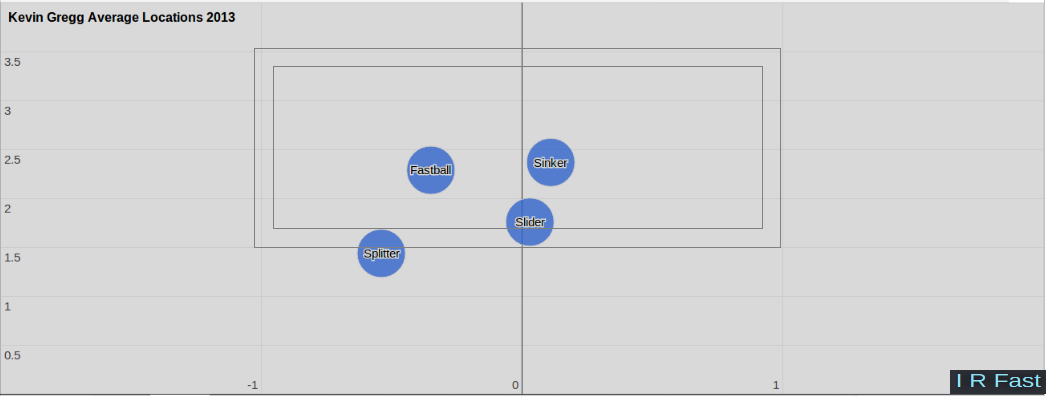
Since all the roster moves made the post long, I just wanted to take a quick look at why Kevin Gregg may be having more success. My guess was location (as his 2013 stuff is nothing special), so here is his average locations from 2012 and 2013:

 He is keeping the ball lower on average this year, which could really play a role in his success so far. Let's break it down by pitch (MLBAM tags). 2012:

2013:


The fastball is clearly more arm side, rather than in the middle of the plate, while his sinker is more glove side. He is also locating the slider and splitter lower in the zone, which, along with moving to the NL Central from the AL East, is probably playing a big role in his success so far with the Cubs.

Saturday, June 15, 2013

Ian Dickson Scouting Report

Ian Dickson is a 22 (will be 23 years old at the end of the season) right-handed pitcher that stands at a listed 6-5. The Cubs traded him to the Nationals for Henry Rodriguez (whom I wrote about here). Statistically, since being picked by the Cubs in the 35th round of the draft in 2011, Dickson has been mediocre, with a 4.33 kwERA and was moved to the bullpen early in 2013. So far this year in A-ball, Dickson has a 4.23 SIERA and 4.14 kwERA with an okay strikeout rate, but too many walks.

I watched his lone MiLB.TV outing (which was a start in April) in 2013 to get a better idea of what Dickson was throwing, as actual scouting reports on Dickson seem hard to find.

It looks like he throws a lot of moving fastballs. He kept them up, most of them middle of the plate or higher. This may help explain the home run rate in a relatively pitcher friendly league. Some did sink some to the glove side, which is probably what he is trying to do. It seemed to have a little bit better command as the game went along. He can work as a backdor moving fastball to right-handers and the velocity looked reasonably good (audio wasn't working on the broadcast so I am not sure what his velo was game in the game). With his very heavy usage of the pitch he just isn't going to miss a lot of bats with it. He threw an occasional 4-seam (just going by movement, as it was more straight) fastball  in on the hands of righties.
His delivery doesn't have a lot of moving parts to it, but the size is clearly not working to his advantage. Both in short season in 2012 and in full season in 2013, his groundball rate was really poor.
The only breaking or off-speed pitch I saw was a slider that seemed to sweep reasonably well, maybe a little bit soft and "loopy" (not real tight or hard). He located it like a traditional slider. Didn't throw it a ton, but he increased usage as the game went along. Dickson doesn't really have a tool to get lefties out, but so far in his minor league career, he actually has reverse splits.

It looks like Dickson is a probably just an organizational relief arm. It seems unlikely that he will really find any success in AA, if he makes it that far. He was drafted very late in the draft, and so far, he is performing like you expect a pitcher drafted late in the draft. He has just two real pitches, with none of them plus or really average, with control that is mediocre.

Friday, March 22, 2013

Times to First: Part 20

The first update since December (it is kind of hard to get times when no baseball is going on). Links mean that I got the time from somewhere else, and you can follow the link to see the tweet.

1. Chad Oberacker (Athletics A +): 11.42 (on a triple)

2. Tucker Frawley (Blue Jays A-): 4.27

3. Marlon Bryd (Mets): 4.34

4. Michael Taylor (Nationals): 4.20

5. Kensuke Tanaka (Giants): 4.00

6. Mitch Maier (Red Sox): 4.32

7. Evan Gattis (Braves): 4.49

8. Joe Leonard (Braves): 4.46

9. Kyle Blanks (Padres): 4.29

10. Jose Pereza (Braves): 4.01 (on a bunt)

11. Roman Quinn (Phillies): 3.81 (on a bunt)

12. Yasiel Puig (Dodgers): 4.04

13. Joey Gallo (Rangers): 6.65 (from 2nd to home)

14. Jake Elmore (Astros): 4.23

15. Ty Wright (Cubs): 4.34

16. Angel Villalona (Giants): 5.21

17. Lance Berkman (Rangers): 4.34

18. Jim Adduci (Rangers): 10.97 (1st to home)

19. Dustin Ackley (Mariners): 4.16

20. Javier Baez (Cubs): 4.31

I uploaded all the times we have so far (399) to a spreadsheet that you can view below. I sorted by times to first (but the other times, at least for players we have just one time for, should be sorted as well as you scroll down), and the team should be the current team, but let me know if there are any errors.

Thursday, November 22, 2012

Arismendy Alcantara Scouting Report

Arismendy Alcantara is a small middle infielder (listed at 5-10 160) that was signed out of the Dominican Republic by the Chicago Cubs in 2010. 

He has been used almost exclusively as a pinch runner/pinch fielder in the Dominican Winter League, but did get an at-bat on Wednesday night (in which he grounded out to end an extra inning game). Even with the platoon advantage (he is a switch hitter who was hitting right-handed against a left-handed pitcher), he didn't seem to have very good plate discipline and he sometimes come out of his swing.

He is not a player that ever really appears in Cubs' prospect lists but he played in A + as a 21 year old (actually he was 20 for the whole actual season). The average age in the Florida State League was 22.7 years old. Despite this, he had a good year with the bat, with a 110 wOBA + and 124 OPS +. This was good for 30th in the league in wOBA (out of hitters with at least 300 plate appearances). More impressively, Alcantara was younger than 26 of the 29 above him. The Cubs Florida State League affiliate Daytona played basically neutral in 2012 (99 one year Park Factor), but he was much more effective at home than he was on the road (the ISO was basically the same, the difference was mainly BABIP). His switch hitting is paying off as well, as he was equally effective from both sides according to OPS in 2012, with better peripherals as a right-hander and more power as a left-hander. He seems to be an average/BABIP dependent hitter, as he doesn't walk much (doesn't have a big strikeout rate, but it is too high for his walk rate) and doesn't hit for much power. He is a ground-ball hitter, though his ground-ball rate did drop in 2012. At the plate, it seems like he has some work to do mechanically. Despite taking no real stride, he loads up with a front leg kick. This isn't the best way to start and he doesn't have a swing that would make any opposing player jealous. I actually saw some video of him before 2012, and it seems that he did not have this load. Perhaps it is ironic that he had a better season with it, or perhaps it is a timing mechanism that works for him. 

After stealing just 8 bases and being caught 8 times in 2011, Alcantara was much more efficient in 2012, stealing 25 bases and was caught just 4 bases. Part of the struggles in 2011 may have to do with leg injuries, as he has had DL stints in each of the past 2 years. However, one would not have expected him to have had the success on the bases he had in 2012 if they were bothering him. Overall, you are seeing improvements in his overall game, as his ISO, Stolen Base success, and Speed Score have all went up over his 3 years (without repeating levels), and he has been dropping his strikeout rate as well (I am not counting 2009, as he spent the year in the Dominican Summer League, which is somewhat of a different animal statistically). His speed score was 8.1 in 2012, which was 2nd to only teammate Matt Szczur in the Florida State League (it was also in the top 40 in the minor leagues as a whole, tied with Brett Jackson and Jimmy Paredes). Basically, he is fast, and a good baserunner as well (Baseball Prospectus gives him a positive baserunner and the Baseball Cube gives him a 85 out of 100 on speed).

Both the data (RTZ, FRAA, and Range Factor) and the scouting reports say he needs to work on his defense. However, he played almost exclusively shortstop in 2012 (after splitting time better short/2B/3B in previous seasons). While athleticism obviously does not always translate to good defense, both his age and speed at least give you a reason to think that he will improve.

Whether or not his defense develops determines whether or not he is a MLB player for me. If he becomes at least a decent to average defender, he could be a slap hitting utility infielder that you could use late in games on the bases. Because his plate discipline needs so much work, I have to imagine that he is going to find AA in 2013 pretty tough. 

Wednesday, November 21, 2012

Ranking the DFA'd

Yesterday was a big day in baseball, as teams had to decide which prospects they wanted to protect from the Rule 5 draft. This of course leads to players being taken off the 40 man roster to make room. According to MLBDepthCharts, 23 players were DFA'd yesterday. Here is my rankings of the players along with a paragraph on each of them:

1.Adam Moore (Royals): He played in just 4 big league games and just 72 overall in the Majors at age 28 (going to turn 29 in May). They haven't gone real well, and he has really struggled with injuries. Still, he has hit well in the minors, and is still somewhat interesting as 3rd catcher. Probably borderline on whether he is worth claiming, definite minor league contract guy.

2. Scott Cousins (Mariners): Despite having some extreme offensive and contact problems in the Majors, two teams have already thought he was worth enough to claim him (and then of course designated him). The tools make him interesting enough to teams that he will get his chance. Another borderline case, the two DFA's probably makes him a guy that you wouldn't claim. MiLB contract and invite to Spring Training makes sense. What he becomes relies on contact, but he is a possibility as a 5th outfielder (though the skill sets of Felix Pie and Darren Ford, both signed to MiLB contracts by the Pirates, are slightly more attractive).

3. Brayan Pena (Royals): long time back-up catcher, epitome of a replacement player. He is going to turn 31 years old to start the 2012 season. I can't imagine anyone claiming him unless they are just absolutely desperate for catching (he has already played for the Braves in the past, just saying). It seems like he is worth a minor league contract and invite to spring training as a AAA catcher/emergency big leaguer.

4. Derrick Robinson (Royals): Despite posting mainly good peripherals, the 25 year old has never hit very well in the minors. He plays a good centerfield according to some data and he can run really well. The 4th rounder at least has the tools to be an extra outfielder, but it just isn't something the Royals need right now.

5. Chris Volstad (Royals): A frustrating back of the rotation starter, the sinker baller has shown some potential, but doesn't miss many bats, and walks too many batters for his skill set. He has still been an above replacement pitcher and could perhaps eat up some emergency innings (a good infield would help him).

6. Cory Burns (Padres): Burns is interesting because he is 25 and put up some sparkling numbers in the PCL this year. The thing that makes him uninteresting is his well below average velocity and the fact that he is a right-handed reliever. He instead relies mainly on a changeup. It is a good changeup, and it has helped him get both lefties and righties out. We will see if it helps him get out hitters on a consistent basis in the Majors.

7. Zach Stewart (Red Sox): A product of a few different trades, Stewart has found the Majors very rough. In his 103 innings, he has a ridiculous FIP of 7.55 thanks to a low strikeout rate (but low walk rate) and over 2 home runs per 9 innings. With that said, he has a good ground-ball rate (50%), so his SIERA is 3.93, pretty solid. What Stewart actually is obviously somewhere in the middle. He has a mix of pitches  that he can throw in virtually any count (his tendencies aren't very predictable) but he has below average velocity. There is a chance he could be a back of the rotation guy, getting a lot of ground-balls and giving up a lot of contact. He is the kind of guy that could benefit from a pitcher ballpark more than others.

8. Mike McCoy (Blue Jays): McCoy cannot hit at all, but he has played in 170 big league games and has shown that he is a good fielder making him a capable utility man in the minors. He is a great example of why AAA Las Vegas numbers mean nothing, as he has clobbered the ball there, only to be one of the worse hitters in the Majors.

9. Cory Wade (Blue Jays): Wade is an interesting guy as a below average velocity reliever that has had some MLB success. A bounce back season from 2012 is likely, but he isn't a guy with high value.

10. Jim Miller (Athletics): DIPs hasn't been impressed with his short (63.1 innings) MLB career, but the veteran right-handed reliever has decent velocity and solid numbers in AAA. The question is not whether or not he can miss bats, it is whether or not he can limit walks.

11. Vin Mazzarro (Royals): Despite decent to above average velocity, Mazzaro has never really put it together. In now 286 big league innings, he has not proved much at all except that he can be an above replacement pitcher. Still just 26, he relies on basically just his fastball and slider, never really finding a 3rd pitch to get hitters out with. Perhaps a move to the bullpen would help, but it didn't work so well in 2012.

12. Bryan Lahair (Cubs): He turned out to be the AAAA hitter that Theo and company insisted didn't exist after a big start. Several Japanese teams have been looking at him, and the rumor is that he was DFA'd so he could pursue opportunities there (it appears that he has already signed with the Softbank Hawks for 950,000). The 10 % BB/30 % K MLB player seems to work over there for a few different reasons, so it wouldn't be surprising to see him have success there. He is probably better than Wily Mo Pena, as at least statistically he is an above average MLB hitter (obviously the lack of other skills get in the way).

13. Chone Figgins (Mariners): I honestly had no idea where to rank him. He has been so terrible over the last 2 seasons (and he wasn't good the year before), and the chances of him getting better at age 35 (before the start of the season) are slim to none. He doesn't quite have the speed he used to, and his defense has been pretty poor (it doesn't look he can be a traditional utility player), and his bat has absolutely disappeared. Still, he has had a really solid career and some team will bring him in on a MiLB deal and see if he can resurrect himself.

14. Sandy Rosario (Red Sox): His numbers may not be eye popping in the minors, but they aren't bad, and he has a good fastball that averages almost 95 MPH along with a slider and change that he throws quite a bit. He is already 27, and despite his short sample in the Majors, he could be a guy that eventually sticks in a MLB bullpen.

15. Fabio Martinez (Indians): Martinez has a big time fastball, but he has really struggled with command. He is still just 23, but hasn't yet reached AA. This is why he isn't worth a 40 man spot yet, as he simply isn't ready. However, there is more potential here than just about anyone on this list.

16. Clint Robinson (Royals): Somewhat of a classic AAA slugger, Robinson has put up some eye popping numbers in the minors. Despite playing in a hitter friendly park in Omaha the last two years, he has virtually no home/road splits and he has walked more than he has struck out against righties. The decent strikeout rate makes him interesting, but it is hard to tell with these sluggers sometimes. He could be a bench bat, a AAAA slugger forever, or even go to the NPB.

17. Brandon Hicks (Athletics): Once considered somewhat of a prospect, Hicks hasn't really hit since he got to AA and his time in the Majors has been a disaster. However, he still can play shortstop, and evidently a pretty good one. There is always some value there.

18. Mike McDade (Blue Jays): Despite not turning 24 until May of 2013, it is quite apparent that McDade is the traditional AAAA slugger. He provides no defensive value with that body type and the bat speed just isn't there. However, he has put up some monster numbers in AA and AAA, and at the very least can be brought in by a team to anchor the 1B/DH spot in AAA and be a bench bat in an absolute emergency.

19. David Carpenter (Red Sox): While Carpenter does have an above average fastball, it has lead to no MLB success. He gets a fair amount of strikeouts, but too many walks and not enough grounders have lead to his demise. His sample sizes in the minors are too small to really glean anything from, but he doesn't belong on a 40 man roster but does at least belong in a MLB camp (if just for the fastball).

20. Danny Valencia (Red Sox): Valencia has had some success in the Majors, he was good in 2010 and above replacement in 2011, but the value is all tied to his bat and he was a mess in 2012. He seems really reliant on BABIP, which is no way to make a living. Perhaps he has some kind of rebound (it's hard to predict BABIP, the "Bill James" Projection system likes a bounce back), but a low walk, low power, bad defense, bad baserunning skill set doesn't exactly lead to attractive players.

21. Ryan Verdugo (Royals): Verdugo's one start in the Majors was an utter disaster, and he clearly has below average stuff and velocity. In the minors, his numbers are much more impressive as a reliever than they are as a starter. We will see if a move back to the bullpen will get him back to the Majors.

22. Ivan De Jesus (Red Sox): Now 25, De Jesus is no longer a shortstop, a below average defender, and has laughable hitting numbers away from Albuquerque. Other than a minor league lifer, I don't see much here.

23. Joel Carreno (Blue Jays): Both AAA and the Majors have proved to be extremely difficult for Carreno, but he is still just 25. As a right-handed reliever without overpowering stuff, one is probably better going off with relievers that are more of a sure thing like Cory Wade or Jim Miller. Or would could go the route of pitchers with better stuff like Fabio Martinez and David Carpenter.

Friday, October 26, 2012

Cubs Claim Carlos Gutierrez: Scouting Report

Carlos Gutierrez is a former first rounder draft pick by the Minnesota Twins but never made it out of AAA and is already 26. He was claimed by the Cubs after the Twins took him off the 40 man roster.

Once a top 10 prospect in the Twins system, he threw just 16 innings this year, all in AAA. He has always been a good ground-ball pitcher (with an okay strikeout rate) featuring a 88-93 mph fastball with a slider and an occasional change-up.

We have Pitch F/X of Gutierrez from 2 games, an Arizona Fall League game in 2010 and a spring training game in 2011.

He can run it up to 94-95 MPH (with a sinker) in relief appearances (the above velo from the FanGraphs' scouting report was back when he was a starter in the lower minor leagues). The question has always been whether or not he has enough off-speed to get hitters out. It is clear that he never developed 3 pitches effective enough to become a starter, but as a reliever, he would really only need one. So can his slider be effective at the big league level? Velocity wise, it is certainly of the hard variety, averaging just over 85 MPH. That is around the velocity of two very different pitchers in term of effectiveness, Johnny Cueto and Mike Pelfrey.

At least in his outing last year, he struggled with both the release point of the pitch, and the command of it:


Strikes have always been an issue for Gutierrez, as he has thrown strikes less than 60% of the time in the last couple of years, when league average in the International League is nearly 63%. He has decent to above average stuff, but his command and control is definitely below average. It is hard to expect it to get much better considering his age.

His strikeout rate to both lefties and righties is about the same, but his ground-ball rate and walk rate has actually been lower to lefties, making him a reverse split pitcher. Considering he doesn't throw his changeup very often at all, this is surprising. I am always skeptical of reverse split pitchers, not because they don't have value, but because they often aren't used properly. 
In 2011, he threw 62.1 above league average AAA reliever according to FIP and SIERA, but didn't make the big league club. Considering that the Twins' bullpen was downright awful, I am surprised he didn't get his chance then. Considering the Cubs gave most of their bullpen innings to Shawn Camp, who is now a free agent, Gutierrez looks to finally get a shot in the big leagues this year. I don't see how he will be very effective, but the Cubs don't have a lot of other options, so he will definitely get a chance.
Tuesday, October 23, 2012

Time to First: Part 16


1. Jim Thome (Orioles): 4.61

2. Josh Donaldson (Athletics): 4.20

3. Jhonny Peralta (Tigers): 4.37

4. Alex Avila (Tigers): 4.52

5. Michael Morse (Nationals): 4.48

6. Zack Cozart (Reds): 4.17

7. Tyson Gillies (Phillies AA): 3.98

8. Brett Gardner (Yankees): 3.84

9. Freddy Galvis (Phillies): 4.34

10. Oswaldo Navarro (Mets AAA): 6.73 (2nd to home)

11. Brandon Belt (Giants): 8.10 (on a double)

12. Adron Chambers (Cardinals): 4.02

13. Hirotoshi Onaka (Rangers A): 3.63 (on a bunt)

14. Preston Beck (Rangers A-): 4.31

15. Carlos Beltran (Cardinals): 4.15

16. Scott Hairston (Mets): 4.15-4.25

17. Billy Hamilton (Reds AA): 3.64-3.78

18. Travis Harrison (Twins RK): 4.15

19. Zach Osborne (Rockies A-): 4.33

20. Gioskar Amaya (Cubs A -): 4.07

Here are all of the times so far: