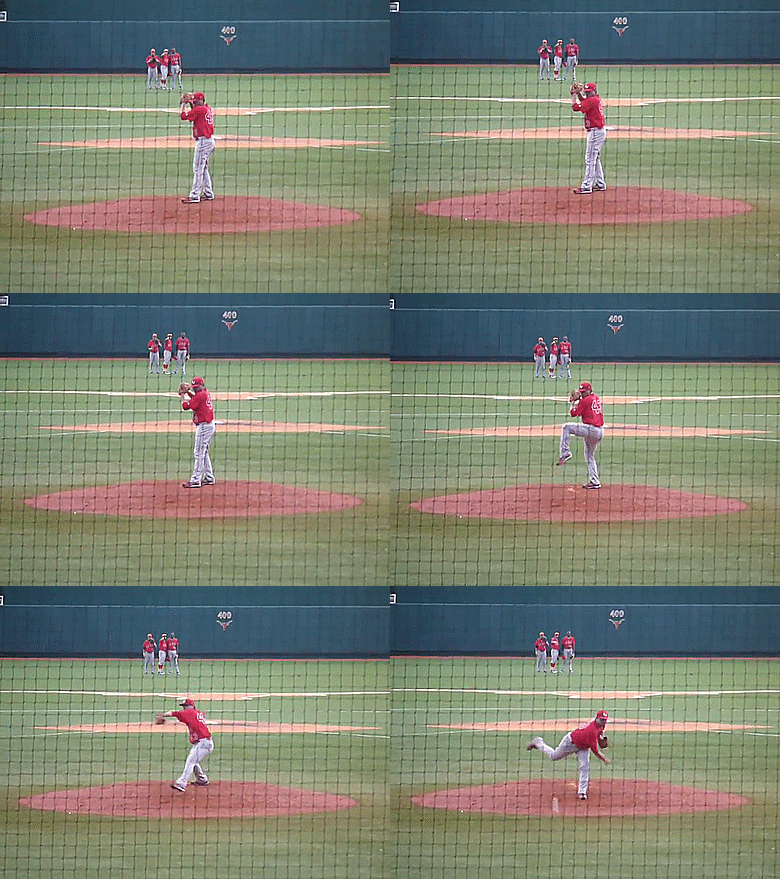
Monday, October 7, 2013

Uni-President 7-Eleven Lions Pitcher Scouting Reports

Continuing the look at CPBL pitchers, the following is a look at the pitchers from the Uni-President 7-Eleven Lions. At 58-53, the Lions are the second best team in the league in 2013, boasting a league best ERA. All velocity numbers are converted from KM/H to MPH.

Lin Yueh-ping
The 31 year old has nearly 600 CPBL innings of experience, pitching mainly out of the bullpen. His 2013 was very good, with a 2.56 ERA, despite barely striking out more hitters than he walked. He is a pretty extreme groundball pitcher.
88-92
80-84 splitter

Kao Chien-san
Soon to turn 40, the reliever has shown no signs of slowing down, posting a 2.25 ERA for 2013 with a plus groundball rate. 
87-88
83-85 slider that looks like a cutter

Boof Bonser
Once rated the 29th best prospect in baseball, Bonser made 111 appearances in MLB games, but struggled throughout his career, pitching under replacement level, and not appearing in the Majors since 2010. He threw just 12.1 innings in the CPBL as a late season pickup. 
89-96
87-88 slider never seemed to be able to get it down
78 curve

Wang Ching-ming

Another pitcher with an ERA under 3, he can at least boast about having twice as many strikeouts as walks. He has pitched out of the bullpen and the rotation and is a flyball pitcher.
83-87, up to 87-89 occasionally is able to get on top of it despite his lack of height
80-82 change
78-82 slider/cutter
69-71 curve not high usage early but began using it more the second time through the order. The pitch has good depth, didn't hang it.

Fu Yu-kang

The 25 year old has emerged as one of the most dominant pitchers in the CPBL, with a 1.31 ERA in 130.1 innings over the last two seasons. He is an extreme flyball pitcher, but has one of the better strikeout rates in the CPBL, with a low walk rate to go with it. 
85-90
74-75 curve
80-81 slider

Lee Wei-hua
The 28 year old doesn't have a lot of CPBL experience, but is a flyball pitcher with about a 1:1 K/BB.
84 fastball
77-79 change
74 breaking ball

Luis Vizcaino

The 39 year old pitched in 543 games in the Majors from 1999-2009, but had spent most of the time since then out of baseball. After a stint in the Mexican League, Vizcaino appeared in 11 games for the Lions.
92-95
82-84 slider with good depth

Nelson Figueroa
With almost 500 MLB innings under his belt, and a stint in Taiwan in 2007, Figueroa came back to the Lions and posted an ERA under three in 95.1 innings.
85-89
78-81 slider
74-75 curve, just a little slower and a little less sharp than the slider. Doesn't use it as much but it seems that he uses it similarly. Sometimes he is around 76-77 and you can't tell what pitch it is.

Tsai Wan-lin

The 26 year old struggled in a small sample size this year, but has shown the ability to get strikeouts with about an even groundball rate in the past.
88-92 armside and downward movement created by his arm action
82-83 slider

Liao Wen-yang

81-87 sinker, got up to 87-91 on a more straight fastball, but it is rare. The sinker is his feature pitch.
68 curve

Lo Ching-lung

86-93
75-80 curve/slider, two different pitches but it was difficult to tell at times which was which, especially by velocity.


Chiu Tsu-kai

84-87 up to 89
76-77 heavy sweep slider down to 72-73

Pan Wei-lun

84-90 some 2-seam or sink
76-79 change
79-82 breaking ball

Sunday, October 6, 2013

EDA Rhinos Pitcher Scouting Reports

Continuing the look at CPBL pitchers, this post has the rest of the pitchers on Juan Morillo's team, the EDA Rhinos. All velocities are converted to MPH.

Lin Chen-Hua
The RHP has a sidearm release point even though he is a starter. He has been a full time starter in the CPBL for two years now, and the 24 year old has been pretty successful from an ERA standpoint, even though he is a low strikeout pitcher that doesn't get many groundballs.

82-86, a little bit of glove side slide to break into lefties. Can also use it as a 2-seam type fastball, but it appeared that he wants to work inside regardless of platoon. Later in his outing, he started moving the ball away from hitters.

75-76 down to 74 breaking ball, appears to be a slider, didn't always have the great slide. It sometimes broke arm side like a change, and I think there are two different pitches based on platoon.

Tsai Ming-Jin
The 29 year old moved back to the bullpen after a failed attempt to move to the rotation in 2012. He has had high ERAs throughout his career, and he doesn't get a lot of strikeouts, though he does get some groundballs.
87-90 moves aggressively arm side, can get it down.
77-78
67-68 curve

Lin Chi-wei

RHP
85-89
76-78 slider
73-76 curve

Lin Ying-Jie

The 32 year old has seen his innings decrease over the past two seasons, but has remained effective. His groundball rate has decreased this year.
80-82 can get glove side movement
76-78 soft slider like movement
73-78 splitter/changeup, grip almost looked like a palm ball
68-69 2-plane break curve

Chen Huan-yang

The 27 year old has failed to really establish himself in the CPBL, but he has decent K/BB rates, and about a 1/1 GB/FB rate.

84-87
75-78 change breaks arm side.
74-79 slider does a good job of getting glove side and down

Nick Green

The 28 year old threw 38 innings in the CPBL, and didn't have a high strikeout rate, but only walked 7 and had a good groundball rate. Green pitched in the Angels and Brewers system before three years in the Atlantic League (independent ball). 

86-87 down to 84-85, up to 89-90 will use it high and it is hittable there, even at this level

71-73 curve very occasionally mix it in.

76-77 breaking ball that breaks straight down.

Lai Hong Cheng

The 25 year old LHP appears to have pitched both out of the bullpen and as a starter. He has developed into a good groundball pitcher, but his K/BB rate has been poor.
87-90
82-83

Shen Yu-Jie

The 32 year old veteran was once one of the best pitchers in the CPBL, but has struggled over the last three years. In his prime, he did everything you want to see a pitcher do, getting grounders, striking out hitters, and not walking many. 
84-85
70-76 sweepy breaking ball

Zhang Geng Hao

The RHP has moved to the bullpen full time now and has posted an ERA over 5 for the 2nd straight year.
86-87
76-82
69-70 curve

Matt Torra

A first round pick in 2005, Torra has never reached the Majors, but has 578.1 AAA innings, not walking hardly anyone, but struggling to miss bats. In 12 starts in the CPBL, he dominated, walking just 5 hitters in 78 innings, but still not striking many hitters out.

86-90, some 2-seam movement or sink.

79-80 changeup can throw it for a strike arm side, not a lot of real movement, just kind of softly drops.

84 slider, mostly a down pitch, doesn't really slide horizontal.

Lin Yen-Fang

 He is a bigger guy that most of the Rhinos.
84-87 with some vertical movement downward.
79-80 change with similar movement, just takes velocity up, sometimes keeps it up.
Seems to have a horizontal late breaking slider at 81-82

Yang Chien-fu

He is pretty small without any real room for projection.
86-90 can sink it
76-78 downward slider
67 curve

Saturday, October 5, 2013

Juan Morillo in the CPBL

Juan Morillo is the hardest thrower in the Chinese Professional Baseball League, and one of the hardest in the Far East as a whole. In case you don't believe me, here is him hitting 99.4 MPH, which is a CPBL record.


Morillo is a former MLB pitcher, appearing in 9 games over four seasons with two different organizations. Especially since not every outing was even a Pitch F/X outing, we do not enough Pitch F/X data to analyze (not to mention that he has not been in the Majors since 2009, so the data would be dated, not containing any possible changes he has made since that time). However, it appears that Morillo didn't get much movement on his fastball (though the sample size was really small and I distrust a lot of Pitch F/X movement data since it varies so much from park to park). So it may be important to look at whether or not his fastball is "straight" when evaluating Morillo

After his brief MLB career and a somewhat odd minor league career, Morillo, who will turn 30 in the offseason, signed with the Rakuten Eagles for the 2010 season, but he didn't pitch in 2011. He was released in April by Rakuten of that year by his own request and was dealing with some elbow problems. He threw just 6.2 Ichi-gun innings for Rakuten, and 17.2 innings for the Ni-Gun team. In both, he struck out a lot of batters, but had a few walks as well. His fastball averaged under 95 MPH (never really got close to 98 MPH on a "cold" gun)  and he threw almost all sliders (with some "cutters" that were the same velocity) as secondary pitches.

Here is what his slider looks like:

If he could control that pitch, then it would be very effective to both lefties and righties. It works as a really good vertical depth pitch, but just from that one pitch alone, you can see why it would be hard to command.

In 2013, Morillo sruggled in the Mexican League in a small sample size to start the year before going to Taiwan. He has only thrown 18 innings for the Rhinos, and his ERA is a 4.50, walking more guys than he is striking out. The only real positive you can say about his statistical line in the CPBL is that he has over twice as many groundouts as flyouts.

I watched one of his outings with the Rhinos and what I saw pretty much matched the data above. He was 94-99 MPH without great command. However, I thought the pitch had good life, and he threw it both high and low. Despite giving up more than a hit an inning, I don't think the fastball, at least in a vacuum, is easy to hit because it is straight. I thought one of the problems he has mechanically is that it looks like he just slings the ball around. His release point, for the most part, is a mess. He uses a delivery that has a lot of moving parts to it, as he goes up, pauses, and then tilts before coming forward. His arm angle is a little non traditional, as it is more of a 3/4 motion that becomes an over the top motion because he falls hard to his left. This "falling" seems like it would be very difficult to repeat on a consistent basis.

He also went that outing without throwing any breaking balls, which is perhaps why it was a successful outing. His fastball isn't an easy pitch to hit for CPBL hitters. It can be an easy pitch to take because it isn't close to the zone.

At age 30 next year, it is hard to believe that he will even figure out how to command his mechanics and throw strikes, but perhaps one could have said the same about Radhames Liz. He found enough command to start effectively in the KBO without losing any of his fastball. Would it make sense for a MLB team to sign him to a no risk minor league deal, try to tinker with his mechanics, and release him when/if he didn't throw strikes? Perhaps. However, I think it would make more sense for the EDA Rhinos to keep him and try to develop him as their closer. He is the hardest throwing pitcher in league history, and even with his flaws, that has real, tangible value. He has a skillset that no one else in the CPBL came even really come close to, and who knows, perhaps he pitches himself back onto MLB radars.

Friday, October 4, 2013

A Look at the Swings of the University of Texas' Hitters

Similar to my look at the deliveries of the pitchers from the University of Texas, the following is a GIF look at the Longhorn hitters' swings.

Brooks Marlow: Junior


Zane Gurwitz: Freshman


Andy McGuire: Freshman


Mark Payton: Senior

Collin Shaw: Junior

Shaw had a rough swing on an outside 90 MPH fastball, but seems to have a pretty short stroke with an ability to make contact. It doesn't appear that he is a power hitter. 

Tres Barrera: Freshman

Good athleticism defensively at first base, but was jammed by inside pitches from a RHP (I think the GIF shows that his swing is a little long). 

Bret Boswell: Freshman

He had his problems at shortstop, perhaps raising questions about his hands, but the range is there and he has an easy plus arm. He had a bad jump on the bases, but seemed to have a good eye with the ability to make good contact.

CJ Hinojosa: Sophomore


Thursday, October 3, 2013

Matt Shoemaker Scouting Report

27 year old Angels' right-handed pitcher Matt Shoemaker made his MLB debut at the end of the 2013 season, making a start against the Seattle Mariners. He went 5 innings, getting all but four batters out (2 hits and 2 walks), with five strikeouts, no runs allowed, and a wild pitch. Clearly one start is not going to give us too much insight into Shoemaker statistically, especially against the Mariners, a below average offensive team. Shoemaker making that start is most likely a product of a weak Angels' system, with very few upper level pitching prospects to be able to fill in when their starters are injured or underperforming. Shoemaker has made 64 starts in the PCL, usually a sign, especially at his age, that he is going nowhere as a prospect. The PCL, especially in parks like Salt Lake's, is a pitchers' nightmare. However, while he was slightly better on the road, he didn't have big home/road splits. I figured the best way to deal with his stats in the PCL would be to use kwERA like we use to evaluate NPB pitchers in an extreme environment the other way. Shoemaker had a 3.94 kwERA in his time in the PCL, while league average in 2013 was 4.16, suggesting that, at least by strikeouts and walks (Shoemaker was a low walk, medium strikeout pitcher with a passable but not not impressive groundball rate), Shoemaker is a better pitcher than the run of the mill average PCL pitcher. Shoemaker is slightly older as well, just turning 27, with the average pitcher being about 26.6 years old in the league.

Of course, AAA statistics are less predictive for success in the MLB than velocity and pitches, so let's start the evaluation of his Pitch F/X data by looking at his spin and speed chart from the game against the Mariners (his only outing that has Pitch F/X data for his career), which should give us an idea of what he throws:

There seems to be four clusters of pitches, fastballs up top, changeups slower than that but with the same spin, the sliders with less spin and a little slower than the change, and three curveballs.

For another look, here is his spin set in a graph along with the rotation on his pitches:


This time the spin is the vertical axis while the rotation is the horizontal axis. We still see four clusters of pitches, but this seems to show, at least slightly better than the speed/spin chart, that Shoemaker is throwing two fastballs.

MLBAM has him throwing six different pitches, and three different fastballs if you count the cutter, and here is where he located them on average according to those automated tags (entire graph is strike zone):

For the most part, Shoemaker appears to be a glove side pitcher, only keeping his sinker on the arm side. Even his changeup drifts glove side, even though he keeps it down. In the minors, he had pretty large platoon splits, worse against lefties by over a run according to both FIP and SIERA. Shoemaker has a lot of moving parts in his delivery, accompanied with a lot of stop and go motions, but I think the actual time of release gives us a good idea why he is a glove side pitcher on average, having problems keeping his changeup away from lefties:

This is extremely messy, with his right leg working against his body, and his head leaning hard to the left. You can see why he would pull the ball so drastically, and this makes his low walk rates in the minors surprising.

Here is what his release points looked like according to the traditional Pitch F/X data, and there seems to be some inconsistency, particularly horizontally:

 Brooks Baseball uses 55 feet as the measure of estimating release points, arguing that it is more accurate than the 50 feet measure. When you look at Shoemaker from that distance, there are less stray marks in his release points, but they still show that he was inconsistent throughout the game:

Inconsistencies aside, here is where his average release point was by the 50 feet measure, along with the average location of his pitches:

Shoemaker seems to have at least back of the rotation stuff, without a plus fastball, but with one that he can run up over 92 MPH and average about 90-91, just short of league average. He seems to have the secondary pitches and the confidence to throw them to be a starter, even if none of them are plus pitches. However, control is what I would be worried about with Shoemaker. He has to be able to repeat his delivery and keep the ball away from lefties (excluding the cutter) to be a successful starter, and I am not sure he is going to be able to do that with his delivery. His fastball doesn't appear to good enough for it to be something he can rely on a lot out of the bullpen, so I don't think he would be a reliever of any impact. To me, Shoemaker looks like a pitcher that is an "up and down guy", a guy who has value as a spot starter, filling in at the MLB when needed, but spending most of the year in the AAA rotation, though perhaps he could be a long/low leverage reliever, something that isn't needed by the Angels if they decide to keep Jerome Williams.

Wednesday, October 2, 2013

Lamar University Cardinals Baseball Scouting Reports

I watched Lamar University play against (and beat) the University of Texas in a Fall game in Austin. Below are some notes on the players I saw, along with some GIFs from the videos I took.

Billy Love
The RHP appears to be filled out already, perhaps a little short. He tilts his leg way out with a short turn away from the hitter. He threw a 90 MPH fastball with arm side tail away from lefties along with a 80-82 MPH slider that he often tried to backdoor to lefties. He also throws some kind of changeup with good depth at 84 MPH. 

J.T. Autrey
The big right-handed pitcher has sort of a hesitation in his delivery when he gets set. He struggled significantly with command, but his fastball was 88-89 MPH, up to 92, with a 78-79 breaking ball, up to 81 MPH. The latter pitch has a little two way movement and he has a tendency to bounce it. 

Lance Warren
Short stocky left-handed pitcher was 82-84 MPH on his fastball with a 69 MPH curve. 

Hunter Perry
The righty lacks a little in size, but had three pitches, a 87 MPH fastball, 79-80 MPH slider, and a 73-75 MPH curveball.

David Carver
87-90 MPH on the fastball, with a breaking ball that varied in speeds, down to 73 MPH, and up to 80 MPH, mostly sitting in the 75-78 range.

Derek Wade
85 MPH fastball, 72 MPH breaking ball, gave up homers to two of the three batters he faced.

Matt Aikin
88-89 MPH fastball with pretty good movement, but no breaking pitches and no command. 

Danny Fernandez
87-90 MPH fastball, with 73 MPH breaking ball.

Jacoby Middleton, a centerfielder out of Odessa College, has good size with room to fill out. He was far and away the best looking prospect on Lamar in the initial eye test, with his positional value and his size. He also showed some raw pop when he got under the ball. However, he had an awful first at-bat, and proved to be a pretty easy out for the University of Texas pitchers. He was chasing just about everything, especially breaking balls out of the zone, and didn't appear to be recognizing pitches well.

Sam Bumpers played shortstop, and I thought he played the position pretty well. He showed very good range on one play, even though he isn't always smooth and natural with all his motions. He isn't very fast on the basepaths, but he hit two balls hard, one pulled, and one hit the other way.

Jude Vidrine showed a good eye at the plate and hung in there left on left very well out of the 3-hole. Kevin Santana is short and stout, and not much of a runner. He keeps his hands very low in his batting stance but showed some raw power. Jake Sutton made a poor play in left-field on a fly-ball, and doesn't have a smooth level swing, but he is an other way hitter that has good contact abilities and surprising strength. Brandon Provost doesn't look like a catcher, but runs like one, and made a good throw on a stolen base attempt. He also had a lot of rough balls in the dirt to block, so much so that it was hard to evaluate from my perspective in the stands. Mason Salazar is a speed slap hitting right-handed batting 2nd baseman that struggled defensively.