The simple stat I usually use to evaluate pitchers in the NPB is usually kwERA. With the offensive environment shifting a couple times over the last few years thanks to ball changes, the walk and strikeout rates have stayed relatively the same, making it easier and more effective to use statistics that just use those numbers, not relying on the changing homer and batted ball rates. We could just use strikeout and walk percentages, but using kwERA helps visualize success (or failure) in a run based format like ERA.
The kwERA constant doesn't work the same in the NPB because of a different run environment, meaning, in this case, that NPB kwERAs are pretty consistently higher than ERAs. Therefore, it doesn't really work when trying to figure out which pitchers have been "unlucky" (in simple DIPs terminology), and may be slightly misleading without context. However, I didn't come up with a new constant (the base assumption in kwERA is that a pitcher who walks as many batters as he strikes out "earns" a 5.40 ERA) for two reasons. The first and most obvious, since this is a ranking, we are comparing pitchers to each other. It doesn't really matter what the actual numbers are, just the comparisons between pitchers in the list. Secondly, adjusting the constant might confuse a reader not familiar with the NPB run environment. The kwERA "environment" is similar in both leagues, so seeing a pitcher with a 4.00 kwERA would be a starting pitcher that is good not great, similar to what it is in the Majors.
I also included HR % because, as the name says, kwERA only looks at
walks and strikeouts. Without actually factoring it into the formula,
looking at how pitchers did preventing homers can be helpful
contextually.
In the rankings, I separated leagues because one league has a DH and the other doesn't, which is usually going to affect pitching statistics. However, the Central, which doesn't have a DH, had a higher HR % (driven by Wladimir Balentien) and about the same kwERA, so you could combine the two.
I also labelled each pitcher by which role they occupied during the season in hopes that we could separate the relievers from the starters. Role was determined by majority of appearances. For instance Masahiro Tanaka had one relief appearance, but clearly he was a starter. I used 50 innings as the cutoff for the list.
No surprise, but Masahiro Tanaka lead the NPB in starter's kwERA, followed by Kenta Maeda, Tomoyuki Sugano, Toshiya Sugiuchi, and Chihiro Kaneko. Out of starting pitchers, the best at limiting homers was Daniel Cabrera in the Central League and Shota Takeda in the Pacific League (though Tanaka was right behind him and Takeda had the worst kwERA in the PL out of pitchers with at least 50 innings). Shinya Kayama was the only pitcher in the NPB with at least 50 innings that didn't give up a homer.
Showing posts with label ERA. Show all posts
Showing posts with label ERA. Show all posts
Tuesday, October 29, 2013


Wednesday, October 9, 2013
Tatsuya Sato Scouting Report
Tatsuya Sato is a 27 year old right-handed reliever for the Orix Buffaloes that has emerged as one of the most effective relievers in the NPB despite taking a weird path to the Buffaloes.
The 5-10 169 reliever is definately undersized, and he didn't make his NPB debut until he was 26. After pitching in college, Sato went the industrial league route after some injuries, and wasn't drafted until he was 25 years old.
After a taste of the Ichi-gun in 2012 where he was successful, he has a 3.73 2013 kwERA with a 51 ERA -, third best in the entire Pacific League out of pitchers with at least 45 innings (Masahiro Tanaka and Takahiro Matsunaga). With that kind of effectiveness, he might be closing on many teams, but the Buffaloes already have the very talented Yoshihisa Hirano, so Sato is more of a setup man, with only 8 games finished.
In his delivery, Sato brings his leg up and back towards him. He doesn't actually turn his hip, so he is working against his delivery a bit, which may help explain his walk rate, which is a little high (but forgivable because of the strikeouts). He uses a pretty dramatic pause as well, mustering every bit of deception up he can. He seems to have cleaned up his head movement in his delivery some, which will help mechanically, and his landing and everything looks good. So other than the obvious fact that he has a lot going on in his delivery, enough that it may work against him in the sense of repeating, but obviously works for him in the sense of deception.
As a draft prospect, he got up to 91-94 MPH, but averaged in the 90 MPH range in 2012. It averaged 91.22 MPH in his final outing of the 2013 season (if he doesn't pitch in the two makeup games at the end of the season).
He can get whiffs high in the zone with the pitch, aggressively using it as a strikeout pitch. Flipping through his heatmaps on NPB Tracker from last year, it seems that he was a very high ball pitcher with the fastball. He may be a slight arm side pitcher, but it doesn't seem that there is a big difference between which side of the plate he throws it to.
Occasionally, he will throw a forkball, but the slider is used a lot more (he had cutter and curve according to draft report, but we haven't seen it in the NPB). The pitch will get up to 86-87 MPH, but averages about 81 MPH, so about normal considering his average fastball in 2012.
His platoon splits are a little odd, as he has a better K/BB against lefties, but a better average against and lower home run rate against righties. With his pitch selection (the slider usage especially), we would expect him to be better against righties. In the end, he will probably go wherever his slider takes him. His fastball will definitely work in the NPB, and as long as his slider is effective, he can change any hitter's, regardless of league quality, eye level.
The 5-10 169 reliever is definately undersized, and he didn't make his NPB debut until he was 26. After pitching in college, Sato went the industrial league route after some injuries, and wasn't drafted until he was 25 years old.
After a taste of the Ichi-gun in 2012 where he was successful, he has a 3.73 2013 kwERA with a 51 ERA -, third best in the entire Pacific League out of pitchers with at least 45 innings (Masahiro Tanaka and Takahiro Matsunaga). With that kind of effectiveness, he might be closing on many teams, but the Buffaloes already have the very talented Yoshihisa Hirano, so Sato is more of a setup man, with only 8 games finished.
In his delivery, Sato brings his leg up and back towards him. He doesn't actually turn his hip, so he is working against his delivery a bit, which may help explain his walk rate, which is a little high (but forgivable because of the strikeouts). He uses a pretty dramatic pause as well, mustering every bit of deception up he can. He seems to have cleaned up his head movement in his delivery some, which will help mechanically, and his landing and everything looks good. So other than the obvious fact that he has a lot going on in his delivery, enough that it may work against him in the sense of repeating, but obviously works for him in the sense of deception.
As a draft prospect, he got up to 91-94 MPH, but averaged in the 90 MPH range in 2012. It averaged 91.22 MPH in his final outing of the 2013 season (if he doesn't pitch in the two makeup games at the end of the season).
He can get whiffs high in the zone with the pitch, aggressively using it as a strikeout pitch. Flipping through his heatmaps on NPB Tracker from last year, it seems that he was a very high ball pitcher with the fastball. He may be a slight arm side pitcher, but it doesn't seem that there is a big difference between which side of the plate he throws it to.
Occasionally, he will throw a forkball, but the slider is used a lot more (he had cutter and curve according to draft report, but we haven't seen it in the NPB). The pitch will get up to 86-87 MPH, but averages about 81 MPH, so about normal considering his average fastball in 2012.
His platoon splits are a little odd, as he has a better K/BB against lefties, but a better average against and lower home run rate against righties. With his pitch selection (the slider usage especially), we would expect him to be better against righties. In the end, he will probably go wherever his slider takes him. His fastball will definitely work in the NPB, and as long as his slider is effective, he can change any hitter's, regardless of league quality, eye level.
Sunday, October 6, 2013
EDA Rhinos Pitcher Scouting Reports
Continuing the look at CPBL pitchers, this post has the rest of the pitchers on Juan Morillo's team, the EDA Rhinos. All velocities are converted to MPH.
Lin Chen-Hua
 The RHP has a sidearm release point even though he is a starter. He has been a full time starter in the CPBL for two years now, and the 24 year old has been pretty successful from an ERA standpoint, even though he is a low strikeout pitcher that doesn't get many groundballs.
82-86, a little bit of glove side slide to break into lefties. Can also use it as a 2-seam type fastball, but it appeared that he wants to work inside regardless of platoon. Later in his outing, he started moving the ball away from hitters.
75-76 down to 74 breaking ball, appears to be a slider, didn't always have the great slide. It sometimes broke arm side like a change, and I think there are two different pitches based on platoon.
Tsai Ming-Jin
 The 29 year old moved back to the bullpen after a failed attempt to move to the rotation in 2012. He has had high ERAs throughout his career, and he doesn't get a lot of strikeouts, though he does get some groundballs.
87-90 moves aggressively arm side, can get it down.
77-78
67-68 curve
Lin Chi-wei

RHP
85-89
76-78 slider
73-76 curve
Lin Ying-Jie
 The 32 year old has seen his innings decrease over the past two seasons, but has remained effective. His groundball rate has decreased this year.
80-82 can get glove side movement
76-78 soft slider like movement
73-78 splitter/changeup, grip almost looked like a palm ball
68-69 2-plane break curve
Chen Huan-yang
 The 27 year old has failed to really establish himself in the CPBL, but he has decent K/BB rates, and about a 1/1 GB/FB rate.
84-87
75-78 change breaks arm side.
74-79 slider does a good job of getting glove side and down
Nick Green
 The 28 year old threw 38 innings in the CPBL, and didn't have a high strikeout rate, but only walked 7 and had a good groundball rate. Green pitched in the Angels and Brewers system before three years in the Atlantic League (independent ball).
86-87 down to 84-85, up to 89-90 will use it high and it is hittable there, even at this level
71-73 curve very occasionally mix it in.
76-77 breaking ball that breaks straight down.
Lai Hong Cheng
 The 25 year old LHP appears to have pitched both out of the bullpen and as a starter. He has developed into a good groundball pitcher, but his K/BB rate has been poor.
87-90
82-83
Shen Yu-Jie
 The 32 year old veteran was once one of the best pitchers in the CPBL, but has struggled over the last three years. In his prime, he did everything you want to see a pitcher do, getting grounders, striking out hitters, and not walking many.
84-85
70-76 sweepy breaking ball
Zhang Geng Hao
 The RHP has moved to the bullpen full time now and has posted an ERA over 5 for the 2nd straight year.
86-87
76-82
69-70 curve
Matt Torra
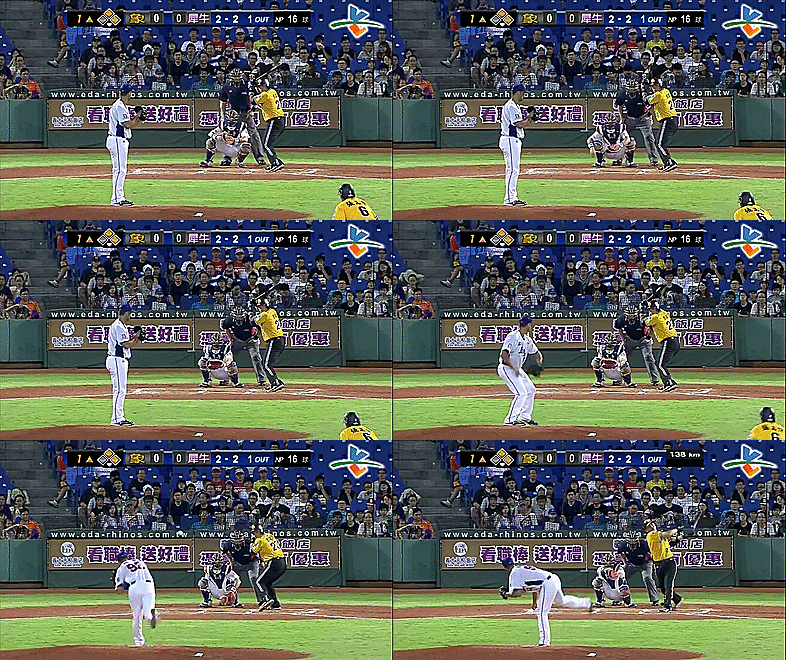 A first round pick in 2005, Torra has never reached the Majors, but has 578.1 AAA innings, not walking hardly anyone, but struggling to miss bats. In 12 starts in the CPBL, he dominated, walking just 5 hitters in 78 innings, but still not striking many hitters out.
86-90, some 2-seam movement or sink.
79-80 changeup can throw it for a strike arm side, not a lot of real movement, just kind of softly drops.
84 slider, mostly a down pitch, doesn't really slide horizontal.
Lin Yen-Fang
 He is a bigger guy that most of the Rhinos.
84-87 with some vertical movement downward.
79-80 change with similar movement, just takes velocity up, sometimes keeps it up.
Seems to have a horizontal late breaking slider at 81-82
Yang Chien-fu
 He is pretty small without any real room for projection.
86-90 can sink it
76-78 downward slider
67 curve
Lin Chen-Hua

82-86, a little bit of glove side slide to break into lefties. Can also use it as a 2-seam type fastball, but it appeared that he wants to work inside regardless of platoon. Later in his outing, he started moving the ball away from hitters.
75-76 down to 74 breaking ball, appears to be a slider, didn't always have the great slide. It sometimes broke arm side like a change, and I think there are two different pitches based on platoon.
Tsai Ming-Jin

87-90 moves aggressively arm side, can get it down.
77-78
67-68 curve
Lin Chi-wei

RHP
85-89
76-78 slider
73-76 curve
Lin Ying-Jie

80-82 can get glove side movement
76-78 soft slider like movement
73-78 splitter/changeup, grip almost looked like a palm ball
68-69 2-plane break curve
Chen Huan-yang

84-87
75-78 change breaks arm side.
74-79 slider does a good job of getting glove side and down
Nick Green

86-87 down to 84-85, up to 89-90 will use it high and it is hittable there, even at this level
71-73 curve very occasionally mix it in.
76-77 breaking ball that breaks straight down.
Lai Hong Cheng

87-90
82-83
Shen Yu-Jie

84-85
70-76 sweepy breaking ball
Zhang Geng Hao

86-87
76-82
69-70 curve
Matt Torra

86-90, some 2-seam movement or sink.
79-80 changeup can throw it for a strike arm side, not a lot of real movement, just kind of softly drops.
84 slider, mostly a down pitch, doesn't really slide horizontal.
Lin Yen-Fang

84-87 with some vertical movement downward.
79-80 change with similar movement, just takes velocity up, sometimes keeps it up.
Seems to have a horizontal late breaking slider at 81-82
Yang Chien-fu

86-90 can sink it
76-78 downward slider
67 curve
Thursday, September 26, 2013
Projecting KBO Pitchers Using Hyun-Jin Ryu's First MLB Season
Hyun-jin Ryu has finished his first regular season in the Majors with the Dodgers, with his last start of the year being on Tuesday night. He ends the season with a rWAR and fWAR over 3.0, pitching at an above MLB average rate, even when considering park factors.
Here is how Ryu's last two seasons breakdown:
2012 KBO: 70 ERA -, 66 FIP - (just based off league averages)
2013 MLB: 83 ERA -, 91 FIP - (FanGraphs)
This of course got me thinking of how current KBO pitchers might fare in the Majors if given a chance. Offense is up in the KBO this year, league average ERA is now 4.31, which is why I used the adjusted ERA and FIP for Ryu. A 3.02 ERA in 2013 would be considered as good as Ryu's 2012 season (a 2.84 FIP would be considered as good as Ryu's 2012 FIP). In the Majors, 130 FIP - is about replacement level. The most aggressive translation (penalizing the KBO pitchers the most) would be 25 FIP - points. So, if we used a direct translation, any pitcher with a 105 ERA/FIP - in the KBO could be considered MLB replacement level talented. This is about 4.53 ERA, or the top 20 KBO starters (11 Korean Natives). I only used starters in this post, because Ryu is a starter and to bring bullpen pitchers into the mix, we would have to adjust for reliever/starter splits.
Out of the 9 non Korean Natives that project to be at least replacement level in the Majors, using career rWAR:
1 no MLB experience
5 under replacement
1 right at replacement
2 above replacement
It should be noted that I projected Ryu as a middle of the rotation/league average MLB starter. He clearly outperformed that projection in the first year, translating better than expected. So it is no surprise that using the way Ryu translated to the Majors, we would be projecting below replacement pitchers to perform at least replacement level. Again, translations are useful because they help us know who to look for, especially if we haven't seen all the players play enough to have the general scouting information that helps MLB teams make decisions on amateur or (in this case) foreign. But, they do not substitute that information.
So here is a list of the 11 Korean pitchers with their current ages whose ERA projects as better than replacement level in the Majors. I also put their 2013 FIPs for comparison, along with their fastball velocities, taken from Naver (except Lee Jae-Hak, who doesn't have a Naver scouting report, I just put his velocity from personal observation. Yu Heui-Kwan doesn't have a Naver scouting report, so he is a future article candidate. If a player has a link attached to their name, I have written about them in the past).
Lee Jae-Hak, 22 years old, 3.49 FIP, 85-89 MPH
Yoon Sung-Hwan, 31 years old, 3.66 FIP, 83-91 MPH
Yu Heui-Kwan, 27 years old, 3.61 FIP
Woo Kyu-Min, 28 years old, 2.96 FIP, 84-89 MPH
No Kyeong-Eun, 29 years old, 3.84 FIP, 86-94 MPH
Yoon Hi-Sang, 28 years old, 4.00 FIP, 84-92 MPH
Song Seung-Jun, 33 years old, 3.82 FIP, 81-92 MPH
Jang Won-Sam, 30 years old, 4.30 FIP, 85-91 MPH
Kang Yoon-Koo, 23 years old, 3.07 FIP, 86-94 MPH
Kim Kwang-Hyun, 25 years old, 4.32 FIP, 83-93 MPH
Bae Young-Soo, 32 years old, 3.42 FIP, 86-92 MPH
Based on the simple Ryu translation, 75 ERA/FIP- in the KBO could be considered MLB average or 3rd starter type. This would be a 3.23 ERA or better. Lee is the only Korean native that has an ERA good enough this year, while Woo and Kang are the Korean natives with FIPs good enough to project as above average in the MLB. Kang also seems to have the best fastball of the group (or is tied with No), though none have as good of a fastball as Ryu (he was listed at 87-95 MPH by Naver).
Charlie Shirek: 3.40 FIP
Chris Seddon: 3.52 FIP
Radhames Liz: 3.35 FIP
Here is how Ryu's last two seasons breakdown:
2012 KBO: 70 ERA -, 66 FIP - (just based off league averages)
2013 MLB: 83 ERA -, 91 FIP - (FanGraphs)
This of course got me thinking of how current KBO pitchers might fare in the Majors if given a chance. Offense is up in the KBO this year, league average ERA is now 4.31, which is why I used the adjusted ERA and FIP for Ryu. A 3.02 ERA in 2013 would be considered as good as Ryu's 2012 season (a 2.84 FIP would be considered as good as Ryu's 2012 FIP). In the Majors, 130 FIP - is about replacement level. The most aggressive translation (penalizing the KBO pitchers the most) would be 25 FIP - points. So, if we used a direct translation, any pitcher with a 105 ERA/FIP - in the KBO could be considered MLB replacement level talented. This is about 4.53 ERA, or the top 20 KBO starters (11 Korean Natives). I only used starters in this post, because Ryu is a starter and to bring bullpen pitchers into the mix, we would have to adjust for reliever/starter splits.
Out of the 9 non Korean Natives that project to be at least replacement level in the Majors, using career rWAR:
1 no MLB experience
5 under replacement
1 right at replacement
2 above replacement
It should be noted that I projected Ryu as a middle of the rotation/league average MLB starter. He clearly outperformed that projection in the first year, translating better than expected. So it is no surprise that using the way Ryu translated to the Majors, we would be projecting below replacement pitchers to perform at least replacement level. Again, translations are useful because they help us know who to look for, especially if we haven't seen all the players play enough to have the general scouting information that helps MLB teams make decisions on amateur or (in this case) foreign. But, they do not substitute that information.
So here is a list of the 11 Korean pitchers with their current ages whose ERA projects as better than replacement level in the Majors. I also put their 2013 FIPs for comparison, along with their fastball velocities, taken from Naver (except Lee Jae-Hak, who doesn't have a Naver scouting report, I just put his velocity from personal observation. Yu Heui-Kwan doesn't have a Naver scouting report, so he is a future article candidate. If a player has a link attached to their name, I have written about them in the past).
Lee Jae-Hak, 22 years old, 3.49 FIP, 85-89 MPH
Yoon Sung-Hwan, 31 years old, 3.66 FIP, 83-91 MPH
Yu Heui-Kwan, 27 years old, 3.61 FIP
Woo Kyu-Min, 28 years old, 2.96 FIP, 84-89 MPH
No Kyeong-Eun, 29 years old, 3.84 FIP, 86-94 MPH
Yoon Hi-Sang, 28 years old, 4.00 FIP, 84-92 MPH
Song Seung-Jun, 33 years old, 3.82 FIP, 81-92 MPH
Jang Won-Sam, 30 years old, 4.30 FIP, 85-91 MPH
Kang Yoon-Koo, 23 years old, 3.07 FIP, 86-94 MPH
Kim Kwang-Hyun, 25 years old, 4.32 FIP, 83-93 MPH
Bae Young-Soo, 32 years old, 3.42 FIP, 86-92 MPH
Based on the simple Ryu translation, 75 ERA/FIP- in the KBO could be considered MLB average or 3rd starter type. This would be a 3.23 ERA or better. Lee is the only Korean native that has an ERA good enough this year, while Woo and Kang are the Korean natives with FIPs good enough to project as above average in the MLB. Kang also seems to have the best fastball of the group (or is tied with No), though none have as good of a fastball as Ryu (he was listed at 87-95 MPH by Naver).
Charlie Shirek: 3.40 FIP
Chris Seddon: 3.52 FIP
Radhames Liz: 3.35 FIP
Friday, September 20, 2013
The Deliveries and Fastballs of the Softbank Hawks
Continuing the look at the deliveries of pitchers in the NPB, this post is a look at the deliveries of the Softbank Hawks, in both screenshot and GIF forms. I tried to get the screenshots from behind, but for some I had to do from the home plate perspective. I tried to use a different video or game to make the GIF, just so readers have different angles, etc. Also, building off the look at fastball effectiveness broken down by velocity, I took a look at each pitcher's last week of pitching (for most of them, just one outing) and used the formula to see how their fastballs would project in the Majors (instead of separating each individual fastball into the velocity groups, I just used the averages of the fastballs in and out of the zone, but still used the percentages of the fastballs thrown inside and out of the zone). The ERA - by each pitcher's name is their 2013 number, and isn't park adjusted.
Brian Falkenborg: 48 ERA-
 Projected Fastball: 6.89 whiff %, 22.62 contact %, .97 HR %
 Shingo Tatsumi: 117 ERA -
 Projected Fastball: 4.36 whiff %, 14.39 contact %, .96 HR %
 Kazuyuki Hoashi: 133 ERA -
 Projected Fastball: 4.97 whiff %, 20.54 contact %, 1.02 HR %
 Akira Niho: 101 ERA -

Projected Fastball: 4.66 whiff %, 27.77 contact %, 1.5 HR %
 Ryota Igarashi: 57 ERA -
 Projected Fastball: 6.81 whiff %, 20.27 contact %, .84 HR %
 Shota Takeda: 98 ERA -
 Projected Fastball: 4.59 whiff %, 18.27 contact %, .90 HR %
 Masahiko Morifuku: 73 ERA -
 Projected Fastball: 5.01 whiff %, 26.51 contact %, 1.6 HR %
 Shota Oba: 148 ERA -
 Projected Fastball: 5.16 whiff %, 18.46 contact %, 1.21 HR %
 Shinya Kayama: 68 ERA -
 Projected Fastball: 4.97 whiff %, 20.54 contact %, 1.3 HR %
 Hayto Terahara: 133 ERA -
 Projected Fastball: 5.95 whiff %, 18.75 contact %, .84 HR %
 Takehito Kanazawa: 56 ERA-
 Projected Fastball: 4.59 whiff %, 24.78 contact %, .64 HR %
 Akihiro Yanase: 49 ERA -
 Projected Fastball: 4.50 whiff %, 24.64 contact %, 1.4 HR %
 Tadashi Settsu*: 65 ERA -
 Projected Fastball: 4.8 whiff %, 21.64 contact %, .49 HR %
 Vicente Padilla: 108 ERA -
 Projected Fastball: 5.13 whiff %, 30.91 contact %, 1.9 HR %
 Sho Iwasaki: 127 ERA -
 Projected Fastball: 6.88 whiff %, 24.55 contact %, .85 HR %

Shintaro Ejiri*: 46 ERA -
 Projected Fastball: 5.94 whiff %, 24.58 contact %, 1.15 HR %
 *Thanks to the always helpful Michael Westbay for the help on Settsu, Padilla, and Iwasaki's pitch data.
*Thanks to Kazuto Yamazaki for the Ejiri GIF
Brian Falkenborg: 48 ERA-


Projected Fastball: 4.66 whiff %, 27.77 contact %, 1.5 HR %


Shintaro Ejiri*: 46 ERA -


*Thanks to Kazuto Yamazaki for the Ejiri GIF
Saturday, August 17, 2013
Kim Sa-Yul Scouting Report
Kim Sa-Yul is a 33 year old right-handed pitcher for the Lotte Giants of the KBO. Listed at just under 6 feet and about 210 pounds, Kim is making the Korean equivalent of about $170,000.
The veteran has been a league average pitcher according to the ERA WAA this year. However, he had served as Lotte's closer in the previous two seasons, and was worth 4 runs over average in 2012 and 3 runs above average in 2011. Despite this, he doesn't have a Naver scouting report, which is the reason for this post.
So far this year, he is throwing 17.75 pitchers per inning, with 4.07 pitches per plate appearance. League average in 2012 was 17.41 per inning, 4.4 pitches per plate appearance. In 2013, out of the 20 pitchers with the most pitches, they average 3.86 pitches per plate appearance and 16.7 pitches per inning. Obviously there is a survivor bias here, mostly because they are a little bit better on average, so teams don't mind making them throw a lot of pitches (4.11 ERA to the league average 4.40 ERA in 2013. The KBO average earned run average in 2012 was 3.82. This means that we will have to change the baseline for the KBO WAA and WAR, and that Kim has been better than league average, at a similar rate to what we saw last year. I'll do it at the end of the season when I do my KBO WAR post, but for now, we will use .49 runs per inning as average and .65 for replacement for ERA. League average FIP has only increased a little, up to 3.98. It might be easier to use kwERA in the KBO going forward, though it is a little more manual work considering Korean sites like to use at-bats instead of plate appearances or batters faced).
This year, Lotte has turned over the closing duties to Kim Sung-bae (1.18 ERA RAA so far this year according to the 2012 baseline, a sidearmer who throws a 83 MPH median fastball according to Naver), and it appears that they are using Sa-Yul as a spot starter and as a reliever. I watched his latest start and charted it, attempting to classify and break down his pitches. Even though he was a closer masquerading as a starter, he showed a starter's pitch selection, with at least four pitches he threw frequently.
Fastball averaged 86.82, went from 84-89 MPH. He didn't hold his velocity very well throughout the outing, probably because he hasn't been a starter consistently. He threw some 2-seamers along with the 4-seam fastball, and also used the fastball as a sinker.
Curve averaged 75.04, was mostly 73-76 MPH, but did throw one 67 MPH curve. The pitch has a lot of loop and straight down movement. I think it is his best pitch.
Changeup 81.13, was usually between 79-82 MPH, but some of the harder ones looked like forkballs. This was his least frequent pitch, but he still threw it at least 7 times in his short outing.
Slider 78.16, between 78-81 MPH. He used this pitch as much as he did the curveball, even though I didn't think it was as good.
The veteran has been a league average pitcher according to the ERA WAA this year. However, he had served as Lotte's closer in the previous two seasons, and was worth 4 runs over average in 2012 and 3 runs above average in 2011. Despite this, he doesn't have a Naver scouting report, which is the reason for this post.
So far this year, he is throwing 17.75 pitchers per inning, with 4.07 pitches per plate appearance. League average in 2012 was 17.41 per inning, 4.4 pitches per plate appearance. In 2013, out of the 20 pitchers with the most pitches, they average 3.86 pitches per plate appearance and 16.7 pitches per inning. Obviously there is a survivor bias here, mostly because they are a little bit better on average, so teams don't mind making them throw a lot of pitches (4.11 ERA to the league average 4.40 ERA in 2013. The KBO average earned run average in 2012 was 3.82. This means that we will have to change the baseline for the KBO WAA and WAR, and that Kim has been better than league average, at a similar rate to what we saw last year. I'll do it at the end of the season when I do my KBO WAR post, but for now, we will use .49 runs per inning as average and .65 for replacement for ERA. League average FIP has only increased a little, up to 3.98. It might be easier to use kwERA in the KBO going forward, though it is a little more manual work considering Korean sites like to use at-bats instead of plate appearances or batters faced).
This year, Lotte has turned over the closing duties to Kim Sung-bae (1.18 ERA RAA so far this year according to the 2012 baseline, a sidearmer who throws a 83 MPH median fastball according to Naver), and it appears that they are using Sa-Yul as a spot starter and as a reliever. I watched his latest start and charted it, attempting to classify and break down his pitches. Even though he was a closer masquerading as a starter, he showed a starter's pitch selection, with at least four pitches he threw frequently.
Fastball averaged 86.82, went from 84-89 MPH. He didn't hold his velocity very well throughout the outing, probably because he hasn't been a starter consistently. He threw some 2-seamers along with the 4-seam fastball, and also used the fastball as a sinker.
Curve averaged 75.04, was mostly 73-76 MPH, but did throw one 67 MPH curve. The pitch has a lot of loop and straight down movement. I think it is his best pitch.
Changeup 81.13, was usually between 79-82 MPH, but some of the harder ones looked like forkballs. This was his least frequent pitch, but he still threw it at least 7 times in his short outing.
Slider 78.16, between 78-81 MPH. He used this pitch as much as he did the curveball, even though I didn't think it was as good.
Friday, August 9, 2013
Yang Hyun-jong Scouting Report
Yang Hyun-jong is a 25 year old (turns 26 next March) left-handed pitcher for the KIA Tigers of the KBO. Strangely, Yang doesn't have a Naver scouting report despite having quite a bit of KBO experience and is one of the ERA leaders in the KBO this year (he was the ERA leader when he got hurt and remained so until his last outing). Because of this, I thought he was a good player to write a scouting report on.
Yang's most recent outing was coming off injury (from what I understand, a pretty serious rib injury on his left side, costing him nearly a month and a half) and that is what i watched. It was not a good start, as even though he struck out 4 and walked 2, he gave up 4 runs, all earned, all in the first (not to mention nearly imploding in the 3rd inning, amazingly giving up no runs). He jammed 95 pitches into 3 and 2/3rds innings.
He looks pretty small on the mound, but is listed at 6 feet tall. He offers no projection thanks to age, and the fact that he has filled out already. From what I saw, Yang has four distinct pitches with three of them having frequent usage.
Yang's fastball was 87-92 MPH. 88-89 was where he usually sat at. He could sink it, and also got it glove side quite a bit (it was probably a glove side pitch on average), even against righties. He got away with this (his fastball inside being hittable was not his problem in the outing) because the velocity is enough that many KBO hitters couldn't square it up unless they were expecting it. It is not something I would recommend him trying if he ever pitches at higher levels, but Yang used enough off-speed pitches that they couldn't sit on his fastball. He would pitch so aggressively inside that he hit a couple of RHB (he also hit a RHB with a breaking pitch, as his control was really poor throughout the game). Yang could also throw it high like a 4-seam to get whiffs, though this appeared to be less common. He hit 92 MPH in the 32nd pitch of the first inning, and then 91 on the next pitch. Then arm strength seems to be there despite the injury.
His feature off-speed pitch appeared to be a 78-80 MPH change. He was really struggling to get it down and it broke glove side, unusual for a changeup. It had somewhat significant movement when he did get it down.
The second off-speed pitch he threw as 79-81 MPH, down to 76-77 MPH, slider. The break on it was often inconsistent, as at times it would tail away from lefties, but not really sweep or slide. When it did break like a slider it had good drop and often broke just straight down. He would throw it to RHB as well as LHB. It was his best whiff pitch in the game, while his fastball was the best weak contact pitch he showed. This was a much better pitch than the changeup he was throwing, even though he threw the former more.
Yang also broke out a 107 curveball in the 3rd inning to a LHB. It had decent tilt, with a little two way break. He threw it for a strike, but it was probably more up than he wanted. He later tried to throw it to a RHB and it slipped out of his hand, staying very high and nearly becoming a wild pitch.
He has walked over 10 percent of batters this year, so it isn't like he has good control, but it is doubtful he has had such poor control this year. Half of his season's HBP came in one inning of the outing. With the latest outing included, Yang has a 10.95 ERA RAA and 22.94 ERA RAR. However, a lot of this success appears to be randomness or luck, as he has given up a .273 BABIP versus the league average .322. This is why his defensive independent metrics are not as good, with a .52 FIP RAA and 12.5 FIP RAR. Still, this is an improvement considering that he had been worth about 52 runs below average before 2013 according to ERA and 31 runs below average according to FIP.
While it is unclear why he went from a pretty poor pitcher in the KBO to at least an above average starter, but Yang is was considered one of the best pitchers in the country before he was drafted 9th overall (which is actually the second round) in 2007. He has the stuff to be successful in the KBO, or at least the fastball, as there are successful left-handers in the Majors with worse fastballs. Evidently, Yang threw up to 93 MPH in high school. Certainly he would be more interesting if he threw that hard, but he can have success with his fastball velocity in the KBO. How much he actually improves depends on whether or not he controls his breaking pitches.
Yang's most recent outing was coming off injury (from what I understand, a pretty serious rib injury on his left side, costing him nearly a month and a half) and that is what i watched. It was not a good start, as even though he struck out 4 and walked 2, he gave up 4 runs, all earned, all in the first (not to mention nearly imploding in the 3rd inning, amazingly giving up no runs). He jammed 95 pitches into 3 and 2/3rds innings.
He looks pretty small on the mound, but is listed at 6 feet tall. He offers no projection thanks to age, and the fact that he has filled out already. From what I saw, Yang has four distinct pitches with three of them having frequent usage.
Yang's fastball was 87-92 MPH. 88-89 was where he usually sat at. He could sink it, and also got it glove side quite a bit (it was probably a glove side pitch on average), even against righties. He got away with this (his fastball inside being hittable was not his problem in the outing) because the velocity is enough that many KBO hitters couldn't square it up unless they were expecting it. It is not something I would recommend him trying if he ever pitches at higher levels, but Yang used enough off-speed pitches that they couldn't sit on his fastball. He would pitch so aggressively inside that he hit a couple of RHB (he also hit a RHB with a breaking pitch, as his control was really poor throughout the game). Yang could also throw it high like a 4-seam to get whiffs, though this appeared to be less common. He hit 92 MPH in the 32nd pitch of the first inning, and then 91 on the next pitch. Then arm strength seems to be there despite the injury.
His feature off-speed pitch appeared to be a 78-80 MPH change. He was really struggling to get it down and it broke glove side, unusual for a changeup. It had somewhat significant movement when he did get it down.
The second off-speed pitch he threw as 79-81 MPH, down to 76-77 MPH, slider. The break on it was often inconsistent, as at times it would tail away from lefties, but not really sweep or slide. When it did break like a slider it had good drop and often broke just straight down. He would throw it to RHB as well as LHB. It was his best whiff pitch in the game, while his fastball was the best weak contact pitch he showed. This was a much better pitch than the changeup he was throwing, even though he threw the former more.
Yang also broke out a 107 curveball in the 3rd inning to a LHB. It had decent tilt, with a little two way break. He threw it for a strike, but it was probably more up than he wanted. He later tried to throw it to a RHB and it slipped out of his hand, staying very high and nearly becoming a wild pitch.
He has walked over 10 percent of batters this year, so it isn't like he has good control, but it is doubtful he has had such poor control this year. Half of his season's HBP came in one inning of the outing. With the latest outing included, Yang has a 10.95 ERA RAA and 22.94 ERA RAR. However, a lot of this success appears to be randomness or luck, as he has given up a .273 BABIP versus the league average .322. This is why his defensive independent metrics are not as good, with a .52 FIP RAA and 12.5 FIP RAR. Still, this is an improvement considering that he had been worth about 52 runs below average before 2013 according to ERA and 31 runs below average according to FIP.
While it is unclear why he went from a pretty poor pitcher in the KBO to at least an above average starter, but Yang is was considered one of the best pitchers in the country before he was drafted 9th overall (which is actually the second round) in 2007. He has the stuff to be successful in the KBO, or at least the fastball, as there are successful left-handers in the Majors with worse fastballs. Evidently, Yang threw up to 93 MPH in high school. Certainly he would be more interesting if he threw that hard, but he can have success with his fastball velocity in the KBO. How much he actually improves depends on whether or not he controls his breaking pitches.
Tuesday, June 11, 2013
Pitch F/X data from the Netherlands WBC Team
In Spring Training, the Netherlands World Baseball Classic team played against the Seattle Mariners in their spring training park. This means we got Pitch F/X data on the pitchers, so I thought it might at least be fun to look at the pitch data and see what the Netherlands pitchers were throwing.
Tom Stuifbergen is the only one that has experience in organized baseball, and has been in the Minnesota Twins' organization since 2007. Stuifbergen is a 24 year old right-hander listed at 255 pounds. He has just one appearance in AA, so he is a little behind as a prospect, excelling when he repeated A+. He has been a low walk, mediocre strikeout, low home run pitcher in his minor league career. Here is what his stuff looks like, via a spin and speed chart:
 An acceptable fastball, along with probably a change and slider. He has a pretty standard release point, but it may have been a little more inconsistent than you would want.
 Here are where he threw his pitches on average in his outing, based on the MLBAM tags:

He has to get the change and slider down a little more, and his fastball was extreme arm side, and probably was too high in the zone. He needs to get on top of the ball better than he did in the outing.
David Bergman is a 31 year old pitcher that has 94 career starts in the Dutch Major Leagues. We need to get some context statistically for the league (I don't have park factors for the league). We don't really know the talent level of the league, and just using the data from baseball reference, it seems to be a league that is incredibly unbalanced. One team went 34-7, and another team went 5-37 in 2012. Only 3 of the 8 teams were under .600, but they all won less than 20% of their games. So far in 2013, one team is 2-25, another is 23-3. As a league, over the past three seasons the average ERA has been 4.11, 5.05 Runs Per Game, and 3.53 FIP (homers are very rare, lot of walks, not many strikeouts comparitively). So we will use those numbers for comparing to league average. Bergman has numbers in the league since 2007, and has a career 42 ERA -, 47 R/G -, and 68 FIP -. In 2013, he has a 28 ERA -, .42 R/G-, and 50 FIP -. In other words, he has been really dominant in the league and is still on top of his game. He has a mediocre fastball, getting it up to just over 90 a couple of times, but mainly sitting at 85 MPH:
 It also loooks like he has a changeup, slider and curveball. His release point is relatively standard, perhaps a little more out and a little lower than the average right-hander:
 Using the MLBAM tags, here are his average locations:
 It seems that he had problems commanding the slider, but got the curve down, with a very high fastball on average. It is hard to imagine he would have success in a more competitive league with that high of a fastball with that little of velocity.
Kevin Heijstek is a 25 year old with data since 2007 in the Dutch Major Leagues. The 6-4 right-hander has a career 47 ERA -, 48 R/G -, and 76 FIP - in his career. In 2013, he has a 14 ERA - (not a typo), 19 ERA -, and 53 FIP -. His fastball didn't get up to the Bergman's, or even 90 MPH, but his average fastball might be a little bit better.


It sure doesn't look like he was finishing his delivery.
Johnny Balentina appears to actually be a position player in the Netherlands, at least that is the only Johnny Balentina I can find. He's a left-handed sidearmer:

He's also an extreme soft-tosser:


Tom Stuifbergen is the only one that has experience in organized baseball, and has been in the Minnesota Twins' organization since 2007. Stuifbergen is a 24 year old right-hander listed at 255 pounds. He has just one appearance in AA, so he is a little behind as a prospect, excelling when he repeated A+. He has been a low walk, mediocre strikeout, low home run pitcher in his minor league career. Here is what his stuff looks like, via a spin and speed chart:


He has to get the change and slider down a little more, and his fastball was extreme arm side, and probably was too high in the zone. He needs to get on top of the ball better than he did in the outing.
David Bergman is a 31 year old pitcher that has 94 career starts in the Dutch Major Leagues. We need to get some context statistically for the league (I don't have park factors for the league). We don't really know the talent level of the league, and just using the data from baseball reference, it seems to be a league that is incredibly unbalanced. One team went 34-7, and another team went 5-37 in 2012. Only 3 of the 8 teams were under .600, but they all won less than 20% of their games. So far in 2013, one team is 2-25, another is 23-3. As a league, over the past three seasons the average ERA has been 4.11, 5.05 Runs Per Game, and 3.53 FIP (homers are very rare, lot of walks, not many strikeouts comparitively). So we will use those numbers for comparing to league average. Bergman has numbers in the league since 2007, and has a career 42 ERA -, 47 R/G -, and 68 FIP -. In 2013, he has a 28 ERA -, .42 R/G-, and 50 FIP -. In other words, he has been really dominant in the league and is still on top of his game. He has a mediocre fastball, getting it up to just over 90 a couple of times, but mainly sitting at 85 MPH:


Kevin Heijstek is a 25 year old with data since 2007 in the Dutch Major Leagues. The 6-4 right-hander has a career 47 ERA -, 48 R/G -, and 76 FIP - in his career. In 2013, he has a 14 ERA - (not a typo), 19 ERA -, and 53 FIP -. His fastball didn't get up to the Bergman's, or even 90 MPH, but his average fastball might be a little bit better.

He also seems to have curve, change, and slider. His release point is also further out than Bergman's, and not any higher:

The MLBAM tags says he throws only three different pitches:

In his outing, he did a better job of getting the fastball down than Bergman, but the change stayed up, and he located the curve like a slider.
Berry Van Driel is a 28 year old 6-6 right-hander with data since 2007 in the Dutch Major Leagues. He has worked mainly as a reliever with a career 59 ERA -, 62 R/G -, and 93 FIP -. So far in 2013, he has a 14 ERA -, 23 R/G -, and 53 FIP -. His fastball seems to be much better than Bergman or Heijstek:

His release point is very similar to Heijstek's, but was really inconsistent in his outing:

This seems to explain why his average strike zone looks pretty bad:

Johnny Balentina appears to actually be a position player in the Netherlands, at least that is the only Johnny Balentina I can find. He's a left-handed sidearmer:

He's also an extreme soft-tosser:

Really just two pitches, nothing over 83 MPH, fastball/curveball. The MLBAM tags called all his fastballs "changeups", but since he didn't throw anything harder, I just called them fastballs:

The "slider" designated by the MLBAM tags is probably a curveball.
Here are the average locations of all pitches thrown for each of the 5 pitchers:

You can see that Berry Van Driel had his serious problems, and Stuifbergen was a little too high as well. Balentina was pretty standard for a lefty, while Hiejstek pitched low in the zone and glove side, with Bergman having a very standard right-handed pitcher location.
Subscribe to:
Posts (Atom)