Thursday, November 21, 2013

AFL Pitch F/X Data: Movement

So far in the look at Pitch F/X data in the Arizona Fall League on this blog, I have looked at the location of pitches, velocity, and even how balls and strikes were called in the league. In this post, I want to look at the movement of pitches, and first, let's look at a graph showing all the pitches thrown measured by Pitch F/X in the league, in the context of horizontal and vertical inches of movement:


Some of the more notable pitches (catcher's perspective):

Far to the right but no real vertical movement: Kyle Simon SL

Far to the left with no real vertical movement: Noe Ramirez FT

Positive vertical movement, some horizontal movement to the left: Matt Ramsey FF

Positive vertical movement, some horizontal movement to the right: Miguel Pena FF

Most negative vertical movement, some horizontal movement to the left: Jason Adam CU

Most negative vertical movement with horizontal movement to the right: Henry Garcia CU

Significant negative vertical movement and horizontal movement to the right: Brandon Maurer CU

Significant negative vertical movement and horizontal movement to the left:
Jason Gurka CU

Significant positive vertical movement and horizontal movement to the right: Mike Montgomery FF

Significant positive vertical movement and horizontal movement to the left:
Jonas Dufek FF

Of course, the biggest problem with using Pitch F/X movement is that it is often measured differently from park to park. That is, it is hard to compare pitchers from different teams using Pitch F/X movement because of all the biases in the data. The Arizona Fall League/Spring Training facilities are notorious for having some movement biases different from "normal" MLB parks. With this in mind, and using the MLBAM tags, this graph compares the average movement of each pitch type (just the major ones, I left out sinkers, splitters, etc.) in the AFL versus the MLB:

 We see that the majority of pitches are shifted up and to the left in the AFL, meaning there is a higher vertical number and more negative horizontal number in the AFL data on average than in the MLB.

Of course, this may be because of the pitchers' themselves. Perhaps there is a different ratio of righties and lefties (which affects movement data) or the pitchers in the AFL on average just have different movement than an average MLB pitcher. Luckily, there were a handful of pitchers in the AFL in 2013 that also have pitched in the MLB. Using just their FF (I used the FA from FanGraphs for their MLB data) tags, we can compare how their fastballs "moved" in the AFL versus the MLB:

Almost without exception, we see the same trend, to somewhat varying degrees. It seems safe to say that AFL vertical movement numbers are too high above 0, and too close to negative numbers.

However, I think we should look at movement data from the individual pitchers on the AFL's Pitch F/X data's own terms, so below are graphs on the four seam fastball, slider, curveball, and changeup split between horizontal and vertical movement, labelled with some notable pitchers.

Johnny Barbato is a Padres' right-handed reliever that was drafted in the 6th round in 2010. In 2012 in A-ball, he was very effective, and matched the peripherals in 2013 in A+. His fastball had better vertical movement than Alex Meyer. What about vertically?


 Ramsey and Adam show up again. What about sliders?

Malcom Culver is a 23 year old reliever in the Royals' system coming off a nice year in A+. 

It is interesting that Kyle Simon's slider appears a couple of times here, getting very little vertical movement at times, and a decent amount at other times. Will Roberts also seemed to vary his slider as well, getting moderate movement to good movement, while his horizontal movement was mostly moderate. Alex Sogard seems to vary his horizontal movement with his curve slightly:
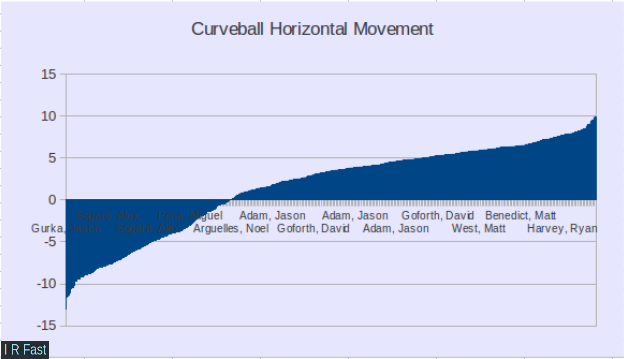
Ryan Harvey is a Rangers' 2012 18th round pick that, despite a large volume of walks, pitched relatively well in relief in A+. Vertically, we see that some curves, perhaps those of Mike Morin, were misidentified sliders.

Matt West shows up again, showing good movement both horizontally and vertically. West is another Rangers reliever, missing most of the last two seasons with injury. West shows up again when it comes to changeup movement:

When it comes to vertical movement, I am not entirely sure why some, with Kevin Vance's name appearing around some of them, have negative vertical movement:
Trevor May, the former highly rated Phillies prospect that was a part of the Ben Revere trade appears with Royals' Noel Arguelles, a high bonus pitcher that has struggled with command.

Wednesday, November 20, 2013

AFL Pitch F/X: Framing/Umpiring

Continuing the look at Pitch F/X data in the Arizona Fall League, I wanted to take a quick glance at one of the most popular subjects in Pitch F/X over the last two or three years, "framing". More specifically, I will look at the strike zone in the AFL, how pitches were called balls and strikes, and give the names of umpires and catchers on some of the more notable calls (I will not have a "framing leaderboard").

First, the following graph shows all the pitches that were called balls in the AFL games tracked by Pitch F/X. I excluded "Ball in the Dirt" tagged pitches because I assumed that they were easily called balls, though you will notice that some of these pitches still didn't make it to the plate.

There is one pitch that really stands out to me on that graph as far as being close to the middle and still called a ball. It was thrown by Will Lamb, a 2nd round pick in 2011 by the Rangers, and was received by Michael Ohlman of the Orioles' organization, who had a big offensive year, but spent most of the year as a DH. The home plate umpire was Jeff Morrow, who will be talked about later. To get a closer look at the pitches called balls, here are the pitches that were called balls in the traditional/simple strike zone:

A couple others stand out here. One was thrown by Mike Nesseth, a Phillies minor leaguer with low walk/strikeout rates, caught by Jake Lowery (Indians, a few 1st base and DH games), and called by Stu Scheurwater, a veteran minor league umpire whom I believe is in AA. Another was thrown by Brewers prospect Taylor Jungmann, caught by Adam Weisenburger, also of the Brewers, and called by Seth Buckminster.

By contrast, here are the pitches that were called strikes in the Pitch F/X games in the AFL:

We see typical lefty strike syndrome here, but I wanted to look at the pitches furthest from the strike zone on each corner, that is, the highest pitch called a strike, the pitch furthest to the left called a strike, etc.

The furthest one to right side of the zone (catcher's perspective), isn't that bad, thrown by Bo Schultz, caught by Dustin Garneau, and called by Marcus Pattillo:

Schultz is a 28 year old Diamondback minor leaguer who pitched in AA and AAA in 2013. While he showed some strikeout potential, he walked too many batters, especially for an older pitcher.

Garneau is a 26 year old that has reached AA for the Rockies. He hasn't been notable (either bad or good) with the bat, and despite a good CS %, seems to have a lot of passed balls. 2013 was the first year that he played anything other than catcher, playing 13 games at DH and 2 at first base.

Pattillo is a AA umpire in the Southern League, and umpired in the Venezuelan Winter League last season.

The furthest to the left is further outside, thrown by Noe Ramirez, caught by Jorge Alfaro, and called by Jeff Morrow:

Ramirez is a 23 year old Red Sox prospect that had good strikeout to walk rates in A+ and AA in 2013.

Alfaro is a 20 year old that is considered by some to be a top 100 prospect in baseball. The Rangers' affiliate has reached A+ and has been okay with the bat. 2013 contained a lot of passed balls and he played some first base and DH.

Morrow is a AAA umpire in the Pacific Coast League.

The highest pitch called a strike was thrown by Omar Duran, caught by Adrian Nieto, and called by Gabe Morales:

Duran is a 23 year old Athletics minor leaguer that spent most of the year in A+. While he struck out a lot of batters, he was also very wild.

Nieto is a 24 year old Nationals prospect that played all of 2013 in A+. He played 24 games at DH this season, but has yet to show any power.

Morales is a AAA umpire in the International League

The lowest pitch called for a strike was thrown by Anthony Ferrera, caught by Derrick Chung, and called by Seth Buckminister

Ferrera struggled with walks in 2013 with the Cardinals' AA affiliate.

Chung is a 25 year old with the Blue Jays that played in A+ in 2013. He has struggled with the bat and has played all over the diamond, including 22 games at 2nd base.

Buckminister is a AAA umpire in the International League. He umpired some spring training games in 2013 and famously broke his hand in one of the games.

I mentioned Jeff Morrow the umpire above in two separate games, so I thought it would be interesting to look at the two games as a whole and see how he did overall, and whether he has a quirky strikezone, or if his missed calls were just missed.

First, let's look at his October 11th games, starting with the called balls.


Other than the obvious one, it seems that there are pitches on every corner that could have been called strikes that Morrow elected to call balls. 

Here are his called strikes from that game:

You will notice, that is just the strike zone, nothing was called a strike that was out of the strike zone. So perhaps he just has a small zone. However, he did call that Ramirez pitch that was way out of the zone a strike on the 28th. To get more data, let's look at his game on the 28th, starting with the pitches he called a ball:

Here, it isn't every corner like the last game, but there appear to be at least 5 pitches on the right side of the strike zone that should have probably been called strikes, assuming that they were measured correctly by Pitch F/X.

Here are his called strikes:

Here, we see that his zone is small when it comes to top to bottom and even to the right, but he gave up a lot of the edge in what is normally the lefty strike zone, something he didn't do on the 11th.

Overall, I think Morrow seemed to fit in the general mold of the AFL home plate umpiring. He would give pitchers some room on the left, but for the most part, was more likely to call a pitch in the zone a ball than call a pitch outside of the zone a strike. This small zone may be why their were 4.17 walks per every 9 innings in the AFL, over half a walk per 9 innings over both AAA leagues in 2013.

Tuesday, November 19, 2013

2013 KBO Pitcher WAR Leaderboard

With KBO free agency (aside from the fates of Yoon Suk-Min and Oh Seung-hwan being decided) already over, it is a good time to look back at the 2013 season in the Korea Baseball Organization. I will start with pitchers, the subject of this post. All 194 pitchers that threw in the KBO this year have complete WAR numbers for the 2013 season in the spreadsheet below.

For replacement level (the R in WAR) I used the traditional .320 winning percentage (18 % worse than KBO 2013 league average), instead of the current ~.29 rate used by Fangraphs or Baseball Reference. This is for no particular reason. I have no idea what a random veteran player in the Futures League is worth in the KBO. As you will see, I used three different versions of WAR for comparison, one based on runs per nine innings allowed (replacement rate was .69 per inning), one based on earned run average (.62 was replacement level), and one based on fielding independent pitching (.58). Then, using runs per 9 innings (which I labelled RPG), I created two different measurements instead of replacement level. The first is average, or WAA. The second is what I labelled as WAFP, meaning Wins over Foreign Pitcher. Foreign Pitchers gave up .5 runs per inning in 2013 in the KBO on a whole, and I thought it would be interesting to compare each pitcher to how you expect an average foreign pitcher to perform in the KBO.

The below spreadsheet are the WAR results for each pitcher in 2013. The sheet is sorted by RPG WAR, but you should be able to copy and paste the data in a spreadsheet, and sort it by whichever metric you want. The basic data (including the foreign pitcher data) and names are taken from MyKBO.net, while the league average rates (adjusted to replacement level by me) were taken from Naver.


 If you have any questions or concerns about methodology (or even the results), please feel free to leave a comment below. 

Sunday, November 17, 2013

2013 AFL Pitch F/X Data: Velocity

In the previous post, I look at the locations of pitches in the Arizona Fall League. In this one, I wanted to continue to look at the data of the 110 pitchers by focusing on velocity. First, here is a graph that breaks down both the pitch selection (by percentage) and average velocity of all pitch types thrown in the Pitch F/X games in the Arizona Fall League:

For comparison, here is the MLB averages according to FanGraphs in 2013:


There were no knuckleballs, knucklecurves, screwballs, eephus, or forkballs thrown in the AFL according to the MLBAM tags. FanGraphs has also kept the old fastball label (FA) instead of moving to the FF. The FAs in the AFL are most likely errors.

While changeups are very slightly slower in the AFL (.03 MPH), they were actually used more frequently in the AFL, which I found surprisingly. Curves were thrown at the same velocity, but less frequently in the AFL, and there were less cutters and sliders as well. It appears that there was a higher volume of four seam fastballs, though they were thrown at half a MPH slower.

What about individual pitchers? Who were some of the hardest throwers in the AFL? Here are the fastest 50 pitches in the AFL tracked by Pitch F/X in 2013:

The fastest 27 pitches were either thrown by Keone Kela or Ken Giles. Giles was a 7th round draft pick in 2011 by the Phillies, and the right-hander has been almost exclusively a reliever in his minor league career and he hasn't yet reached AA. He has struggled with walks, but has put up gaudy strikeout numbers. Kela has been profiled on the blog before, but his 2013 season only contained 39 innings over three different levels (though his strikeout rate was great). Juan Jaime had the only two pitches out of the top 39 fastballs not thrown by Kela or Giles. Jaime is already 26, and the Braves' right-hander has struggled to put a full season together, just making AA in 2013. He had high walk and strikeout numbers.

How about the slowest 50 pitches in the AFL?


Kevin Vance and his slow curve had a good year in AA for the White Sox out of the bullpen, and he has racked up plenty of strikeouts. Mike Morin also had several of the slowest pitches in the AFL, and he is coming off of a great year in the Angels system with an ERA under two and reaching AA.

Of course, we haven't looked at individual pitch types yet, so broken down by pitch type, MLBAM tags, here are the fastest individual pitches per each type:


Lendy Castillo reached the Majors with the Cubs in 2012, but struggled. In 2013, he actually spent most of the year in the lower minors and struggled there as well. Adys Portillo doesn't turn 22 until December, but is coming off a lost year with just 3 appearances (just starts) in A-ball. Shawn Armstrong, an 18th round pick by the Indians, had a tremendous year in 2012, but spending most of 2013 in AA, had a very mediocre year by ERA because of walks, but he continued to strikeout batters. Matt Heidenreich was acquired by the Astros in the Brett Myers trade, but had a horrendous 2013. Alex Meyer is one of the top pitching prospects in baseball, but had a shortened year in AA.

The slowest pitches by each type:

I think there are some Pitch F/X errors here, and it seems to have mistreated Miguel Pena of the Red Sox. However, scouting reports have described him as a pitchability guy with a fastball mainly in the 80s, so perhaps these low readings aren't unbelievable.

While we haven't looked at results or hitters yet (I plan on taking a deeper look later), I thought it would be interesting to see whether or not there was a correlation between faster fastballs and success in the AFL, like we see in basically every level of play.

Not surprisingly, the harder the fastball, the more likely it is to be a whiff, and the softer, the more likely it turns into a run scoring play (though the out versus no out distinction is fuzzy at best).

What about pitches on the whole, regardless of classification? One would expect that younger hitters would struggle with slower pitches, fooled by breaking balls, and hitting fastballs better. It turns out, this is the case for the most part:

Batted ball results don't make as much sense as they do with the fastballs, but the pattern is clear. Batters were more likely to hit faster pitches, or at least, fastballs over breaking balls and offspeed pitches.

Saturday, November 16, 2013

2013 AFL Pitch F/X Data: Location

There were approximately 8856 pitches by 110 pitchers correctly and fully tracked by Pitch F/X in the Arizona Fall League  in 2013. On the blog, I would like to look at all the pitches as a whole, along with some individual hitters and pitchers. This is the first post in the hopeful series. First, I wanted to look at how pitches were located by individual pitchers. So the following picture (click to enlarge) is the average location of all the pitches thrown by each pitcher. The entire graph is the strikezone:

I thought it would be helpful to highlight some of the more extreme pitchers. Cam Bedrosian and Omar Duran were the most extreme high ball pitchers. Duran is a 23 year old lefty reliever in the A's organization with extremely high strikeout rates in the lower levels. He has also been extremely hard to hit home runs off of. Bedrosian was a 1st round pick by the Angels in 2010, but statistically, he has really struggled with walks, despite an okay strikeout rate and a low home run rate. John Stilson was an extreme low ball pitcher in the AFL, and he has been mostly successful in the Blue Jays' system out of Texas A&M since being drafted in 2012 as both a starter and a reliever. Yankees left-hander Fred Lewis was also an extreme low ball pitcher in the AFL and the 26 year old former 47th rounder has had low home run rates along with good strikeout rates in the minors.

Lefty Jarret Martin was an extreme arm side pitcher in the AFL, and he has really struggled with walks in his career, currently with the Dodgers after being drafted twice by the Orioles. Chris Bassitt, a 6-5 24 year old with the White Sox, was an extreme arm side pitcher as a right-hander. He is coming off a strong season where he pitched well in his first taste of AA. Two pitchers that stand out as being pitchers that throw the ball slightly below the middle of the strike zone on average, along with pitching both sides of the plate equally, are Vidal Nuno and Chad Rogers. Nuno is a control specialist that had some success with the Yankees this year while Rogers is a former 28th round pick in 2010 by the Reds. The undersized right-hander was a full time starter in the upper minors for the Reds in 2013 and had a solid year, despite not having flashy peripherals.

Since we are talking about mostly young pitchers trying to refine their stuff and command and make it to the Majors, I thought it might be at least interesting to look at the wildest pitches thrown in the AFL out of the ones tracked by Pitch F/X. I broke the wildest pitches into two graphs, fastballs versus non-fastballs (using MLBAM tags). Then for each graph, I looked at the pitch furthest to the left, the right, and highest and lowest. Here are the "wildest" (not counting intentional balls) fastballs, labelled with actual MLBAM tag:

It is no surprise that Omar Duran had the highest thrown fastball because of what we saw with the first graph. Angel Baez is a 22 year old Royals right-hander that really struggled with command in 8 A+ starts this year. He does have some strikeout potential, but has really failed to put a lot of innings together. Couch is a 24 year old right-hander in the Red Sox system that is actually a control specialist, with not a lot of walks in his career, but not a high strikeout rate either. Ferrara is a left-handed pitcher that really struggled with walks and homers in his first full year in AA.

How about non fastballs?

Simon actually had the two wildest curves to the left. The Phillies' reliever's problem was walks in AA in 2013, it was a lack of strikeouts. Cravy, showing up twice with two different pitches in the graph, was dominant as a reliever in A+ for the Brewers, and if there is a problem, it is strikeouts, not walks. Ramirez, with the Red Sox A+ and AA, was also very good, with no such question about strikeouts for the former 4th round pick.

In general, here were the average pitch locations, regardless of handedness, of each pitch type in the AFL in Pitch F/X games in 2013:


Thursday, November 14, 2013

Michihiro Ogasawara Scouting Report

In the most recent list of players who have exercised their free agent options in the NPB, an interesting name popped up: Michihiro Ogasawara. Ogasawara is a 40 year old left-handed infielder that has spent the last seven years with the Yomuiri Giants, but has played in just 56 Ichi-Gun games over the last two seasons, yet he has not exercised his domestic free agent option, but his international free agent option, meaning he must be looking to come to the United States or play in a different league.

Statistically, Ogasawara was a very interesting NPB player for quite some time, posting an OPS of at least .900 each season from 2000-2010, playing in at least 100 games each year (and at least 130 in all but one). He has hit 377 homers in the NPB, and had an OBP over .400 from 2000-2004 (.389 for his career). However, the drop off was sudden and dramatic. In 83 games in 2011, Ogasawara's walk rate dropped to 8.6 % (from his career rate of 11.1 %) and his strikeout rate jumped to 21 % (from 15.98 % for his career). His power was sapped as well, as his slugging rate dropped to .338, poor for even the run starved environment of the NPB's 2011-2012 seasons. In 99 plate appearances in 2012, he hit a hilarious .152/.194/.185 and was given just 40 plate appearances in 2013.

Ogasawara had 100 plate appearances in the Ni-Gun in 2013, and he was below average at getting hits, extra base hits, walks, and strikeout too much. Statistically, Ogasawara looks done. He has moved from mainly 3rd base to exclusively 1st base, and he has never really been a stolen base threat, which has only been exasperated over the past couple of years (no stolen bases over the last two years in the Ichi-gun, no stolen bases in the Ni-gun this year). So all the value comes out of his bat, something that has disappeared over the past three years.

Since he is a free agent, it doesn't make sense to look back at what he was, but instead, who he is now.  Here is Ogasawara's only NPB homer in the last two years

The pitch doesn't appear to be especially fast, but he does an okay job of getting around on a pitch up and in despite the crazy hand positioning and the weird way he holds his bat. The bat path is smooth, and apparently the speed works, but he doesn't look like a prototypical power hitter. It makes me wonder where he generated his power from when he was a big time NPB home run hitter.

Here is another 2013 swing, where he apparently thinks he hit a homer, but actually makes an out:

The pitch is more on the outside part of the plate, and about 89 MPH. He pulls it with some authority, but I do find the fact that he flips the bat like it is a homer, only to see that it is not. I don't want to read too much into it, but he has nearly 400 career homers, you would think he would know when he has homered. The power is clearly not what it used to be, and we can judge that by statistics.

I really can't see him making an impact or even an attractive option for teams outside the NPB. He doesn't appear to have a quirk, like Shunsuke Watanabe, that may make him attractive as a part time player. At one time, he would have made sense for MLB teams since he had real power, but those days are gone.

Tuesday, November 12, 2013

Fighters Sign Michael Crotta

Michael Crotta signed with the Nippon Ham Fighters in the NPB for equivalent of $500,000. A 6'6 30 year old right-handed pitcher, Crotta pitched in the Major Leagues in 2011 for the Pittsburgh Pirates, the team that drafted him in the 17th round in 2006 out of Florida Atlantic University. The short stint didn't go very well, as he gave up 11 runs in 10.2 innings. He then didn't pitch at all in 2012 thanks to a terrible elbow injury.

Crotta spent the entire 2013 season on the Nationals' AAA team, pitching only in relief and statistically, not a whole lot stands out. He had a 3.57 ERA, with a 17.2 strikeout percentage and walk percentage of nearly 10 percent. However, I thought it was worth looking further to see what the Fighters might see in Crotta.

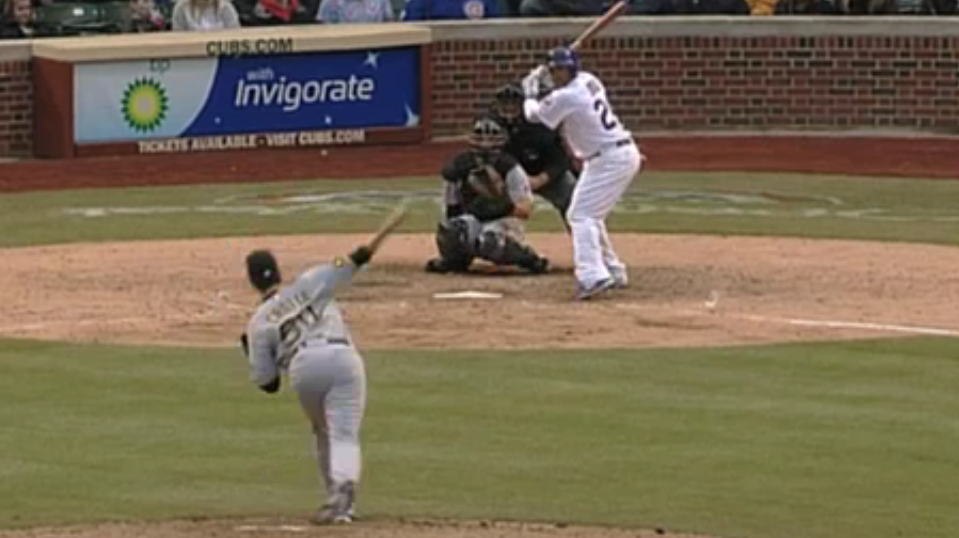
Despite the injury, his delivery has remained virtually the same. Here is a look at what his delivery looked like in 2010:


And here was his release point in 2011:


 Here is what his delivery looked like in 2013:

And his 2013 release point:


The Lehigh Valley gun on MiLB.tv tends to be slow, but I checked the last time he pitched at the park (one of the few MiLB broadcasts with on screen radar guns) and Crotta was throwing 95 MPH with some armside tail. He occasionally kept it high, but would really bust in on a right-hander's bat, seeming to use the two seam like Japanese pitches often use the two seam, trying to get inside rather than throwing it to opposite platoon batters to keep it outside. He can get occasional sink glove side as well and didn't give up a homer all year, so it doesn't seem that staying over the middle of the plate was a problem. He was up to 96, with very consistent velocity, throwing mostly 94 the next inning.

The other pitch Crotta showed was a 84-85 MPH slider. He perhaps had some problem getting on top of it, with mostly downward movement. It was mainly used against lefties, against an occasional righty (though it stayed arm side). It did not appear to be a splitter or change and didn't appear to be a very good pitch. Against impatient hitters when he gets it somewhat down it can be a groundball pitch.

In the Majors, Crotta didn't throw near as hard, averaging under 93 MPH. The MLBAM tags and the Pitch Info tags disagreed whether he threw mainly sinkers or mainly four seamers, but they agreed that he threw a slider as his main breaking pitch and just one changeup. I definitely saw two different fastballs in my short look, but I would probably label them two seamer and sinker.

In my previous article I looked at how NPB teams targeted height and velocity, and the Fighters were above average at possessing both. Crotta is a great example of a guy possessing both, almost at an extreme. 

You do wonder if he is going to miss enough bats to be a successful back of the bullpen pitcher in the NPB, where getting strikeouts can be difficult. The track record and breaking pitch do not suggest he will rack up many strikeouts, but the fastball velocity might. If he can work a little higher in the zone, and still throw 94-96 MPH, he will get plenty of swings and misses.