Another injury riddled and roster moved filled two weeks for the Free Agent Fantasy Team:
Grilli, Slowey and Bogusevic all went to the DL and were placed on the Inactive team. Luis Cruz also went to the DL, but I just released him because I didn't want to use a minor league roster spot to keep him around.
Thomas Neal was brought up to big league team, but then went back down. I obviously updated his stats, but he stays on inactive team. Loney did go on paternity leave, but came back, so no roster move.
Melky Cabrera was activated off the DL and went to big league team. I also signed Humberto Quintero, who signed a big league contract with the Mariners, to get my big league roster up to 21. Since we are about 104 games into the season, he will make $171,852. I released Bobby Wilson from my minor league team to make room, as he wasn't hitting in AAA and I have plenty of catching depth now, with 3 on the big league team and Kelly Shoppach still on the minor league team. I also released Clay Rapada to put my inactive team back at 15.
Assuming 104 games played:
16.1 fWAR, 46.7 wins, 57.3 losses
16.2 rWAR, 46.8 wins, 57.2 losses
13 WARP, 46.3 wins, 57.7 losses
-2.9 WAA, 49.1 wins, 54.9 losses
The three replacement level metrics are the closest they have been all year, unifying as the wheels have absolutely fallen off of my team.
Showing posts with label Kevin Slowey. Show all posts
Showing posts with label Kevin Slowey. Show all posts
Sunday, July 28, 2013


Sunday, June 16, 2013
Free Agent Fantasy Team Update: Kevin Gregg's Success as a Cub
This week's Free Agent Fantasy Team Update contains a lot of roster moves:
Rick Ankiel was DFA'd and then released by Mets, so he is released from my team. I had missed that Dewayne Wise was on the DL, so I moved him to the inactive part of my roster. John Lannan will be back with the the Phillies to start on Monday, so I am putting him back on the big league roster. Shawn Camp was activated from the DL as well, so he moves to the active part of my roster. Thomas Neal was recalled by the Yankees, so he also moves from the minors/inactive part of the roster to the MLB part of the roster. Assuming that he is making league minimum, he is now owed $284,000. Chien Wang was also signed by Blue Jays, so I signed him to big league roster. He will also be owed 284,000 dollars. This puts my payroll at about 100.5 million dollars for the season. This also puts my big league roster at a full 24. It also means I had 2 spots open for my minor league/inactive team, so I signed J.C. Romero and Clay Rapada relievers who signed MiLB contracts in the past couple of weeks. Apparently Travis Ishikawa has exercised his opt-out clause, but that will probably take a couple of days to play itself out, so I am going to keep him on the inactive part of the roster as there was no update at the time of publishing. Now, let's see how my team is doing:
Since about 70 games have been played this season:
12.4 fWAR, 32.98 wins and 37.02 losses
13 rWAR, 33.58 wins and 36.42 losses
10.5 WARP, 32.9 wins and 37.1 losses
.4 WAA, 35.4 wins and 34.6 losses
So the three WARs have congregated to about as close as they have been all year. WAA continues to be the one that rates my team the highest, and I am only above .500 according to that measure.
Since all the roster moves made the post long, I just wanted to take a quick look at why Kevin Gregg may be having more success. My guess was location (as his 2013 stuff is nothing special), so here is his average locations from 2012 and 2013:
 He is keeping the ball lower on average this year, which could really play a role in his success so far. Let's break it down by pitch (MLBAM tags). 2012:


Rick Ankiel was DFA'd and then released by Mets, so he is released from my team. I had missed that Dewayne Wise was on the DL, so I moved him to the inactive part of my roster. John Lannan will be back with the the Phillies to start on Monday, so I am putting him back on the big league roster. Shawn Camp was activated from the DL as well, so he moves to the active part of my roster. Thomas Neal was recalled by the Yankees, so he also moves from the minors/inactive part of the roster to the MLB part of the roster. Assuming that he is making league minimum, he is now owed $284,000. Chien Wang was also signed by Blue Jays, so I signed him to big league roster. He will also be owed 284,000 dollars. This puts my payroll at about 100.5 million dollars for the season. This also puts my big league roster at a full 24. It also means I had 2 spots open for my minor league/inactive team, so I signed J.C. Romero and Clay Rapada relievers who signed MiLB contracts in the past couple of weeks. Apparently Travis Ishikawa has exercised his opt-out clause, but that will probably take a couple of days to play itself out, so I am going to keep him on the inactive part of the roster as there was no update at the time of publishing. Now, let's see how my team is doing:
Since about 70 games have been played this season:
12.4 fWAR, 32.98 wins and 37.02 losses
13 rWAR, 33.58 wins and 36.42 losses
10.5 WARP, 32.9 wins and 37.1 losses
.4 WAA, 35.4 wins and 34.6 losses
So the three WARs have congregated to about as close as they have been all year. WAA continues to be the one that rates my team the highest, and I am only above .500 according to that measure.
Since all the roster moves made the post long, I just wanted to take a quick look at why Kevin Gregg may be having more success. My guess was location (as his 2013 stuff is nothing special), so here is his average locations from 2012 and 2013:


2013:
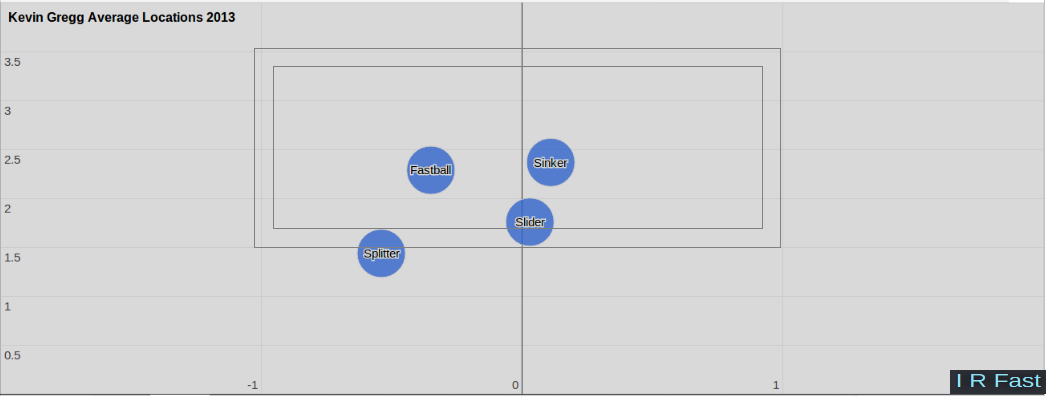
The fastball is clearly more arm side, rather than in the middle of the plate, while his sinker is more glove side. He is also locating the slider and splitter lower in the zone, which, along with moving to the NL Central from the AL East, is probably playing a big role in his success so far with the Cubs.
Sunday, May 5, 2013
Free Agent Fantasy Team: A Look at Kevin Slowey
At Fantasy CPR, I had been updating my all free agent fantasy team, but at the request of the editor, I will start updating it here instead. Instead of posting every week and going up on Monday, I'll post it just every two weeks (along with some notes, usually a pitch f/x look at one of the players), and post it on Sunday. If you aren't familiar with the idea, here is the original post.
First, Roster Moves for the week:
Randy Wells, who was in my minor league system, retired, so he moves to the released bin. In his place, I signed Roy Oswalt, whom the Rockies signed to a minor league deal. Evidently he can make up to 4 million dollars if he hits all of his intensives, but for now, I'll just classify it as a MiLB contract until we know the actual numbers (and he is promoted to the Majors). Here is a look at the team with updated WAR numbers:
Since most teams in the Majors have played about 30 games, here is how my team is doing:
3.2 WARP, 12.8 wins to 17.2 losses
3.3 fWAR, 12.12 wins to 17.88 losses
5.5 rWAR, 14.32 wins to 15.68 losses
.1 WAA, 15.1 wins to 14.9 losses
Clearly, some guys are turning a corner, and the team is looking a little better because of it. As much press as Jeff Keppinger is getting for his horrible start, Maicer Izturis has been just as bad. One of my favorite stories of the team so far (other than James Loney's unsustainable start and getting any value out of Kevin Gregg, who I used as a roster filler) is Kevin Slowey. Slowey had a pretty poor year with the Twins in 2011, and then was traded twice in the following off-season, pitching in AAA and then going on the DL for the rest of the 2012 season. The Marlins signed him to a MiLB deal, and he has pitched quite nicely so far this year, with a 80 FIP - and 3.55 kwERA. He has done it in typical Slowey fashion, not striking out many hitters and walking very few. The big difference is the home run rate. Statistically, that is going to take longer to stabilize than strikeout and walk rates (which are about career average for Slowey right now). However he does seem to be getting a little bit softer contact.
From 2007-2011, the average batted ball Kevin Slowey gave up (non-bunts, no minimum distance, according to baseball heatmaps) went 203.872 feet. So far in 2013, it is going 194.312 feet.
Here is his spray chart against in 2011 at home (via katron.org):

Here it is in 2013 (remember that all distances and spray charts are where the ball ends up):

The biggest difference I see is that he is giving up less power to right field. This is a little odd, because he is pitching mostly glove side this season (in number form, 325 pitches on the glove side of the plate and 242 pitches on the arm side of the plate), where you would expect balls to go to right field (pulled by lefties or the other way by righties):

So what are some things that might tell us why he is having this success pitching glove side? For one, Slowey is standing more upright in his delivery than he ever has.
Here is his release point so far in 2013:

Here is his release point in previous years (each point is a pitch and a year, data taken from Brooks Baseball):

His average before 2013 was about 5.88 vertically and -2.16 horizontally. This year, it is -2.06 horizontally (basically the same), but 6.12 vertically. Zack Greinke and Esmil Rogers are his new closest comparisons, while Chan Ho Park was his previous closest comparison. While Park's delivery was actually good and prototypical, the Rogers and Greinke comparisons are more desirable obviously. However, while it may explain some general success (a more upright delivery is better), it doesn't help explain the glove side success, as both Rogers and Greinke are more arm side pitchers in the strike zone than glove side pitchers (using Brooks Baseball's frequency maps, Park was actually more of a glove side pitcher). I think the main thing for Slowey is that he likes to keep the ball away, which you see when you look at pitches thrown just to left-handed hitters (114 glove side pitches, 144 arm side pitches):

I put the little box in the up and in corner to left-handed hitters to illustrate the point that he is avoiding the part of the strike zone to lefties where they can easily pull a ball for a homer, especially since Slowey has a below average fastball in velocity. Historically, Slowey has thrown pitches in that corner about 5.1% of the time, which is more than a normal right-handed pitcher would throw up there (based on Brooks' maps again). Against lefties, he has thrown a pitcher up there a little less, at 4.3 %, but that is much higher than a normal right-handed pitcher will throw it there against a lefty. From my count (looking at just the data itself), he has thrown just 8 in that highlighted zone (.5 to 1 horizontally and 2.5 to 3.5 vertically) against lefties, which is less than 3.1 percent of his pitches against lefties. Perhaps if he is able to keep this up, that is, throwing away and keeping it out of hitters happy zones, he will be able to limit home runs and be a somewhat better pitcher than he was before (especially if he can keep his strikeout and walk rates the same and continue keeping the ball away).
First, Roster Moves for the week:
Randy Wells, who was in my minor league system, retired, so he moves to the released bin. In his place, I signed Roy Oswalt, whom the Rockies signed to a minor league deal. Evidently he can make up to 4 million dollars if he hits all of his intensives, but for now, I'll just classify it as a MiLB contract until we know the actual numbers (and he is promoted to the Majors). Here is a look at the team with updated WAR numbers:
Since most teams in the Majors have played about 30 games, here is how my team is doing:
3.2 WARP, 12.8 wins to 17.2 losses
3.3 fWAR, 12.12 wins to 17.88 losses
5.5 rWAR, 14.32 wins to 15.68 losses
.1 WAA, 15.1 wins to 14.9 losses
Clearly, some guys are turning a corner, and the team is looking a little better because of it. As much press as Jeff Keppinger is getting for his horrible start, Maicer Izturis has been just as bad. One of my favorite stories of the team so far (other than James Loney's unsustainable start and getting any value out of Kevin Gregg, who I used as a roster filler) is Kevin Slowey. Slowey had a pretty poor year with the Twins in 2011, and then was traded twice in the following off-season, pitching in AAA and then going on the DL for the rest of the 2012 season. The Marlins signed him to a MiLB deal, and he has pitched quite nicely so far this year, with a 80 FIP - and 3.55 kwERA. He has done it in typical Slowey fashion, not striking out many hitters and walking very few. The big difference is the home run rate. Statistically, that is going to take longer to stabilize than strikeout and walk rates (which are about career average for Slowey right now). However he does seem to be getting a little bit softer contact.
From 2007-2011, the average batted ball Kevin Slowey gave up (non-bunts, no minimum distance, according to baseball heatmaps) went 203.872 feet. So far in 2013, it is going 194.312 feet.
Here is his spray chart against in 2011 at home (via katron.org):

Here it is in 2013 (remember that all distances and spray charts are where the ball ends up):

The biggest difference I see is that he is giving up less power to right field. This is a little odd, because he is pitching mostly glove side this season (in number form, 325 pitches on the glove side of the plate and 242 pitches on the arm side of the plate), where you would expect balls to go to right field (pulled by lefties or the other way by righties):

So what are some things that might tell us why he is having this success pitching glove side? For one, Slowey is standing more upright in his delivery than he ever has.
Here is his release point so far in 2013:

Here is his release point in previous years (each point is a pitch and a year, data taken from Brooks Baseball):

His average before 2013 was about 5.88 vertically and -2.16 horizontally. This year, it is -2.06 horizontally (basically the same), but 6.12 vertically. Zack Greinke and Esmil Rogers are his new closest comparisons, while Chan Ho Park was his previous closest comparison. While Park's delivery was actually good and prototypical, the Rogers and Greinke comparisons are more desirable obviously. However, while it may explain some general success (a more upright delivery is better), it doesn't help explain the glove side success, as both Rogers and Greinke are more arm side pitchers in the strike zone than glove side pitchers (using Brooks Baseball's frequency maps, Park was actually more of a glove side pitcher). I think the main thing for Slowey is that he likes to keep the ball away, which you see when you look at pitches thrown just to left-handed hitters (114 glove side pitches, 144 arm side pitches):

I put the little box in the up and in corner to left-handed hitters to illustrate the point that he is avoiding the part of the strike zone to lefties where they can easily pull a ball for a homer, especially since Slowey has a below average fastball in velocity. Historically, Slowey has thrown pitches in that corner about 5.1% of the time, which is more than a normal right-handed pitcher would throw up there (based on Brooks' maps again). Against lefties, he has thrown a pitcher up there a little less, at 4.3 %, but that is much higher than a normal right-handed pitcher will throw it there against a lefty. From my count (looking at just the data itself), he has thrown just 8 in that highlighted zone (.5 to 1 horizontally and 2.5 to 3.5 vertically) against lefties, which is less than 3.1 percent of his pitches against lefties. Perhaps if he is able to keep this up, that is, throwing away and keeping it out of hitters happy zones, he will be able to limit home runs and be a somewhat better pitcher than he was before (especially if he can keep his strikeout and walk rates the same and continue keeping the ball away).
Saturday, December 8, 2012
Brendan Lafferty: Rule 5 Scouting Report
The Phillies took Brendan Lafferty in the AAA part of the Rule 5 draft from the Royals. Lafferty was originally a 47th round pick by the Phillies in 2004, but decided to go to UCLA instead. After 4 years as a mediocre (statistically) reliever, the Royals took him in the 18th round in 2009. He has basically only been a reliever in the minors and the 26 year old pitched the whole year in AA (so he is old for the level).
Lafferty's Pitch F/X data comes from the Arizona Fall League in 2011.
Known for his fastball, it averaged over 94 MPH, along with a lot of sinkers (averaging between 93-94 MPH) and sliders (83.58 MPH average). He also threw a reasonable number of changeups that average just under 80 MPH. When you look at other relievers with similar fastballs, his changeup is much slower than most relievers who throw that hard (which made looking for velocity and pitch comparisons basically impossible). So even though he is not known to have good secondary stuff, he at least throws it a lot. He is somewhat of a sinker/slider guy, but the fastball and change at least gives him some other weapons. Statistically, he doesn't act like a sinker/slider pitcher either. He had a good strikeout rate (25.5 %) with a gigantic walk rate (14.4%) with a mediocre ground-ball rate (and high home run rate) in 2012. He pitched in an extreme hitters park in 2012, but actually gave up more homers on the road.
He also threw strikes under 60% of the time in 2012. 60% is usually considered a magic number that virtually every successful Major League pitcher surpasses (with very few, such as Cliff Lee and Kevin Slowey throwing 70% or near). So, if one is trying to put Lafferty in a category, it is impossible to put him into the sinker/slider category (and is hard to put him in the advanced older pitcher category as well), and instead he falls under the wild/hard throwing lefty.
He has a better K/BB against lefties, along with a better GB %, but his home run rate is higher against righties. This seems to be more of a fluky HR/FB % issue than an actually telling us about his skill set (there are always some issues with reliever splits and sample sizes, even when looking at multiple seasons. Lafferty giving up more homers to lefties doesn't jive a lot with the rest of the information we have).
Lefties that throw hard are always interesting and usually valuable, but the age obviously limits his ceiling. He has the good strikeout rate but Lafferty obviously has a lot of other issues. His delivery is somewhat hard to watch, as he brings his leg up rather high and pauses in the middle of his delivery. His arm slot then seems to not follow his delivery, as he moves his body like he is going to come over the top, only to come what you would probably call 3/4ths. He has good size at 6-3, but it doesn't appear that he is using the size to his advantage and actually looks like he is working against his body while pitching. In much of the video I watched of Lafferty, he was keeping the ball low, but had all kinds of problems with basic command/control. With his velocity and mix of pitches, he shouldn't be giving up homers if he is keeping the ball low. While there is no real way to quantify whether or not he is keeping the ball low (there are technically several ways, but none without flaws such as relying on selection bias, possibly bad stringer data in AA, or just looking at ground-ball rate), it seems safe to assume that a pitcher that throws a sinker at least a quarter of the time but has a 1.34 HR/9IP is not keeping the ball low. I wholly expect that the Phillies are taking a chance on left-handed velocity and will most likely tinker with his delivery in either AA or AAA.
Lafferty's Pitch F/X data comes from the Arizona Fall League in 2011.
Known for his fastball, it averaged over 94 MPH, along with a lot of sinkers (averaging between 93-94 MPH) and sliders (83.58 MPH average). He also threw a reasonable number of changeups that average just under 80 MPH. When you look at other relievers with similar fastballs, his changeup is much slower than most relievers who throw that hard (which made looking for velocity and pitch comparisons basically impossible). So even though he is not known to have good secondary stuff, he at least throws it a lot. He is somewhat of a sinker/slider guy, but the fastball and change at least gives him some other weapons. Statistically, he doesn't act like a sinker/slider pitcher either. He had a good strikeout rate (25.5 %) with a gigantic walk rate (14.4%) with a mediocre ground-ball rate (and high home run rate) in 2012. He pitched in an extreme hitters park in 2012, but actually gave up more homers on the road.
He also threw strikes under 60% of the time in 2012. 60% is usually considered a magic number that virtually every successful Major League pitcher surpasses (with very few, such as Cliff Lee and Kevin Slowey throwing 70% or near). So, if one is trying to put Lafferty in a category, it is impossible to put him into the sinker/slider category (and is hard to put him in the advanced older pitcher category as well), and instead he falls under the wild/hard throwing lefty.
He has a better K/BB against lefties, along with a better GB %, but his home run rate is higher against righties. This seems to be more of a fluky HR/FB % issue than an actually telling us about his skill set (there are always some issues with reliever splits and sample sizes, even when looking at multiple seasons. Lafferty giving up more homers to lefties doesn't jive a lot with the rest of the information we have).
Lefties that throw hard are always interesting and usually valuable, but the age obviously limits his ceiling. He has the good strikeout rate but Lafferty obviously has a lot of other issues. His delivery is somewhat hard to watch, as he brings his leg up rather high and pauses in the middle of his delivery. His arm slot then seems to not follow his delivery, as he moves his body like he is going to come over the top, only to come what you would probably call 3/4ths. He has good size at 6-3, but it doesn't appear that he is using the size to his advantage and actually looks like he is working against his body while pitching. In much of the video I watched of Lafferty, he was keeping the ball low, but had all kinds of problems with basic command/control. With his velocity and mix of pitches, he shouldn't be giving up homers if he is keeping the ball low. While there is no real way to quantify whether or not he is keeping the ball low (there are technically several ways, but none without flaws such as relying on selection bias, possibly bad stringer data in AA, or just looking at ground-ball rate), it seems safe to assume that a pitcher that throws a sinker at least a quarter of the time but has a 1.34 HR/9IP is not keeping the ball low. I wholly expect that the Phillies are taking a chance on left-handed velocity and will most likely tinker with his delivery in either AA or AAA.
Thursday, September 22, 2011
Behind the horrific season Kevin Slowey is having
Perhaps I am just a sadist, but I find a horrifically ugly season interesting and entertaining. Horrific and ugly are two words that quickly come to mind when assessing Twins starting pitcher Kevin Slowey's 2011 season. The bizarre thing is that Slowey has had moderate success in the Majors before this year. In 08, he put together a 3.99 ERA, 1.154 WHIP, and a ratio of over 5 strikeouts per walk. Last season, his stats weren't quite as good, but very formidable (2.3 WAR in 08, .8 WAR last season). This year, his numbers look something like this. 0-7 (I put very little stock in pitching records), 6.54 ERA, 1.360 WHIP (not awful, and I will show you why his WHIP isn't bad in a second), a -.4 WAR, and a WASP of 6480. What went wrong? Well, it appears that Slowey's problems with the longball have finally caught up with him. His 1.5 homers allowed per 9 innings is about standard for his career and is way too high. He doesn't walk hardly anyone (averaging just .8 walks per 9 innings, an amazing number), but perhaps that is the problem. The stats seem to show he is not throwing it out of the zone at all. He has thrown 70 percent of his pitches for strikes, while the artist of quality strike throwing, Cliff Lee, is throwing 69 percent of his pitches for strikes. It is pretty easy to claim that Slowey has neither the stuff or control to live in the strike zone as much as Lee does. His batting average against is .303 and .321 on balls put in play. That means that either he is extremely unlucky or is getting the ball hit hard off him. The Twins have not been good on defense all year, and statistics seem to show that Slowey may be just unlucky this season, as his FIP (fielder independent ERA) is 4.49 (which is still a career high). Also, what was fly balls in previous years for Slowey, have turned into line drives (a career low in fly ball percentage, and career high in line drive percentage). Another thing that may hurt the "he is unlucky case" is that he hasn't even given up an infield hit. Slowey's curveball is being hit unlike its ever been hit before as Fangraphs notes that his curveball has given up 4.1 more runs than an average curveball. Is Slowey experiencing bad luck on a bad team? Sure, but he is not exactly Cy Young either.
Subscribe to:
Posts (Atom)