Wednesday, October 16, 2013

Hanshin Tigers Pitcher Deliveries

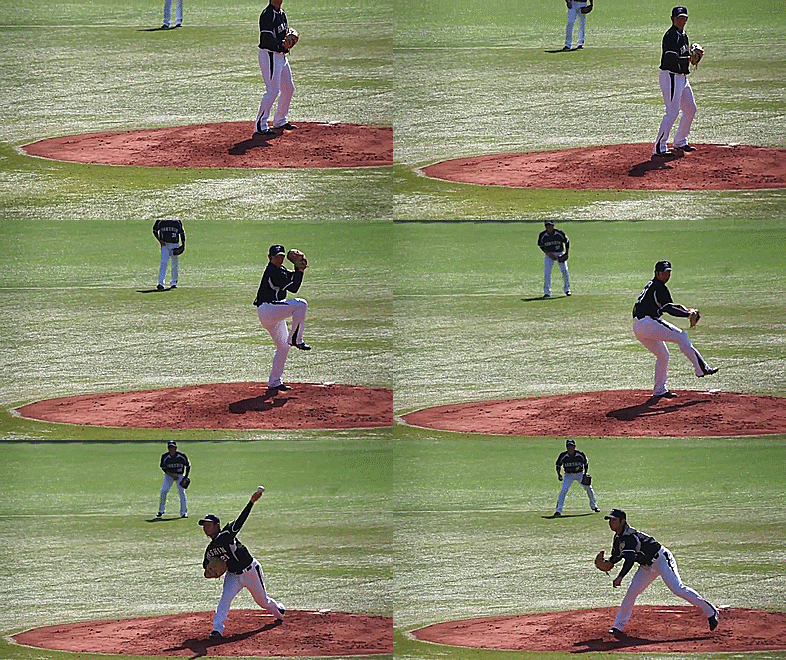
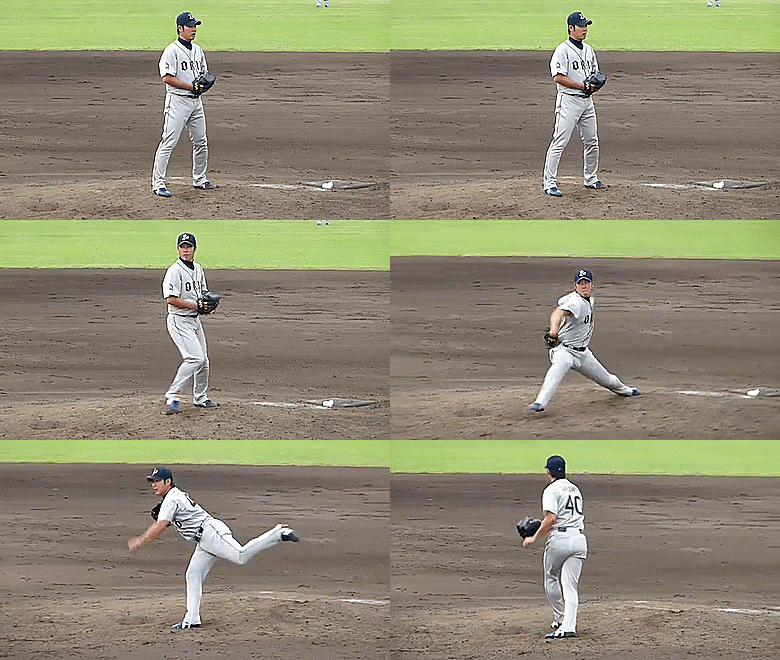
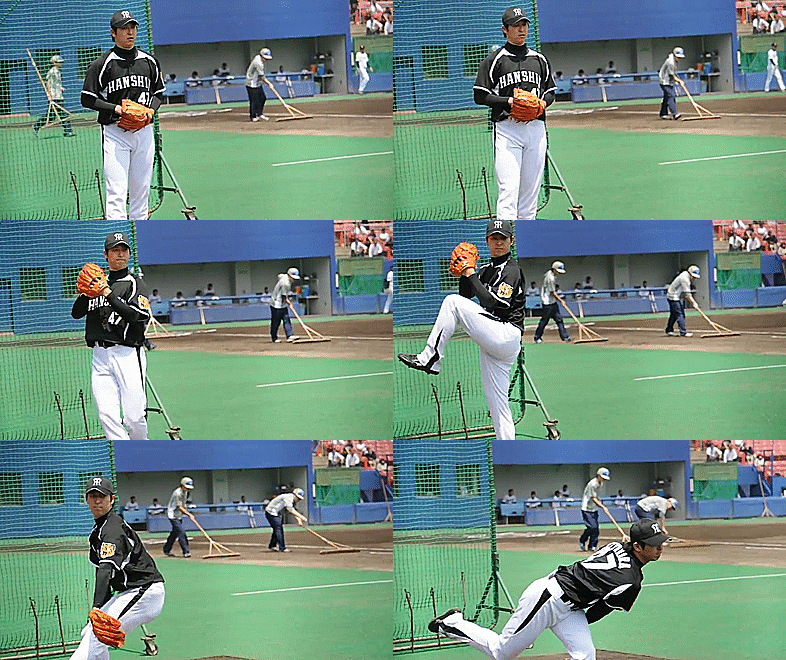
Continuing our look at the deliveries of NPB pitchers, the following are the deliveries of the Hanshin Tigers. Along with the names, I posted their fastball
velocities from 2012 or the most recent year NPB Tracker has data for them, plus the 1.5 MPH addition because of the evidence that velocity readings in the NPB are low for those that have it (several of them do not).

Ryo Watanabe: 88.74

Daiki Enokida: 87.51

Atsushi Nomi: 88.04

Masanori Fujihara: 88.52

Yuya Ando: 87.61

Kazuo Ito

Kazuhito Futagami: 86.18

 Shintaro Fujinami


 Kazuya Tsutsui: 88.63

Minoru Iwata: 87.95

Hiroaki Saiuchi

Takumi Akiyama: 87.36

Shinobu Fukuhara: 91.3

 Tatsuya Kojima: 89.15

Tomoyuki Kubota: 89.16


 Yasutomo Kubo: 88.65

 Kazuya Takamiya: 90.05

 Ken Nishimura: 88.09
 Blaine Boyer
 Naoto Tsuru: 86.95

Daiki Kiyohara: 86.08


Kazuyuki Kaneda


 Randy Messenger: 91.85

Jason Standridge: 90.71

Ryoma Matsuda


Akira Iwamoto

 Kosuke Kato: 88.81
Hirokazu Shiranita: 88.33

Robert Zarate


Yutaka Tamaki


Keisuke Hayashi


Tuesday, October 15, 2013

2013 Japanese Minor League Pitching Statistics

With the Japanese Minor League (the Ni-Gun or 2-Gun of the NPB) season over,, I wanted to look at the statistical leaders of the league through some relatively simple metrics. In this post, I'll take a look at the pitchers (soon I'll take a look at the hitters). I won't use minimum age or inning requirements, posting all of the numbers below, but afterwards I will have some notes on young pitchers that might be worth watching.

First, we need to look at the league averages of the numbers we are looking at, all pretty simple percentages. While I won't calculate kwERA for all the pitchers, Ni-Gun league average in 2013 (I didn't separate Western or Eastern League) was 4.48. Instead of using RA9 or ERA (though I kept the ERAs of each pitcher in the spreadsheet) I based everything off of percentages from batters faced. For instance, 11.19 % of batters scored a run, while 9.4 % of batters scored an earned run in the Ni-Gun in 2013. 23.3 % of PAs ended in a hit (instead of using traditional batting average I used hit percentage of plate appearances), while 8.3 % ended in a walk, 15.83 % strikeout, and 1.58 % homers.

It might be helpful to compare the Ni-Gun run environment to the environment of Major League Baseball (in 2013). There are slightly more runs scored in the MLB (11.96 % of plate appearances), with more of them being earned (11.13%). There is a considerable higher amount of homers (2.75 %) and strikeouts (18.13 %), but less walks (7.35 %). There are also more hits allowed in the Majors as well (24.15%).

So here are all the numbers of all pitchers who who threw in the 2013 Ni-Gun season. The raw numbers are taken from NPB's official English site, with my percentages added to them. It is sorted by runs scored percentage.

Out of pitchers with at least 200 batters faced, Marines veteran and playoff starter (though 2013 turned out to be a real breakout year for him) Takuya Furuya had the best run percentage. Baystars' lefty Kenji Tsuchiya probably qualifies as the best run percentage by a prospect. He has pitched an insignificant amount of Ichi-Gun innings, but as you would expect, he was better than average across the board in every category in the Ni-Gun this year. He throws a change and a slider, both under 80 MPH, with his mid to high 80 MPH fastball.

The leader in strikeout percentage with at least 100 batters faced was Ryuji Ichioka, a 22 year old right-hander for the Yomiuri Giants. He has thrown a handful of innings for the Ichi-gun team for the past two years, enough that we know (via NPB Tracker data), that he has a fastball just short of 90 MPH, with a slow curve, a mid-70s slider, and a low 80s forkball. His walk and home run rates were below Ni-Gun averages as well. Just below him, with more batters faced, and a lower hit percentage (though higher walk and home run rates), is Mizuki Tsuchida, a 23 year old with the Giants who hasn't pitched in the Ichi-Gun. Tsuchida is a former Island League (independent ball) pitcher who can get up to 92 MPH with a slider as the main secondary weapon.

The best pitcher (100 PAs minimum) at limiting hits in the Ni-Gun was Mu-Young Kim, a 27 year old with the Softbank Hawks. He has gotten 31 innings with the Ichi-Gun team over the last two years, and has been effective, with a 3.93 kwERA. His fastball has averaged about 88 MPH in the NPB. The Fighters rookie Hidekazu Kawano was one of the most effective at limiting hits as well, with a high K rate but high walk rate in the Ni-Gun before being effective in the Ichi-Gun.

The best guy at avoiding walks was Hirofumi Yamanaka, a 28 year old Hawks pitcher that made his Ni-Gun debut in 2013 (unsuccessfully). In the Ni-Gun, he had an above average strikeout and run rates, and gave up as many homers as he walked batters. As you might expect, most of the low walk pitchers are older pitchers, not really prospects. The lowest walk rate out of pitchers 24 or younger was the Giants' Ryosuke Miyaguni, a 21 year old right-hander with over 180 innings of Ichi-Gun experience. There his walk rate hasn't translated, almost doubling to 8 %, though he has decent numbers in the NPB. He throws only about 87 MPH with a lot of sliders.

Friday, October 11, 2013

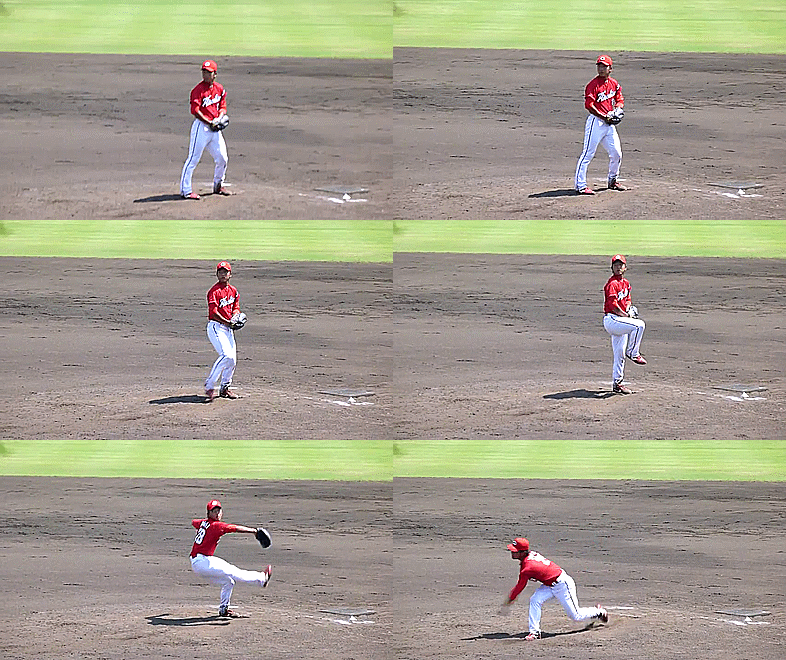
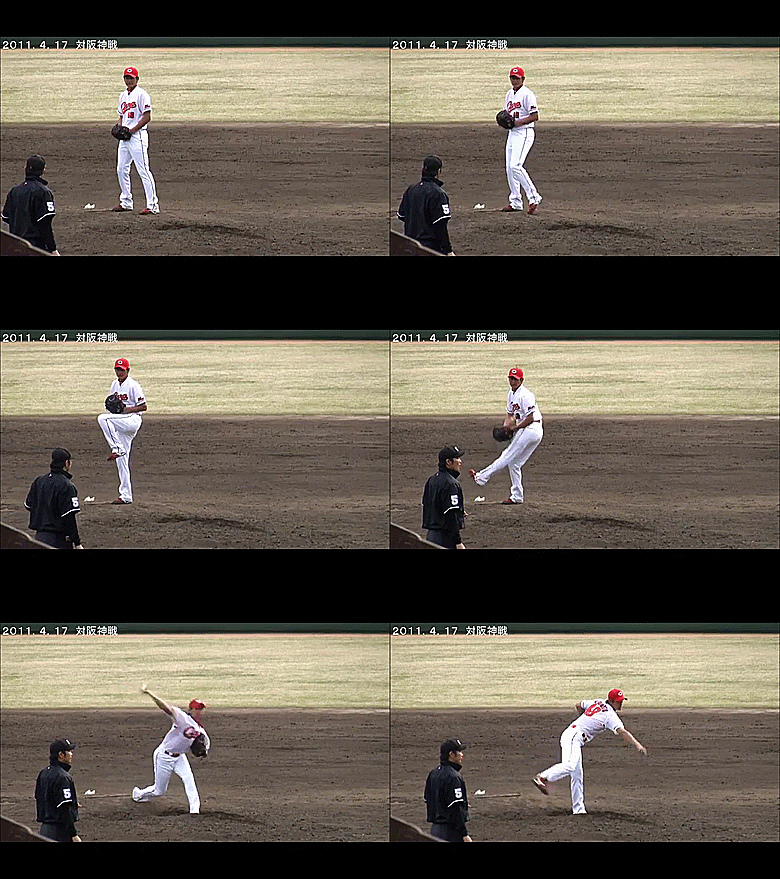
Hiroshima Carp Pitcher Deliveries

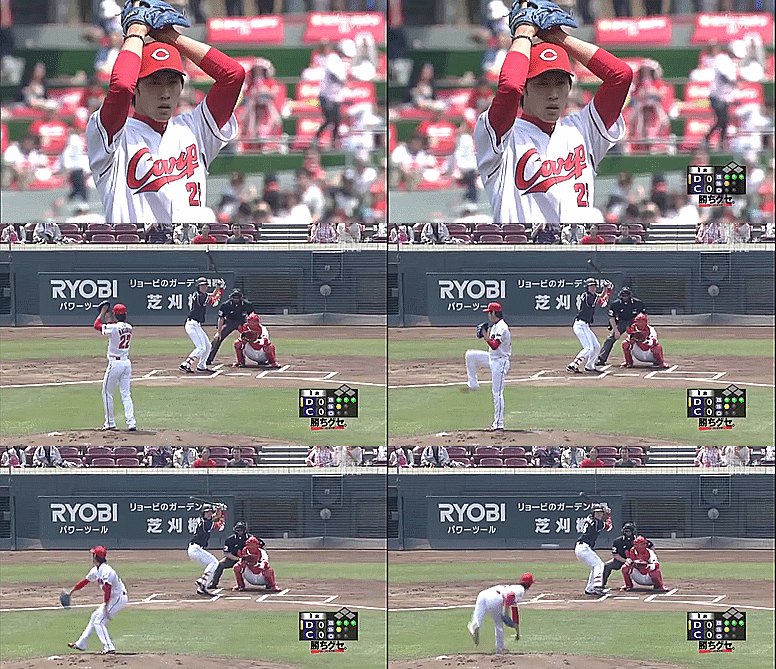
Continuing the look at NPB pitchers and their deliveries, we now start in the Central League. I decided to start with the Hiroshima Carp, mainly because of Kenta Maeda, but also because I had to pick someone. In this post, by each name, I included the pitcher's career NPB kwERAs, just to give readers an idea of how effective they have been in the highest level of Japanese Baseball.

Yuya Fukui: 4.55 kwERA


Hirofumi Ueno: 4.85

Jumpei Shinoda: 4.78

Takeru Imamura: 3.81

Kan Otake: 4.46


Kenta Maeda: 3.63


Yusuke Nomura: 4.34

Katsuhiro Nagakawa: 3.58


Yuki Saito: 4.98


Kyohei Nakamura: 5.78


Ryuji Yokoyama: 3.97


Takaya Kawauchi: 4.36

Yuki Iwami: 5.4


Hirotaka Egusa: 4.09

Masaya Kanemaru: none

Ren Nakata: 4.52
Tsuyoshi Kikuchihara: 4.15

Tomohiro Umetsu: 4.31

Bryan Bullington: 4.02
Takayuki Oshima: 4.69

Jumpei Ono:4.90


Hideki Kishimoto: 4.42


Takaya Toda: 6.52

Hisashi Takeuchi: 6.26

Kam Mickolio: 3.94


Miguel Socolovich: 4.83

Keisuke Imai: 4.43
Yuichi Hisamoto: 4.38


Kota Ito: 5.4


Yuki Tsurumoto: 7.58


Thursday, October 10, 2013

Lamigo Monkey's Pitcher Deliveries

The Lamigo Monkeys had the worst ERA in the CPBL in 2013, so perhaps fittingly, they are the final team in my look at CPBL pitchers.


#72 Mike Loree


50th round pick by the Giants out of Villanova made it to A-ball. After struggling in independent ball in 2010, he was great in 2011, earning four outings with the Pirates AA affiliate. He returned to independent ball in 2012 and didn't have a great year. He threw over 200 innings with the Monkeys, and was effective, with a 3.6 ERA. At 6'6", he gets very good extension, takes advantage of it in a pretty simple delivery without many moving parts.

86-89, gets down to 84, gets on top of ball well, doesn't seem to be a sinker most of the time, but keeps it low.

71-74 down to 69 curve with pretty impressive depth, but the movement is pretty slow, so I wonder if some of that is mitigated.

81-82 down to 79-80 impressive downward tilt, good pitch to lefties.  Seems to be a forkball to me.

79 change, not a lot of movement, not near as good as the forkball.

#73 Rommie Lewis LHP


In the CPBL he pitched 18.1 innings without an earned run, but threw 23.2 innings with the Toronto Blue Jays in his Major League career with an ERA over 7. He really slings the ball back, which gives him pretty good movement glove side with the fastball. The deception and size has to be tough on lefties, not as tough on righties.
89-92 sometimes had command issues arm side.
76-79 left pitch up, not a lot of movement.

#32 Wang Yi LHP

He has a pretty normal delivery, sort of lanky with some arms and legs going forward.
86-89 can get it glove side, would say he has good horizontal movement
78-80 change arm side gets more of a glove side pitch that looks like a slider occasionally at 79-81.


Kuo Wen-Kai RHP

The 25 year old comes with a bit of a high sidearm motion, but really struggled in a short 2013 stint.
84-87
85-86 with 2 seam movement
68-71, down to 66 curve that looks sort of like a knucklecurve
70-74 change? Will throw it with platoon advantage
76-78 slider

Huang Chong-Chen


The 26 year old misses almost no bats, but is a good groundball pitcher.
81-83 up to 85, can sink it
75
78-79 some sort of splitter or slider

Hsieh Chang-Rong


The 26 year old rookie posted just over 40 innings in 50 appearances, and had as many strikeouts as walks.
82-85
77 change
72 slider

Chen Cheng-Da

The submariner has a 71-73 MPH fastball and 67 change

Cheng Cheng-Hao


The 26 year old had a rough season, and like a lot of pitchers on the team, he is more of a groundball pitcher than a strikeout pitcher.

84-87
80-81 glove side
74-76 slider

Treng Chou-Hau

The 32 year old will soon turn 33, and had a nice season, soaking up over 130 innings despite not a lot of strikeouts, relying mainly on grounders.

84-87 can sink it
78-82 split throws to both lefties and righties. High usage
82-83 slider
71-73 curve

#81 Wu Pei-Hui


The 27 year old rookie threw 37 okay innings, with decent strikeout and walk rates.

86-88 down to 84-85
78-82 slider
74-75 change
69-71 curve

Huang Chin-Chih

Pitching in the CPBL since 2003, the 35 year old has never eclipsed 100 innings, but has always been pretty solid. 2013 was no different, with an ERA under 4 despite rarely striking out anyone.

82-86
76-81 some kind of slider
77 some kind of split

Wednesday, October 9, 2013

Tatsuya Sato Scouting Report

Tatsuya Sato is a 27 year old right-handed reliever for the Orix Buffaloes that has emerged as one of the most effective relievers in the NPB despite taking a weird path to the Buffaloes.

The 5-10 169 reliever is definately undersized, and he didn't make his NPB debut until he was 26. After pitching in college, Sato went the industrial league route after some injuries, and wasn't drafted until he was 25 years old.

After a taste of the Ichi-gun in 2012 where he was successful, he has a 3.73 2013 kwERA with a 51 ERA -, third best in the entire Pacific League out of pitchers with at least 45 innings (Masahiro Tanaka and Takahiro Matsunaga). With that kind of effectiveness, he might be closing on many teams, but the Buffaloes already have the very talented Yoshihisa Hirano, so Sato is more of a setup man, with only 8 games finished.

In his delivery, Sato brings his leg up and back towards him. He doesn't actually turn his hip, so he is working against his delivery a bit, which may help explain his walk rate, which is a little high (but forgivable because of the strikeouts). He uses a pretty dramatic pause as well, mustering every bit of deception up he can. He seems to have cleaned up his head movement in his delivery some, which will help mechanically, and his landing and everything looks good. So other than the obvious fact that he has a lot going on in his delivery, enough that it may work against him in the sense of repeating, but obviously works for him in the sense of deception.

As a draft prospect, he got up to 91-94 MPH, but averaged in the 90 MPH range in 2012. It averaged 91.22 MPH in his final outing of the 2013 season (if he doesn't pitch in the two makeup games at the end of the season).

He can get whiffs high in the zone with the pitch, aggressively using it as a strikeout pitch. Flipping through his heatmaps on NPB Tracker from last year, it seems that he was a very high ball pitcher with the fastball. He may be a slight arm side pitcher, but it doesn't seem that there is a big difference between which side of the plate he throws it to.

Occasionally, he will throw a forkball, but the slider is used a lot more (he had cutter and curve according to draft report, but we haven't seen it in the NPB). The pitch will get up to 86-87 MPH, but averages about 81 MPH, so about normal considering his average fastball in 2012.

His platoon splits are a little odd, as he has a better K/BB against lefties, but a better average against and lower home run rate against righties. With his pitch selection (the slider usage especially), we would expect him to be better against righties. In the end, he will probably go wherever his slider takes him. His fastball will definitely work in the NPB, and as long as his slider is effective, he can change any hitter's, regardless of league quality, eye level.

Tuesday, October 8, 2013

Quantifying Yu Darvish's Injury

There are a lot of poorly constructed narratives and talking points when it comes to Yu Darvish, and I have no interest in deconstructing or rebutting any of them. However, from watching nearly every single Darvish start since he came to the United States (mainly because of geography), I found it interesting, though perhaps not surprising, that Darvish was struggling with an injury, in this case, a nerve problem causing him to lose feeling in his leg.

For this post, I wanted to see if there was something in the Pitch F/X data that showed if/how the injury was hampering Darvish, and to look at his season as a whole. I decided, since I am looking at each outing individually, that I would only to look at his 2013 home outings. This way we won't be subject to any biases in Pitch F/X data from park to park (this is especially important when looking at release point and movement data).

Darvish made 19 home starts in 2013, and just to use a random sample size, his last 7 starts had a higher game score on average than his first 7 starts. He also averaged over a strikeout more and about a half a walk less per outing in those last 7 starts. His ERAs and FIPs of those starts were better in the last 7 than the first 7, so it is impossible to make the argument that Darvish faded down the stretch when it comes to effectiveness. However, it does seem that Darvish wasn't able to go as deep into games, as he averaged 2 less batters and 6 less pitches in his last 7 outings. Whether this was quicker hooks, general fatigue, or the nerve issue (or the back or neck issues which bothered him in Japan and off and on in Texas) isn't worth speculating about unless you've stolen Darvish's medical records or given him a physical. So instead, let's look at the data and see if there is any evidence that his injury was affecting how he was pitching.

First let's see where he has located the ball, on average, per start:

You probably wouldn't think it considering that Darvish was a high strikeout, high home run pitcher in 2013, but he is a pretty extreme low ball pitcher. He throws a lot of sliders, so perhaps it isn't too surprising, but he does stay arm side on average (he does change his slider location based on platoon split a little more than average). In September, you will notice that he was throwing the ball lower than he usually does, and two of those starts were more glove side than usual. His April 7th was his most glove side start. August, perhaps his best month (by wOBA against it was), was the month he consistently threw higher. He wasn't as effective in September (May was still probably worse), and it is easy to see the differences between the two months. Here we can see how Darvish's release point changed from start to start at home:

August shows up as the highest release point, something that makes sense with the highest average locations. Higher release points are usually better, and the statistics don't suggest anything different here. Darvish went on the DL for a short time in early July, and we saw that one of his late June starts had an average location stand out for being pretty heavily glove side. That particular start (the 18th) has a pretty normal release point compared to his others, but June 30th stands out for being closer to the center of the rubber, as does an early July start. Late April and early May is when his release point got the furthest from the center of the rubber and the lowest. His September starts don't stand out here, but his August starts do again.

The article linked to above does show that his fastball lost a little velocity at the end of the year. How about fastball movement?

The June 13th start stands out on the graph, but I believe this is due to an error. One of the fastballs had negative vertical movement, which doesn't make a lot of sense (though it was 91.5 MPH so I don't think it was a classification error, just a Pitch F/X error). Other than that, it appears that to be hard to find real trends. In September, he didn't have the lowest vertical movement starts, but he lacked the elite ones he got throughout the season. However, his September 14th start had the 2nd most horizontal movement of the home part of the season. I don't think this is particularly helpful.

It seems that the data doesn't explicitly show an injury late in the season for Darvish, as we don't see in either the release point or location data a clear difference in September from the rest of the months. That doesn't mean that the injury was not there, it just didn't show up in an obvious way in the Pitch F/X data. The biggest difference was actually August, a month where he was dominant. One can easily see the difference between August and September, but August seems to be the outlier, and would be the red flag month if you didn't know that he was struggling to finish games in September.