Saturday, October 19, 2013

KBO Catchers Pop Times

With the Korea Baseball Organization regular season over, I'll soon be releasing the 2013 KBO WAR rankings. This year, I don't believe there will be a real defensive component as there just isn't enough good data. Last year's data was especially unhelpful when it came to catcher defense. There are many facets to catcher defense, such as receiving and game calling, but the simplest facet is measured by a stopwatch, measuring the time it takes for a catcher to catch the ball and throw it to 2nd, a catcher's poptime. In this post I wanted to look at the poptimes of catchers in the KBO, so I looked at the main catcher from each team (and an extra catcher for Doosan), found a video of a throw down of each, and timed it several times. I labelled the results with each catcher's name and made a GIF of them throwing, just for a visual look.


Choi Jae-hoon: 1.91-1.94


Hyun Jae-yoon: 2.00-2.10

Heo Do-Hwan: 1.90-1.95


Lee Hong-gu: 2.00-2.05

Yang Yi-Ji: 1.84-1.85


Kang Min-ho: 1.9-2.00


Jung Beom-mo: 1.97-2.00


Jin Kap-Yong: 2.09

Kim Tae-goon: 2.00

Jung Sang-ho: 2.00


Friday, October 18, 2013

2013 Japanese Minor League Hitting Statistics

In a previous post, I took a look at the Japanese Minor League (Ni-Gun) pitching statistics. In this one, I'll take a look at the hitters in the league.

When looking at Ni-Gun league averages, we remember that 23.3 % of plate appearances turn into a hit, 8.3 % of them turn into a walk (31.6% of them are walks or hits), 15.83 % strikeouts, 11.19 scored a run, and 1.58 % homers. By looking at the hitting statistics (which are provided below), we see that 3.68 % of plate appearances turn into doubles, .55 % of them triples, 1.94 % stolen bases, and 1.04 % of them caught stealings.

So below are all the hitters with plate appearances in the Ni-Gun in 2013, sorted by plate appearances. I changed the data I cared about into percentages, but kept the regular slash lines.

Out of hitters with at least 100 games, Shingo Ishikawa lead in hit percentage, a 20 year old Nippon Ham Fighter infielder. 32 year old Lions 1B/C Tatsuyuki Uemoto lead the league in hit percentage out of hitters with at least 100 plate appearances. Yasushi Iihara, a 30 year old Yakult Swallow infielder, had the highest batting average out of 100 plate appearance players, while former MLBer Vinny Rottino had the best batting average of hitters with at least 200 plate appearances.

24 year old Lions infielder (with no NPB experience) Noamichi Umeda lead the league in doubles (over 200 plate appearances), and Dragons outfielder (23 years old) Shingo Ito lead in triple percentage, with more triples than doubles. 26 year old Wataru Hiyane with the Swallows lead the league (over 100 plate appearances) in stolen base percentage, but also had much more caught stealings by percentage than league average. From best I can see, Softbank Hawks outfielder Shuhei Fukuda had the highest steal percentage with a lower than average caught stealing percentage (he wasn't caught at all in 9 steal attempts).

33 year old Naotaka Takehara Buffaloes outfielder lead the league in walks with at least 100 plate appearances, but Lions Daichi Mizuguchi seems to be the leader in walks out of guys with no Ichi-gun plate appearances with a young age (24 years old). 33 year old Swallows outfielder Yuichi Matsumoto had the lowest strikeout rate out of hitters with at least 100 plate appearances. Yasushi Lihara had the best OBP in the Ni-Gun, while Fukuda was 2nd best out of 100 plate appearances.

Kenichi Marumo of the Yomiuri Giants, 25 year old outfielder with no Ichi-Gun experience, lead the league in home run percentage. 24 year old infielder Issei Morita lead the league in total homers. 33 year old Baystars infielder Taketoshi Goto had the highest slugging percentage out of players with at least 100 plate appearances, while Shoitsu Omatsu, 31 year old Marines infielder, had the best slugging percentage out of hitters with at least 200 plate appearances.

Thursday, October 17, 2013

Yoo Hee-kwan Scouting Report

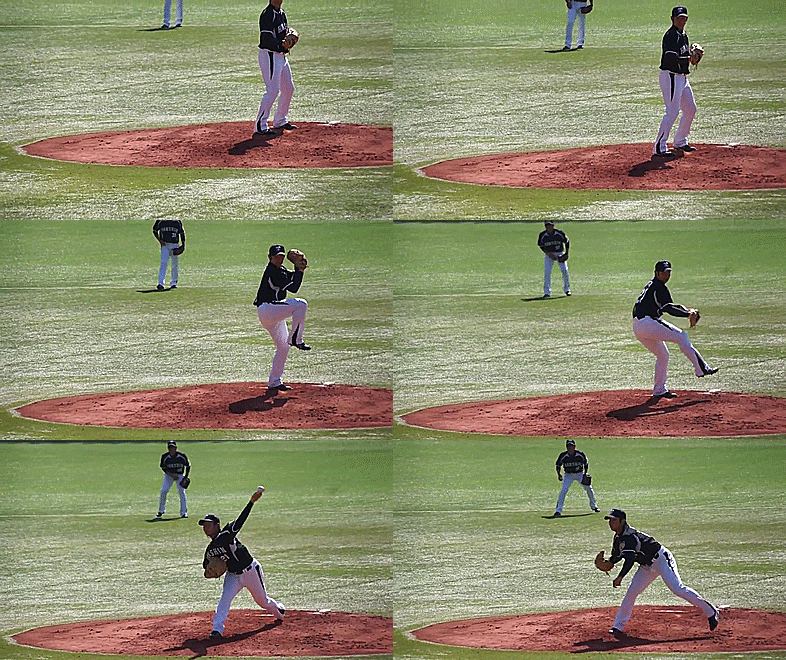
Yoo Hee-kwan (or Yu Heui-Kwan) was one of the KBO pitchers that statistically rated out as a possible MLB prospect, at least going by 2013's statistics. Yoo threw 145.1 innings in 2013, posting a 3.53 ERA and 3.58 FIP. This had to be one of the biggest surprises of the Korea Baseball Organization season, as he had just 16 innings under his belt in the KBO before the year started, and hadn't pitched with Doosan since 2010. Yoo also made two starts in the first round of the playoffs against the Nexen Heroes, striking out nearly a guy an inning, and giving up just 1 run. The 27 year old left-hander burst on to the scene rather suddenly, so he doesn't have a Naver scouting report. Standing under 6 feet, Yoo isn't the prototypical starting pitcher, which may be one of the reasons he was a late bloomer. As we will see below, he also isn't a traditional power pitcher.

First, however, let's take a look at his mechanics, starting with a side view

He brings a high leg kick, with a slight hip turn before coming forward, keeping his hands high. It doesn't appear to be what you would consider an extremely deceptive delivery, but it is clearly one that works for him. He threw low with great frequency, so it seems that he gets on top of the ball very well despite the size.

The following GIF is Yoo throwing a fastball by the best hitter in the KBO, Park Byung-ho

The first thing you notice is the velocity. The pitch is only about 82.46 MPH. In his two playoff starts, Yoo maxed out at just short of 84 MPH and averaged about 81.5 MPH.

He would pitch inside to right-handers at times despite the velocity, and as you can see above, was effective at doing so. Many times to left-handers he was trying to get the fastball outside and would basically fall off the mound, overcompensating to get the ball glove side.

Slider:

According to the way I classified his pitches, the slider averaged just above 74 MPH. It is pretty sweepy when it is going well, getting to the opposite side of the plate rather consistently. However, sometimes he would throw something gloveside that wasn't as sweepy, slowing it down to 71 MPH at times. Many times these pitches hung towards the middle of the plate, so there is a chance they were just badly thrown sliders. He did throw it to righties very rarely, going low and in, and mostly doing so effectively.

Change:

Averaging about 75 MPH, the pitch was extremely arm side heavy and his best and most frequent secondary pitch. It occasionally had good downward movement. While he almost always did a good job of keeping it low, there did appear to be two different movements on the change, as he would bury it sometimes, and other times he kept it up for a strike. Both of these looked to be by design. When he wasn't getting whiffs with the change, he was still getting grounders. It seemed to be most effective when he would throw fastballs low and away, and then follow with the change in a similar spot, causing major problems in the hitter's timing.

The change and the slider sometimes tended to blend, at about 74-75 MPH it would go inside and low to right-handed batters, sometimes looking like a weird 2-seamer.

Curve:

This was the least frequent out of his four main pitches (assuming the variations aren't different pitches), and of course the slowest, averaging about 66 MPH. It didn't always have great depth consistently and he had a tendency to hang it, but he could fool a left-handed batter with it every once in a while.

Obviously the fastball velocity alone limits him from being a MLB prospect, and it helps explain why it took this long for him to get his first chance in the KBO, but with that said, there is a good mix of pitches and deception here, enough that he should be effective in the KBO in coming years. Yoo probably won't continue to pitch at the same level as he did in 2013 as hitters begin to have more opportunities to adjust to him, but he should still be an above average starter in the league just because of his pitchability. 

Wednesday, October 16, 2013

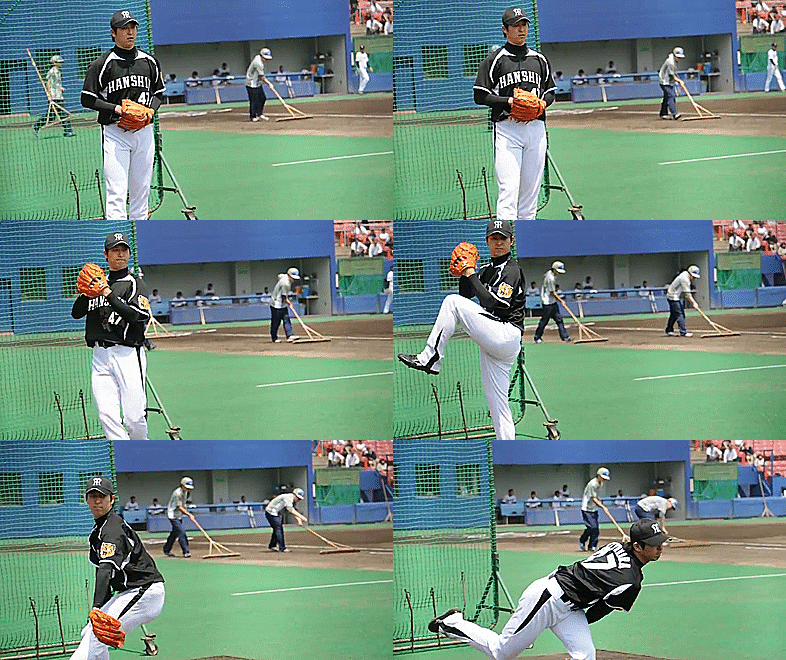
Hanshin Tigers Pitcher Deliveries

Continuing our look at the deliveries of NPB pitchers, the following are the deliveries of the Hanshin Tigers. Along with the names, I posted their fastball
velocities from 2012 or the most recent year NPB Tracker has data for them, plus the 1.5 MPH addition because of the evidence that velocity readings in the NPB are low for those that have it (several of them do not).

Ryo Watanabe: 88.74

Daiki Enokida: 87.51

Atsushi Nomi: 88.04

Masanori Fujihara: 88.52

Yuya Ando: 87.61

Kazuo Ito

Kazuhito Futagami: 86.18

 Shintaro Fujinami


 Kazuya Tsutsui: 88.63

Minoru Iwata: 87.95

Hiroaki Saiuchi

Takumi Akiyama: 87.36

Shinobu Fukuhara: 91.3

 Tatsuya Kojima: 89.15

Tomoyuki Kubota: 89.16


 Yasutomo Kubo: 88.65

 Kazuya Takamiya: 90.05

 Ken Nishimura: 88.09
 Blaine Boyer
 Naoto Tsuru: 86.95

Daiki Kiyohara: 86.08


Kazuyuki Kaneda


 Randy Messenger: 91.85

Jason Standridge: 90.71

Ryoma Matsuda


Akira Iwamoto

 Kosuke Kato: 88.81
Hirokazu Shiranita: 88.33

Robert Zarate


Yutaka Tamaki


Keisuke Hayashi


Tuesday, October 15, 2013

2013 Japanese Minor League Pitching Statistics

With the Japanese Minor League (the Ni-Gun or 2-Gun of the NPB) season over,, I wanted to look at the statistical leaders of the league through some relatively simple metrics. In this post, I'll take a look at the pitchers (soon I'll take a look at the hitters). I won't use minimum age or inning requirements, posting all of the numbers below, but afterwards I will have some notes on young pitchers that might be worth watching.

First, we need to look at the league averages of the numbers we are looking at, all pretty simple percentages. While I won't calculate kwERA for all the pitchers, Ni-Gun league average in 2013 (I didn't separate Western or Eastern League) was 4.48. Instead of using RA9 or ERA (though I kept the ERAs of each pitcher in the spreadsheet) I based everything off of percentages from batters faced. For instance, 11.19 % of batters scored a run, while 9.4 % of batters scored an earned run in the Ni-Gun in 2013. 23.3 % of PAs ended in a hit (instead of using traditional batting average I used hit percentage of plate appearances), while 8.3 % ended in a walk, 15.83 % strikeout, and 1.58 % homers.

It might be helpful to compare the Ni-Gun run environment to the environment of Major League Baseball (in 2013). There are slightly more runs scored in the MLB (11.96 % of plate appearances), with more of them being earned (11.13%). There is a considerable higher amount of homers (2.75 %) and strikeouts (18.13 %), but less walks (7.35 %). There are also more hits allowed in the Majors as well (24.15%).

So here are all the numbers of all pitchers who who threw in the 2013 Ni-Gun season. The raw numbers are taken from NPB's official English site, with my percentages added to them. It is sorted by runs scored percentage.

Out of pitchers with at least 200 batters faced, Marines veteran and playoff starter (though 2013 turned out to be a real breakout year for him) Takuya Furuya had the best run percentage. Baystars' lefty Kenji Tsuchiya probably qualifies as the best run percentage by a prospect. He has pitched an insignificant amount of Ichi-Gun innings, but as you would expect, he was better than average across the board in every category in the Ni-Gun this year. He throws a change and a slider, both under 80 MPH, with his mid to high 80 MPH fastball.

The leader in strikeout percentage with at least 100 batters faced was Ryuji Ichioka, a 22 year old right-hander for the Yomiuri Giants. He has thrown a handful of innings for the Ichi-gun team for the past two years, enough that we know (via NPB Tracker data), that he has a fastball just short of 90 MPH, with a slow curve, a mid-70s slider, and a low 80s forkball. His walk and home run rates were below Ni-Gun averages as well. Just below him, with more batters faced, and a lower hit percentage (though higher walk and home run rates), is Mizuki Tsuchida, a 23 year old with the Giants who hasn't pitched in the Ichi-Gun. Tsuchida is a former Island League (independent ball) pitcher who can get up to 92 MPH with a slider as the main secondary weapon.

The best pitcher (100 PAs minimum) at limiting hits in the Ni-Gun was Mu-Young Kim, a 27 year old with the Softbank Hawks. He has gotten 31 innings with the Ichi-Gun team over the last two years, and has been effective, with a 3.93 kwERA. His fastball has averaged about 88 MPH in the NPB. The Fighters rookie Hidekazu Kawano was one of the most effective at limiting hits as well, with a high K rate but high walk rate in the Ni-Gun before being effective in the Ichi-Gun.

The best guy at avoiding walks was Hirofumi Yamanaka, a 28 year old Hawks pitcher that made his Ni-Gun debut in 2013 (unsuccessfully). In the Ni-Gun, he had an above average strikeout and run rates, and gave up as many homers as he walked batters. As you might expect, most of the low walk pitchers are older pitchers, not really prospects. The lowest walk rate out of pitchers 24 or younger was the Giants' Ryosuke Miyaguni, a 21 year old right-hander with over 180 innings of Ichi-Gun experience. There his walk rate hasn't translated, almost doubling to 8 %, though he has decent numbers in the NPB. He throws only about 87 MPH with a lot of sliders.

Friday, October 11, 2013

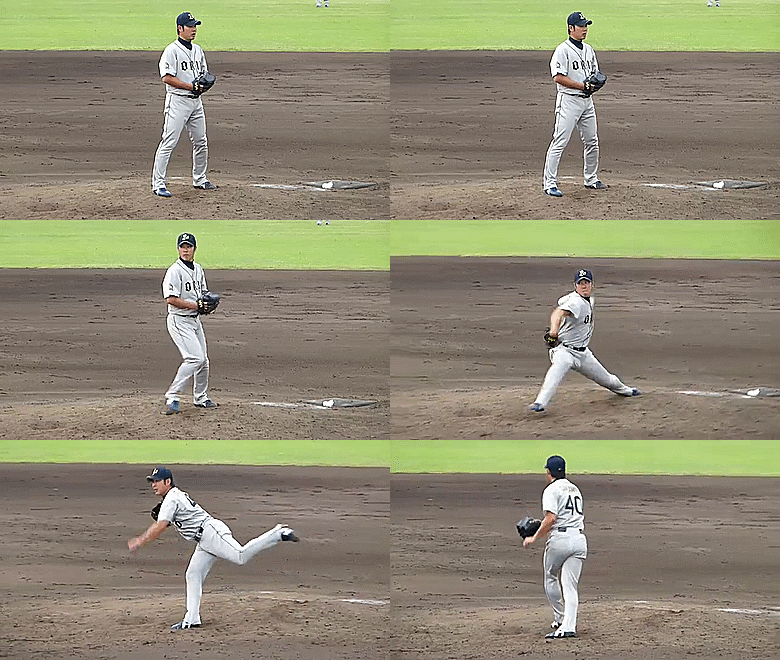
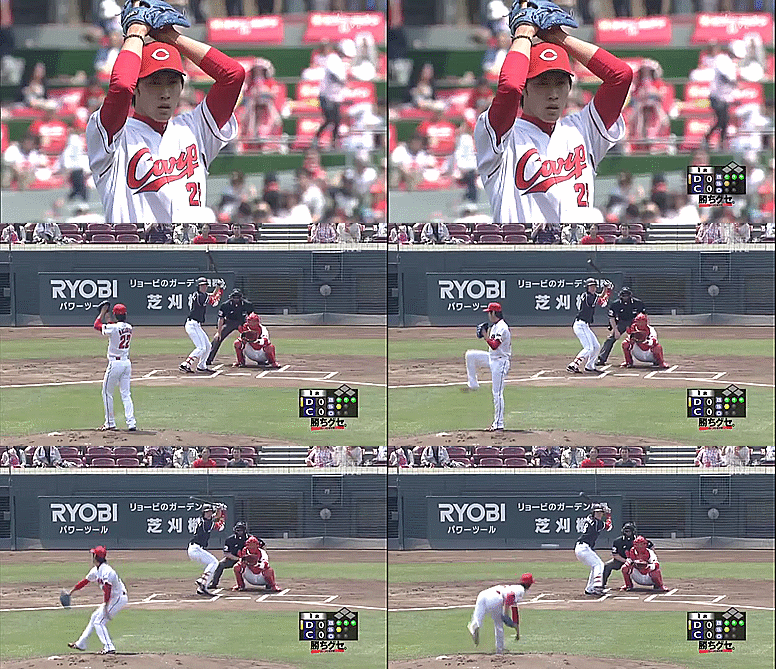
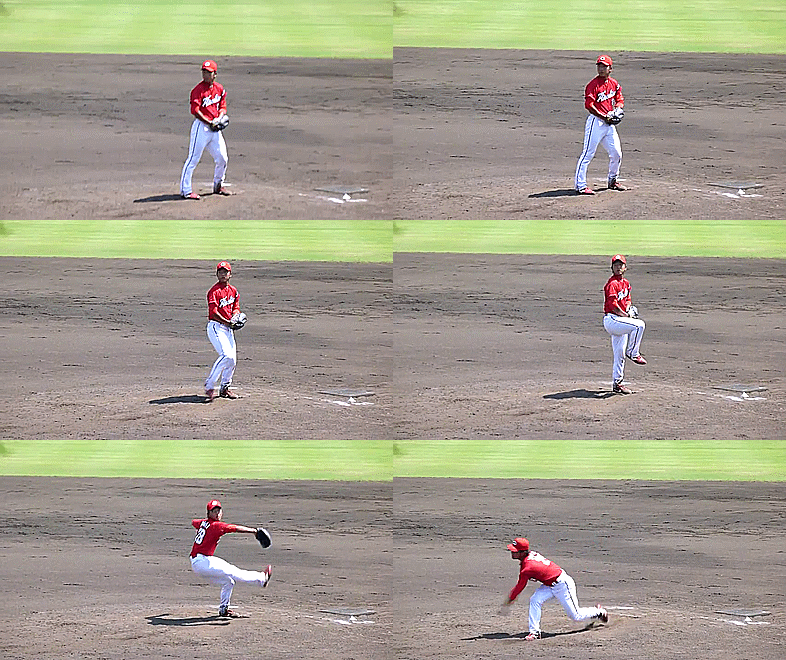
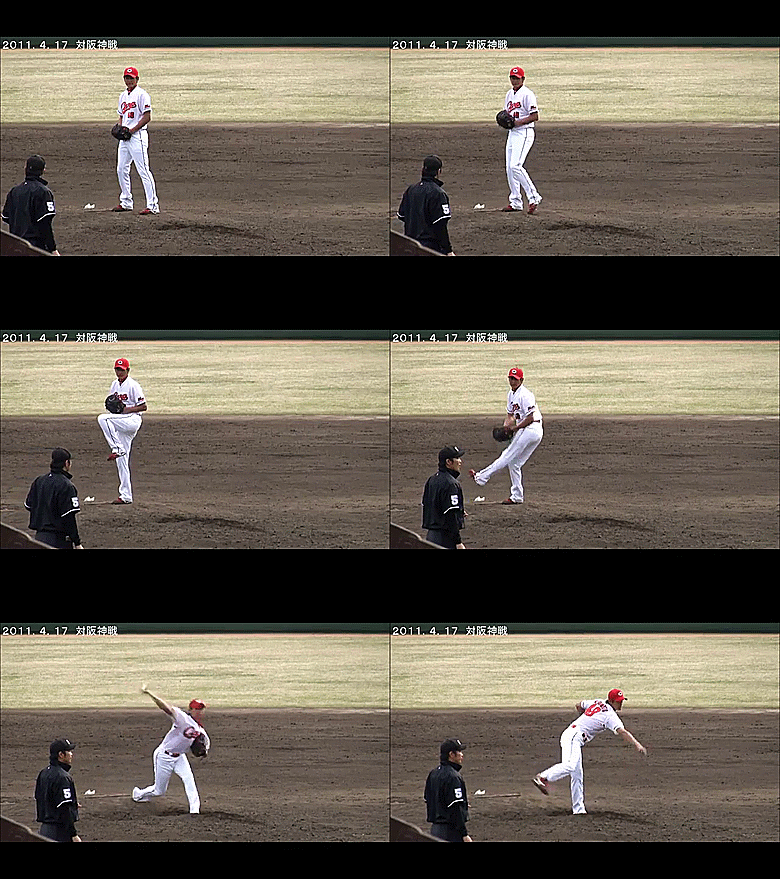
Hiroshima Carp Pitcher Deliveries

Continuing the look at NPB pitchers and their deliveries, we now start in the Central League. I decided to start with the Hiroshima Carp, mainly because of Kenta Maeda, but also because I had to pick someone. In this post, by each name, I included the pitcher's career NPB kwERAs, just to give readers an idea of how effective they have been in the highest level of Japanese Baseball.

Yuya Fukui: 4.55 kwERA


Hirofumi Ueno: 4.85

Jumpei Shinoda: 4.78

Takeru Imamura: 3.81

Kan Otake: 4.46


Kenta Maeda: 3.63


Yusuke Nomura: 4.34

Katsuhiro Nagakawa: 3.58


Yuki Saito: 4.98


Kyohei Nakamura: 5.78


Ryuji Yokoyama: 3.97


Takaya Kawauchi: 4.36

Yuki Iwami: 5.4


Hirotaka Egusa: 4.09

Masaya Kanemaru: none

Ren Nakata: 4.52
Tsuyoshi Kikuchihara: 4.15

Tomohiro Umetsu: 4.31

Bryan Bullington: 4.02
Takayuki Oshima: 4.69

Jumpei Ono:4.90


Hideki Kishimoto: 4.42


Takaya Toda: 6.52

Hisashi Takeuchi: 6.26

Kam Mickolio: 3.94


Miguel Socolovich: 4.83

Keisuke Imai: 4.43
Yuichi Hisamoto: 4.38


Kota Ito: 5.4


Yuki Tsurumoto: 7.58